index●comunicación
Revista científica de comunicación aplicada
nº 15(2) 2025 | Pages 275-298
e-ISSN: 2174-1859 | ISSN: 2444-3239
Petitions to the Senate: A Participatory Tool to Address Social Concerns?
Peticiones al Senado: ¿una herramienta de participación ante las preocupaciones sociales?
Received on 18/06/2024 | Accepted on 21/02/2025 | Published on 15/07/2025
https://doi.org/10.62008/ixc/15/02Petici
Iris Simón-Astudillo | Universidad de Valladolid
iris.simon@uva.es | https://orcid.org/0000-0003-3114-8414
Irene López-Alonso | Universidad Complutense de Madrid
ireneloalo@gmail.com | https://orcid.org/0009-0005-6130-5267
Abstract: For decades, political disaffection has been a common feature of society since citizens do not feel represented by those who govern them, which can lead to them abstaining from participating in political life. To address this issue, we decided to examine whether the problems identified by the Spanish population in the barometers of the Centro de Investigaciones Sociológicas (CIS) are related to the petitions registered in the Senate. To this end, sixty surveys and all the initiatives sent to the Upper House over the course of seven full legislatures (2004-2023) were collected and analyzed. No correlation was found between the population's concerns and the petitions submitted to the Senate, which leads us to conclude that citizens do not possess sufficient knowledge to use this channel of participation in an adequate manner, besides the institutions' failure to promote it.
Keywords: Petition; Public opinion; Senate; Participation; Disaffection; Spain.
Resumen: La desafección política lleva décadas instaurada en la sociedad debido a que la ciudadanía no se siente representada por sus gobernantes, lo que puede desembocar en que se abstenga de participar en la vida política. Para abordar esta cuestión, se ha decidido examinar si los problemas que identifica la población española en los barómetros del Centro de Investigaciones Sociológicas (CIS) tienen relación con las peticiones que se registran en el Senado. Para ello, se recogieron y analizaron sesenta encuestas y todas las iniciativas enviadas a la Cámara Alta a lo largo de siete legislaturas completas (2004-2023). Así, se ha podido comprobar que no hay correlación entre las preocupaciones de la población y las peticiones al Senado, lo que nos lleva a pensar que la ciudadanía no dispone de los conocimientos suficientes para utilizar este canal de participación de manera adecuada, además de que las instituciones no promocionan dicha vía.
Palabras clave: petición; opinión pública; Senado; participación; desafección; España.
To quote
this work: Simón-Astudillo, I. & López-Alonso,
I. (2025). Petitions to the Senate: A Participatory Tool to Address
Social Concerns? index.comunicación, 15(2), 275-298. https://doi.org/10.62008/ixc/15/02Petici
1. Introduction
Citizen participation is a fundamental element in the development and consolidation of democracies. Otherwise, decisions would be taken by an elite isolated from the concerns of citizens, which would not represent their interests. In this sense, citizen participation becomes an essential mechanism for the legitimacy of a democracy (Verba et al., 1995; Weiss, 2023), as it allows citizens to express their preferences, influence decision-making, and demand transparency and accountability from their representatives.
The Spanish case is distinguished by a notable tradition of citizen protests with rates reaching 17.2%, which positions Spain as the most mobilized country in Europe (Azedi, 2022). Although non-institutional participation remains a minority phenomenon on the continent, in Spain the percentages of people who have demonstrated in the last year exceed 10% (Borbáth, 2023). This may be because, unlike in other countries, there was no historical time for social movements to claim their own political space. In the post-Franco transition, parties, trade unions and social movements formed a single counter-institutional block, which prevented the development of differentiated political action (Alonso et al., 2015).
In contrast, Spain is in the European average when it comes to the most widespread form of institutional participation: voting. According to The International Institute for Democracy and Electoral Assistance (n.d.), the country obtained a 66.59% voter turnout in the last elections, while the average for the continent was 63.87%. In this context, another formal means of participation in Spain is the right to petition, channeled through both the Senado and the Congreso de los Diputados [the Senate and the Congress of Deputies]. Petitions reach the Petitions Committee of each Chamber, a permanent non-legislative body composed of representatives of the parties elected in the elections.
Petitions in Spain have not been studied in depth due to the difficulty of accessing the reports, so we decided to analyze this participation tool in order to find out how it works and how useful it is. In this case, the aim is to identify whether the themes of the petitions coincide with the problems that citizens identify Spain as having in the barometers of the Centro de Investigaciones Sociológicas (CIS) [Sociological Research Center]. These concerns of the population have been studied in previous research (e.g. Gil-Torres, 2018), but not in relation to this institutional tool. Similarly, it has already been established that politicians generally do not respond to the concerns of the population on their Twitter accounts (Pérez-Curiel and García-Gordillo, 2020), nor has it been verified whether these are translated into requests to state bodies.
The aim of this article is to analyze the relationship between the petitions processed by the Senate and the national problems identified by the Spanish population. In this way, the aim is to examine whether citizens' problems are translated into specific petitions to check whether this tool is used as a repertoire of action to influence public policy.
2. Theoretical Framework
2.1. Political Participation and the Right to Petition
According to Verba et al. (1995), political participation is defined as the intention or effect of influencing local, national or international government, either by influencing how public policies are implemented directly or by participating in how political representatives are elected. Moreover, it is not an individual action, but a social act that involves interaction between diverse actors. In this sense, citizen participation is a two-way process, where citizens not only exercise their political rights, but also demand answers and accountability from their representatives (Merino, 1997).
For decades now, citizens in Western democracies can be seen as collaborating with political representatives rather than straightforwardly opposing them (Meyer and Tarrow 1998; McAdam et al. 2001). Nevertheless, collective action continues to entail various costs for those who participate (Gause, 2022), and this involvement highlights to policymakers that the issue being protested is sufficiently important to incur these costs (Barrie et al., 2023).
It cannot be ignored either that participation nowadays is complex because, above all, we delegate the power of decision to our representatives. Citizens cannot be aware of all the political issues that are decided on a day-to-day basis because the world would come to a standstill, so elites are elected to make these decisions based on a program, although in recent years campaigns such as 'Vote, please' have been promoted, focusing on the individual responsibility of voting (Simancas et al., 2023).
But citizen participation is not limited to voting in elections. There are various ways to get involved in the political process, such as attending demonstrations, contacting political representatives, signing petitions or boycotting (Van Deth, 2014). It is the responsibility of governments to create an enabling framework for citizen engagement, to remove barriers to participation for certain groups, and to promote a culture of inclusive and democratic participation. Indeed, despite a climate of political disaffection (Cazorla-Martín et al., 2023) in recent years, the population is not ceasing to get involved. Moreover, this distrust of institutions can motivate different forms of protest, including signing petitions (Schoene, 2019). Dissatisfaction with public policies can drive citizens to stay engaged.
However, it should be borne in mind that citizens are not a homogeneous mass about whose behavior one can generalize (Alaminos-Fernández et al., 2024). There are studies that indicate how a person's biography influences the way they mobilize. Azedi (2022) showed that people with a higher level of education, without a partner, with a lower religious sentiment, who were an ethnic minority, public sector workers, trade union members and those with little trust in government were much more likely to protest. Being male and young were also factors (Borbáth and Gessler, 2020; for a review, Quaranta et al., 2021).
Furthermore, if the statistics are segregated by gender, women tend to prefer less institutionalized forms of protest in favor of more spontaneous and lifestyle-related ones, such as signing petitions (Pfanzelt and Spies, 2019; Coffé and Bolzendahl, 2021). There is also a difference among women, with married, divorced and dependent women being less likely to be politically active (Coffé and Bolzendahl, 2010). Likewise, younger women tend to engage in non-institutional repertoires of action to a greater extent than older women (Gerber et al, 2019; Burciu and Hutter, 2022).
It is also noteworthy that there are more protests in southern Europe and under conservative governments because left-wing citizens are more prone to non-institutional participation and oppose the government much more regularly (Borbáth and Gessler, 2020). This is also due to people on the right prioritizing the electoral channel (Hutter and Kriesi, 2013), a form of institutional participation, which leads to a predominance of left-wing protest.
As noted, there are two ways of participating in democracy: institutional and non-institutional, although they can often be combined (Jeroense and Spierings, 2023). Like Borbáth (2023), we follow Hooghe and Marien's (2013: 139) definition of institutional participation as «defined and organized by members of the political elite». In contrast, non-institutional participation is defined as «used predominantly by nonelite actors, in order to challenge the political elite or to gain access to the political agenda».
In Spain, Álvarez and Arceo (2023: 522) stress that «the Cortes and the different autonomous parliaments have established new participation mechanisms: from rules for presenting legislative initiatives to, in some autonomous regions, the opportunity to pro-pose amendments to certain bills»[1]. Several authors have studied this channel from both a legal and a communicative approach (Bocking-Welch et al., 2022; Campos-Domínguez, 2009; Leston-Bandeira, 2019) and have concluded that the right to petition is a mechanism for institutional citizen participation.
However, petitions, understood as a social demand, have also evolved outside these formal channels. This tool, which manifests itself both offline and online, can be translated into groups that collect signatures or private companies that use their platform to channel citizens' claims. These alternative channels are produced by the filters of the formal petition mechanisms themselves, in which a significant number of demands are rejected. In the case of Change.org, the corporation understands that the quality of the petitions is related to the number of people who adhere to them, so they do not carry out a prior screening (Calvo, 2016). However, on numerous occasions, a large number of signatures do not achieve the users' objective (Morales-Medina and Cabezas-Clavijo, 2024).
Consequently, these differences between formal and informal petitions can alienate the population from their representatives as they feel that these institutions are increasingly distant from their daily problems. Although the right to petition has been present in some parliaments for centuries, often even as the only mode of institutional participation available to the population (Leston-Bandeira and Siefken, 2023), formal petitions have yet to prove effective in representing public unease.
In this way, we must assess whether petitions could be a formal mechanism for collecting citizens' demands or they are an unknown and distant instrument for citizens.
2.2. Disengagement and Disaffection with Politics
The distance between politics and the real problems of citizens means that institutions are increasingly distant from their citizens, which has resulted in a political disaffection that has been channeled for more than two decades in different movements such as Occupy Wall Street, 15M, the yellow waistcoats and the so-called tides (Megías and Moreno, 2024). This disaffection is part of the evaluation of the political system as ineffective (Cazorla-Martín et al., 2023), which may be related to the loss of trust in institutions, the lack of citizen interest in politics and the unwillingness to participate in it (Martin and Van Deth, 2007).
Previous studies agree that the crisis of legitimacy being experienced at the global level hinders the credibility of institutions and even of the citizens themselves who are interested in participating. There has been a rupture between representatives and the represented (Schoene, 2019; Caffarena, 2020; Castellanos, 2020; Castells, 2020; Megías and Moreno, 2024). In this sense, some authors argue that policies ignore the material issues closest to the citizenry —jobs, unemployment, housing— in order to focus on immaterial issues that the represented may not consider among their priorities because their material issues have not been resolved (Schoene, 2019).
In this way, this distancing from the system leads citizens to question its functioning and legitimacy as they perceive that they have ceded their sovereign power to institutions and people who are distant from their realities and incapable of providing solutions to the problems they have to live with (Castells, 2020). As Held et al. (2001) point out, this alienation could manifest as a lack of interest in politics because they feel that politics does not directly affect their lives and they feel powerless to influence its course. Citizens perceive the political opportunity structure as closed (Toubøl, 2019).
Both Castellanos (2020) and Castells (2020) situate the economic crisis of 2008 as a turning point in the crisis of legitimacy and the rise of disaffection with the political class. Representatives did not establish an adequate communication flow with their constituents, nor did they involve them in the decisions that were taken, but they did have to face the harsh consequences. This crisis showed how distant the rulers were from the governed, since the latter did not see their concerns and needs reflected in the decision-making process to tackle this critical moment. Thus, as Castellanos (2020) points out, a feeling of powerlessness towards institutions and a lack of credibility in political decision-making processes began to emerge, leading to a gradual loss of confidence in democratic institutions.
All the above leads us to question whether the population uses institutional participation channels such as the right to petition to raise their demands and make their claims known to the representatives. In a context in which other means of participation such as social networks seem more active and influential in the political agenda (Barberá et al., 2019), we wonder whether the petitions to the Senate match the problems that citizens are concerned about in order to find out whether they consider formal channels for participation. In doing so, we seek to analyze whether this instrument fulfils its function of giving voice to citizens' needs.
3. Methodology
To carry out this study, we propose a quantitative research methodology that combines the collection and analysis of the content of the petitions to the Senate with the examination of the question «What do you consider to be the main problem currently existing in Spain?» from the barometers of the Centro de Investigaciones Sociológicas (CIS). The years from 2004 to 2023 are taken as the period of analysis, as this allows us to consider seven complete legislatures and two decades of longitudinal study.
3.1. Objectives
The following objectives are set out:
01: To compare the concerns of Spanish citizens with the subject matter of the petitions sent to the Senate.
02: To determine whether the political ideology of citizens influences their identification of Spain's main problems.
03: Identify whether the number of petitions registered in the Senate varies according to the political party of the House.
To achieve these aims, a series of research questions are formulated to help answer them:
Q1: What are the main problems in Spain that citizens identify?
Q2: What are the themes of the petitions that the population sends to the Senate?
Q3: Is there a correlation between concerns and petitions to the Upper House?
Q4: What impact does the political ideology of citizens have on the perception of the main problems in Spain?
Q5: Does the political persuasion of the majority represented in the Senate have an impact on the petitions that are registered?
3.2. Choice of Sample
The petitions sent to the Senate from 2004 to 2023 have been selected, divided according to the seven legislatures. Subsequently, the data was extracted from the reports produced by the Upper House, which can be found on its website[2]. These petitions have been categorized by subject according to the institution to which they should be referred: Administration, Agriculture and Livestock, Royal House, Professional Associations, Trade, Constitution, Consumer Affairs, Post Office, Corruption, Culture, Equality, Defense, Sports, Social Rights, Disability, Economy, Education, Electoral, Retirement, Justice, Environment, Historical Memory, Mobility, Citizen Participation, Political Parties, Heritage, Pensions, Poverty, Presidency, Budgets, Religion, RTVE (National TV) and Health.
About the CIS data, three barometers per year since January 2004 were analyzed in order to obtain a sample as representative as possible for each period. Thus, a total of sixty barometers were used, from which the top three problems identified by citizens in Spain were extracted.
3.3. Methods
The study was carried out using a quantitative method of data extraction whereby the variables were analyzed by means of an analysis sheet. The sheet corresponding to the petitions includes legislature, year, subject matter and predominant political sign of the Chamber. This type of content analysis technique using pre-established variables has already been used in other political communication studies, such as Rubio et al. (2021) or Serra-Silva (2022).
Regarding the CIS data, these have been extracted from its barometers since 2004 in the question referring to Spain's main problems, and therefore include: month and year of the barometer, legislature, the three main problems and the scale of ideological self-placement (measured from 1 to 10, with 1 being extreme left and 10 extreme right). The Centro de Investigaciones Sociológicas has been consulted for years as a database for comparative research with barometers by works such as Bouza (2011), Magallón-Rosa (2021), and Rodríguez-Díaz and McCombs (2023).
4. Results
After the extraction, analysis and correlation of the data, the following results have been obtained, which are presented in response to the research questions posed.
4.1. Citizens' Problems do not Translate into Institutional Demands
It can be affirmed that there is no correlation between the main problems identified by Spanish citizens and the petitions sent to the Senate. Since the population gives importance to economic issues and the petitions focus on issues related to the courts and the administration in general. Interestingly, of the social issues categorized in the petitions ('Pensions', 'Health' and 'Education'), only the latter was mentioned collaterally in CIS concerns. After a year and a half in which the coronavirus is cited as a problem in Spain (from May 2020 to January 2022), Health is mentioned in June 2022 with 20.9% of the population concerned about the issue.
One fact that may help to understand this result is that, if we analyze the entities that sent petitions to the Upper House, more than 80% are registered by a person. Only 5.7% are associations; 4.2%, an institution; and 0.3%, a trade union, to name but a few examples. This may suggest that citizens use petitions as a tool for personal interest and not to seek major legislative change.
This hypothesis is reinforced if we look at the data on 'Equality' or related to women. With less than fifty petitions on this subject, it is possible to review and verify that most of them refer to complaints about the family meeting point, protection and care for a minor child victim of gender violence, guardianship and custody of the offspring of the person sending the petition, guardianship of an allegedly abused niece or the investigation of a case of gender violence. All of these are individual cases that do not address a common problem.
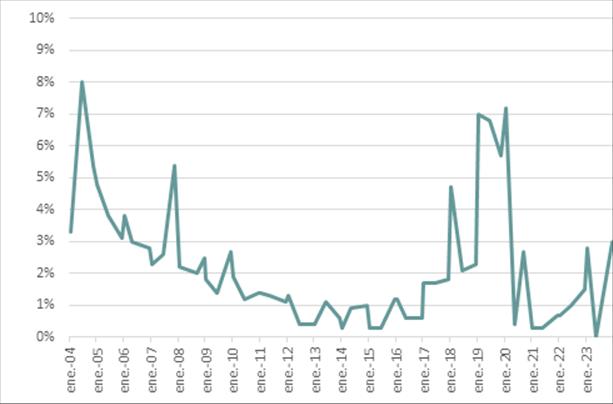
As for the CIS data on violence against women, which is how this concern is referred to, petitions amount to over 3% between January 2004 and April 2006, June 2007, January 2018, and between January 2019 and January 2020. As can be seen in Figure 1, the two highest peaks are June 2004 with 8% and January 2020 with 7.2%. Possible explanations for these two peaks may be, in the first case, that it was the month in which the draft of the subsequent Organic Law on Comprehensive Protection Measures against Gender Violence was passed, so the population was exposed to the issue; and, in the second case, that since 2018 there were years of massive feminist protests that drew the attention of the general population.
Figure 1. Violence against women as a concern
Source: CIS data elaborated by the authors.
This example shows that, although the same theme appears in both the petitions and the concerns expressed in the CIS, they are not necessarily related to time or content.
4.2. The Economy Worries the Population, 'Justice' Tops the List of Demands
The main concerns identified by citizens since 2004 are remarkably constant. These are: unemployment, terrorism and/or ETA, citizen insecurity, housing, immigration, economic problems, the political class and/or political parties, corruption and fraud, the coronavirus, healthcare, and political problems in general. All these categories have appeared in at least one barometer as one of the three main problems in Spain detected by citizens. It is remarkable that there are only eleven concerns in twenty years of study and, as can be seen, most of them have to do with economic and political issues. However, eco-nomic issues are practically absent from the petitions to the Senate, with the highest percentage being concentrated in the most recent survey. The highest percentages are concentrated in eight categories: Justice (32.48%), Domestic Affairs (5.96%), Defense (5.86%), Administration (5.51%), Foreign Affairs (5.31%), Pensions (4.46%), Health (4.46%) and Education (3.86%). As can be seen, these are issues closely related to the State and its functioning rather than matters that directly affect citizens' daily lives, as the last three might be.
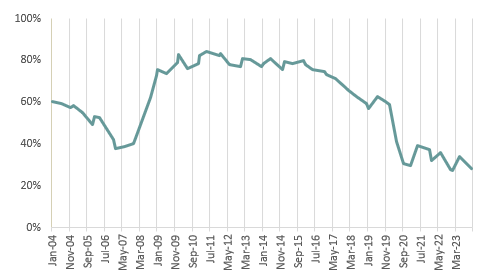
The only concern that appears in all barometers is unemployment, irrespective of the position held, so it is the only one that has real continuity. As can be seen in Figure 2, the percentage of this problem rises during the years of the Great Recession, which is to be expected because part of the population lost its job or was afraid of losing it. In contrast, very few job-related petitions found in the Senate, only 1% (20 petitions). Along the same lines, the second most frequently mentioned concern, although not in all surveys, is economic problems (70% of barometers), followed by corruption and fraud (31.67%), as well as the choice of the political class and political parties (also 31.67%).
Figure 2. The evolution of unemployment as a problem in Spain
Source: CIS data elaborated by the authors.
There are other problems that are very localized in time and clearly respond to the situation in Spain. In this sense, terrorism and/or ETA is concentrated in the barometers between January 2004 and January 2010, with intermittent appearances (it does not appear in December 2006, November 2007, September 2008 or December 2009). This concern peaks in January 2005 with 53.3% of the population considering it a predominant problem. On the other hand, it reached its lowest point in January 2010 appearing in 17.6% of the population’s concerns, and then disappeared from the top three concerns. A similar situation occurs with the coronavirus, which appears in the May 2020 barometer and remains among the top three until January 2022. September 2020 is the time with the lowest percentage (27.3%), while January 2021 is the highest (51.4%).
Another situation, albeit more prolonged over time, is the variable of problems of an economic nature. This emerges in November 2007 with 29.4% and reaches its period of maximum preponderance between September 2008 and June 2012, which coincides with the hardest years of the Great Recession. Similarly, corruption and fraud are located between June 2013 and June 2019, with the highest value in December 2014 (60%) and the lowest in December 2018 (24.7%). The rise in this concern may be due to the judicial investigations of some of the most notorious cases of political corruption in the country, such as Gürtel, Púnica and the ERE in Andalusia.
Figure 3. Issues with the most petitions in the Senate[3]
Source: Upper House data elaborated by the authors.
On the other hand, and as has already been pointed out, the most repeated subject matter in the petitions to the Senate is 'Justice', a fact that could be related to the legislative function of the Upper House. Even so, it should be noted that these initiatives are individual petitions on problems with the administration, judicial disagreements or other issues that concern aspects of personal life and not general conflicts or concerns that could bring together an affected group.
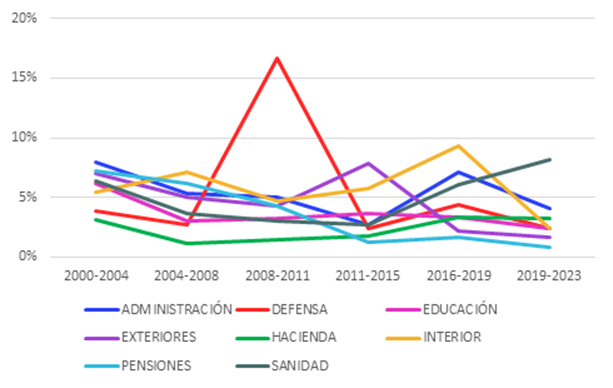
Figure 3 shows the evolution of the seven categories with the highest percentage, except for 'Justice'. As it accounts for one third of the petitions to the Senate, it detracts from the graphical representation of the other themes, which is why it was decided to exclude it from the image, but it is worth noting that it rises steadily until 2011-2015, where it drops drastically until 2016-2019. Otherwise, several aspects and trends can be highlighted in this temporal development. Firstly, the line 'Pensions' is always decreasing; 'Finance' has been slightly increasing since 2004-2008, but is generally stable; and 'Education' shows a slight decrease. In this line, 'Health' goes down until 2011-2015 and then goes up. As can be seen in Figure 3, the absolute numbers of petitions are very low, so variations may not be significant. For example, for 'Health', the requests from 2008 to 2011 were 12; from 2011 to 2015, 9; from 2016 to 2019, 11; and from 2019 to 2023, 10.
On the other hand, more pronounced peaks can be seen in 'Defense' in 2008-2011, in 'Foreign Affairs' in 2011-2015, and in 'Administration' and 'Domestic Affairs' in 2016-2019. In the latter two, no single initiative stands out, so no common theme can be discerned. However, in 'Foreign Affairs', a large number of the initiatives were related to the request by parents to draw up a manifesto repudiating the events that led to the death of their son in a psychiatric prison in Argentina. On the other hand, when looking at 'Defense', most of the petitions refer to the modification of certain aspects of Law 39/2007, of 19 November, on military careers. This large influx may be due to the fact that the State Security Forces and Corps are not allowed to form associations, so they must submit petitions on an individual basis. This would be the only case that we have been able to verify in which a collective rather than an individual improvement is sought.
4.3. Ideology Conditions the Perception of Spain's Problems
The fourth research question asked whether ideological beliefs could influence the different concerns of citizens. To test this question, this variable was collected from the CIS barometers themselves, coded under the name «Ideological self-placement scale (1-10)», and a non-parametric test (ANOVA) was carried out to check whether the relationship was significant.
With the results obtained, it can be affirmed that ideology influences the identification of Spain's problems (p=0.025; p<0.05). In specific examples, people on the ideological right are more concerned about terrorism and/or ETA than people on the left (p=0.004; p<0.05). Conversely, the latter are more concerned about issues such as unemployment (p=0.002; p<0.05), corruption (p=0.000; p<0.05) and housing (p=0.002; p<0.05) than citizens on the right. However, the data are not significant if the concern that is isolated is the political class and/or political parties (p=0.230; p<0.05), as well as immigration (p=0.474; p<0.05). In both of these cases, ideology has no influence.
4.4. The Political Sign of the Upper House does not Determine the Number of Petitions
The Spanish Senate has always been controlled by the two major parties in the electoral panorama, the Popular Party and the Socialist Party, due to the country's seat distribution system. Historically, the Upper House has had a conservative majority, with the exception of the last legislature, in which the political forces were more balanced, although with a slight preponderance of the progressive line. At first glance, one could say that, proportionally, more petitions were submitted under conservative majorities than under progressive ones.
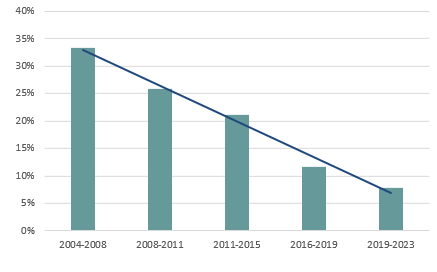
An example of this would be the 'Administration' theme, where 105 petitions were submitted under the conservative majority (i.e. 21 per legislature) and only 5 under the progressive one. Despite this, no causal relationship can be made between the sign of the Senate and the number of petitions submitted, given that the number of petitions submitted has decreased over time (see Figure 4). This fact, coinciding with the fact that the last legislature is precisely the only progressive one, may distort the data and conclusions[4].
Figure 4. Percentage of petitions per legislature
Source: Upper House data elaborated by the authors.
Due to the lack of clarity of the information in this regard, it was decided to perform a Student's t-test to compare the number of petitions under five right-wing and one left-wing majority (see Table 1). This confirms that the number of initiatives in the conservative legislatures is not significantly different from the number of petitions in the progressive legislature (p=0.068; p<0.05).
Table 1. Two-sample t-test assuming unequal variances
|
|
Conservative |
Progressive |
|
Media |
4,622222222 |
1,518518519 |
|
Variance |
214,635 |
14,10277778 |
|
P(T<=t) two-tailed |
0,068041163 |
|
Source: Upper House data elaborated by the authors.
5. Conclusions
The petitions that citizens send to the Upper House address very personal and individual issues. In general, they do not refer to problems affecting the general population, a question that the first objective of this study addressed by comparing the concerns of Spanish citizens with the subject matter of the petitions sent to the Senate. It was found that a third of the petitions, the highest cumulative percentage, are associated with ‘Justice’ issues related to problems in divorce, custody or parental authority of minors, issues that are shared with ‘Equality’. In contrast, the CIS barometers show that the main problems identified by Spanish citizens are of a material nature, in line with what Schoene (2019) indicated, and refer, above all, to issues of an economic nature. As a paradigm, concern about unemployment has been a constant for more than two decades in Spain and does not appear in a single petition submitted to the Upper House in that period.
The differences between the subjects covered by the surveys conducted by the Centro de Investigaciones Sociológicas and the petitions sent by citizens to the Senate suggest that there is no correlation between the problems perceived by the Spanish population and the petitions sent to the Senate. This may be closely related to a lack of knowledge of the channels available to citizens to participate in the institutions. With the distancing between representatives and represented (Caffarena, 2020; Castellanos, 2020; Castells, 2020; Megías and Moreno, 2024), the population has reached a point of disconnection with institutions that they do not feel they can influence (Held et al., 2001).
Public policies are removed from the everyday interests of citizens, which can lead to citizens not even considering participating through the institutional channels available to them. Toubøl (2019) already pointed out that institutional neglect of material issues promotes non-formal participation, outside the established channels, as the population assumes this neglect as intrinsic to the institutions. And, as discussed along this paper, this type of protest is highly common in Spain (Azedi, 2022; Borbáth, 2023). The lack of correlation between the tangible concerns of citizens and the petitions sent to the Senate evidences the detachment of the Chamber from the concerns of those represented there.
The second objective of this study was to determine whether the political ideology of citizens influences their identification of the country's main problems. It may seem obvious that Spanish society is not a uniform group, since it is a community where not only different schools of thought can be found, but also different positions within the same line. However, after this analysis, we could conclude that the influence of ideology varies according to the subject matter. There is evidence that ideology does not influence issues such as immigration, but also that left-wingers are more concerned about issues such as unemployment than conservatives. This ideological distance in the perception of Spain's main problems could be related to the way power addresses the needs of citizens. Public policies do not consider material issues such as employment or housing, which affect people's daily lives, and this can generate distrust towards institutions (Schoene, 2019), especially among those facing greater socio-economic difficulties.
Finally, the third objective of this study sought to identify whether the number of petitions registered in the Senate varies according to the political sign of the House. Although it has not been possible to demonstrate that more petitions are registered under a conservative upper chamber compared to a progressive one, it is worth noting that in southern European countries there is a tradition of greater protest during periods of right-wing governments, which is partly explained by the tendency of the left to oppose the executive more frequently (Borbáth and Gessler, 2020). Moreover, historically, conservative citizens have tended to prioritize institutionalized forms of participation, such as the electoral vote (Hutter and Kriesi, 2013).
Although progress has been made in research on citizen participation, we would like to emphasize the main limitation of this work: the possibility of consulting the petitions sent by citizens to the Congress of Deputies. The Petitions Committee is present in both Chambers, but the Lower House does not provide access to these initiatives, not even on request, with the justification of data protection. Although we understand that the petitions to the Senate may be fewer than those addressed to the Congress of Deputies due to the very peculiarity of the Chambers, it is not possible to know with certainty due to the lack of information. This limitation is evidence of the hermeticism of Spanish institutions and how they distance themselves from their citizens.
In relation to the above, several lines of future research directly connected to the right to petition and the use made of it by the Spanish population are set out. The first of these could aim to unravel whether constituents are aware of the institutional channels for active participation in the political life of the Houses, since this article leaves this question open. On the other hand, if access to the petitions registered by the Congress of Deputies were available, it would be possible to carry out a more far-reaching study on whether the political sign of the Chamber influences the number of initiatives that are sent and thus contribute to the field of research on the different forms of protest in Spain.
Ethics and Transparency
Acknowledgements
Iris Simón-Astudillo is grateful for the support provided by the call for pre-doctoral contracts UVa 2022, co-funded by Banco Santander. The authors would also like to thank Lucía Sanz Valdivieso for proofreading the translation of this article.
Conflict of Interest
The authors declare that they have no conflict of interest in relation to the research, authorship and/or publication of this article.
Funding
This study did not receive specific funding from any public or private entity.
Author Contributions
|
Contribution |
Author 1 |
Author 2 |
Author 3 |
Author 4 |
|
Conceptualization |
X |
X |
|
|
|
Data curation |
X |
X |
|
|
|
Formal Analysis |
X |
X |
|
|
|
Funding acquisition |
|
|
|
|
|
Investigation |
X |
X |
|
|
|
Methodology |
X |
X |
|
|
|
Project administration |
X |
X |
|
|
|
Resources |
|
|
|
|
|
Software |
X |
X |
|
|
|
Supervision |
X |
X |
|
|
|
Validation |
X |
X |
|
|
|
Visualization |
X |
|
|
|
|
Writing – original draft |
X |
X |
|
|
|
Writing – review & editing |
X |
X |
|
|
Data Availability Statement
The data used for this research is freely available and can therefore be found in the reports of the Committee on Petitions of each legislature and in the CIS digital barometers.
References
Alaminos-Fernández, A. F., Francés García, F., & Santacreu-Fernández, O. (2024). The Influence of Political Efficacy and Party Identity on Voter Turnout in Spain: Citizens’ Links to the Functioning of the Political System. Revista Española de Investigaciones Sociológicas, (185), 3-22. https://doi.org/10.5477/cis/reis.185.3-22
Alonso, L. E., Betancor nuez, G., & Cilleros Conde, R. (2015). Nuevos y novísimos movimientos sociales: Una aproximación al activismo social en la España actual. En C. Torres Albero (Ed.), España 2015. Situación social (pp. 1126-1148). CIS (Centro de Investigaciones Sociológicas).
Álvarez Sánchez, S., & Arceo Vacas, A. (2023). Lobbying of the Civil Society in Spain: capacity of influence over the public institutions. Estudios sobre el Mensaje Periodístico, 29(3), 521-532. https://doi.org/10.5209/esmp.88987
Azedi, A. (2022). Does Job Insecurity Motivate Protest Participation? A Multilevel Analysis of Working-Age People from 18 Developed Countries. Sociological Perspectives, 66(3), 476-495. https://doi.org/10.1177/07311214221139291
Barberá, P., Casas, A., Nagler, J., Egan, P. J., Bonneau, R., Jost, J. T., & Tucker, J. A. (2019). Who Leads? Who Follows? Measuring Issue Attention and Agenda Setting by Legislators and the Mass Public Using Social Media Data. American Political Science Review, 113(4), 883-901. https://doi.org/10.1017/S0003055419000352
Barrie, C., Fleming, T. G., & Rowan, S. S. (2023). Does Protest Influence Political Speech? Evidence from UK Climate Protest, 2017–2019. British Journal of Political Science, 1-18. https://doi.org/10.1017/S0007123423000376
Bocking-Welch, A., Huzzey, R., Leston-Bandeira, C., & Miller, H. (2022). Petitioning and People Power in Twentieth-Century Britain. In M. Mair, R. Meckin & M. Elliot (Eds.), Investigative Methods: An NCRM Innovation Collection (pp. 75-86). ESRC National Centre for Research Methods. https://doi.org/10.5258/ncrm/ncrm.00004550
Borbáth, E. (2023). Differentiation in Protest Politics: Participation by Political Insiders and Outsiders. Political Behavior, 1-24. https://doi.org/10.1007/s11109-022-09846-7
Borbáth, E., & Gessler, T. (2020). Different worlds of contention? Protest in Northwestern, Southern and Eastern Europe. European Journal of Political Research, 59(4), 910-935. https://doi.org/10.1111/1475-6765.12379
Bouza, F. (2011). La agenda pública en el Reino de España: desafección política, paro y problemas económicos. Papeles de relaciones ecosociales y cambio global, 116, 151-158.
Burciu, R., & Hutter, S. (2022). More stress, less voice? The gender gap in political participation during the COVID-19 pandemic. European Journal of Politics and Gender, 1-20. https://doi.org/10.1332/251510821X16602276230640
Caffarena, V. A. (2020). Public decision making: the grey area of institutional transparency. Revista española de la transparencia, (11), 75-111. https://doi.org/10.51915/ret.112
Calvo, D. (2016). Participación política y peticiones electrónicas: calidad y temática de las iniciativas publicadas en Change. org. En Comunicación, cultura y cooperación: V Congreso Iberoamericano de Comunicación: libro de comunicaciones (pp. 500-514). Asociación Española de Investigación de la Comunicación.
Campos-Domínguez, E. (2009). El desarrollo de la ciberdemocracia en el Congreso de los Diputados: la comunicación e interacción entre ciudadanos y parlamentarios a través de internet (2004-2008) [Doctoral Thesis]. UCM. https://bit.ly/4cfufvt
Castellanos, C. J. (2020). Participación ciudadana y buen gobierno democrático: posibilidades y límites en la era digital. Marcial Pons, Ediciones Jurídicas y Sociales.
Castells, M. (2020). Ruptura. La crisis de la democracia liberal. Alianza editorial.
Cazorla-Martín, Á., Montabes-Pereira, J., & Hernández-Tristán, M. J. (2023). Political Disaffection and Digital Political Participation in Latin America: A Comparative Analysis of the Period 2008–2020. Societies, 13(3), 59. https://doi.org/10.3390/soc13030059
Coffé, H., & Bolzendahl, C. (2010). Same Game, Different Rules? Gender Differences in Political Participation. Sex Roles, 62(5-6), 318-333. https://doi.org/10.1007/s11199-009-9729-y
Coffé, H., & Bolzendahl, C. (2021). Are all politics masculine? Gender socialised personality traits and diversity in political engagement. European Journal of Politics and Gender, 4(1), 113-133. https://doi.org/10.1332/251510820X15991530007006
Gause, L. (2022). Revealing Issue Salience via Costly Protest: How Legislative Behavior following Protest Advantages Low-Resource Groups. British Journal of Political Science 52(1), 259-279. https://doi.org/10.1017/S0007123420000423
Gerber, M., Schaub, H. P., & Mueller, S. (2019). O sister, where art thou? Theory and evidence on female participation at citizen assemblies. European Journal of Politics and Gender, 2(2), 173-195. https://doi.org/10.1332/251510819X15471289106095
Gil-Torres, A. (2018). Bipartidism and pluridemocracy in Spain: the construction of the Spanish sociopolitical context according to the CIS (2011-2016). index.comunicación, 8(1), 81-100. https://bit.ly/3KO7B1n
Held, D., Gómez Cedillo, A., Albero, T., & Gómez Cedillo, A. (2001). Modelos de democracia. Alianza Editorial.
Hooghe, M., & Marien, S. (2013). A comparative analysis of the relation between political trust and forms of political participation in Europe. European Societies, 15(1), 131-152. https://doi.org/10.1080/14616696.2012.692807
Hutter, S., & Kriesi, H. (2013). Movements of the left, movements of the right reconsidered. In J. Van Stekelenburg, C. Roggeband & B. Klandermans (Eds.), The future of social movement research: Dynamics, mechanisms, and processes (pp. 281-298). University of Minnesota Press.
Jeroense, T., & Spierings, N. (2023). Political participation profiles. West European Politics, 46(1), 1-23. https://doi.org/10.1080/01402382.2021.2017612
Leston-Bandeira, C. (2019). Parliamentary petitions and public engagement: an empirical analysis of the role of e-petitions. Policy & Politics, 47(3), 415-436. https://doi.org/10.1332/030557319X15579230420117
Leston-Bandeira, C., & Siefken, S. T. (2023). The development of public engagement as a core institutional role for parliaments. The Journal of Legislative Studies, 29(3), 361-379. https://doi.org/10.1080/13572334.2023.2214390
Magallón-Rosa, R. (2021). The agenda below the radar. Disinformation and fact checking on (im)migration. Migraciones, (52), 59-87. https://doi.org/10.14422/mig.i52.y2021.003
Martin, I., & Van Deth, J. (2007). Political Involvement. In Van Deth, J., Montero, J. R. & Westholm, A. (Eds.), Citizenship and Involvement in European Democracies. A Comparative Analysis (Chapter 12). Routledge.
McAdam, D., Tarrow, S., & Tilly. C. (2001). Dynamics of Contention. Cambridge University Press.
Megías, A., & Moreno, C. (2024). Political Disaffection in European Countries near Spain: A Stable Attitude? Revista Española de Investigaciones Sociológicas, (179), 103-124. https://doi.org/10.5477/cis/reis.179.103
Merino, M. (1997). La participación ciudadana en la democracia. Instituto Federal Electoral.
Meyer, D. S., & Tarrow, S. (1998). The Social Movement Society: Contentious Politics for a New Century. Rowman and Littlefield.
Morales-Medina, T., & Cabezas-Clavijo, Á. (2024). Netflix and the cancel culture: analysis through Change.org. index.comunicación, 14(1), 229-254. https://doi.org/10.62008/ixc/14/01Netfli
Pérez-Curiel, C., & García-Gordillo, M. (2020). Indicators of influencer of Spanish politicians on Twitter. An analysis in the framework of the elections in Catalonia. Estudios sobre el Mensaje Periodístico, 26(3), 1133-1144. https://doi.org/10.5209/esmp.64880
Pfanzelt, H., & Spies, D. C. (2019). The gender gap in youth political participation: evidence from Germany. Political Research Quarterly, 72(1), 34-48. https://doi.org/10.1177/1065912918775249
Quaranta, M., Cancela, J., Martín, I., & Tsirbas, Y. (2021). Trust, Satisfaction and Political Engagement during Economic Crisis: Young Citizens in Southern Europe. South European Society and Politics, 26(2), 153-179. https://doi.org/10.1080/13608746.2021.1991568
Rodríguez-Díaz, R., & McCombs, M. (2023). Personal Agenda – Public Agenda Congruency: A Contingent Condition for Agenda-Setting Effects. Communication & Society, 36(4), 191-212. https://doi.org/10.15581/003.36.4.191-212
Rubio Núñez, R., Marañón Martín, L., & Gonzalo Rozas, M. Á. (2021). Is there a citizen lobby? A case of participation in the Spanish Congress. Revista De Las Cortes Generales, (110), 235-271. https://doi.org/10.33426/rcg/2021/110/1573
Schoene, M. (2019). Institutional Distrust, Institutional Participation, and Protest Behavior in the European Social Movement Sector. Contention, 7(2), 51-75. https://doi.org/10.3167/cont.2019.070204
Serra-Silva, S. (2022). How parliaments engage with citizens? Online public engagement: a comparative analysis of Parliamentary websites. The Journal of Legislative Studies, 28(4), 489-512.
Simancas González, E., García-López, M., Arévalo-Salinas, Á. I., & Bustos-Díaz, J. (2023). Online citizen activism more than ten years after 15M. The case of ‘Vote please’. index.comunicación, 13(2), 225-243. https://doi.org/10.33732/ixc/13/02Activi
The international institute for democracy and electoral assistance. (s.f.). Voter Turnout Database. https://bit.ly/3yYmMTb
Toubøl, J. (2019). From democratic participation to civic resistance: The loss of institutional trust as an outcome of activism in the refugee solidarity movement. British Journal of Sociology, 70(4), 1198-1224. https://doi.org/10.1111/1468-4446.12622
Van Deth, J. W. (2014). A conceptual map of political participation. Acta Política, 49(3), 349-367. https://doi.org/10.1057/ap.2014.6
Verba, S., Schlozman, K. L., & Brady, H. E. (1995). Voice and equality. Civic voluntarism in American politics. Harvard University Press.
Weiss, J. (2023). Disengaged or raising voices? An analysis of the relationship between individual risk perception and non-institutionalised political participation. Acta Política, (59), 439-457. https://doi.org/10.1057/s41269-023-00301-x