index●comunicación
Revista científica de comunicación aplicada
nº 15(2) 2025 | Páginas 249-274
e-ISSN: 2174-1859 | ISSN: 2444-3239
Spanish Video Podcasting on YouTube and
Spotify: Conversational
and Professionalized
Video podcasting español en YouTube y Spotify: conversacional y profesionalizado
Received on 20/08/2024 | Accepted on 08/04/2025 | Published on 15/07/2025
https://doi.org/10.62008/ixc/15/02Videop
Nadia Alonso-López | Universitat Politècnica de València
naallo1@har.upv.es| https://orcid.org/0000-0002-5220-2232
Carlos López-Olano | Universitat de València
carlos.lopez-olano@uv.es| https://orcid.org/0000-0002-8121-5999
José Gamir-Ríos | Universitat de València
jose.gamir@uv.es | https://orcid.org/0000-0001-5379-6573
Abstract: This study analyses the implementation and development of video podcasting in Spain. To achieve this, a content analysis was conducted using 19 variables applied to the 112 most prominent video podcasts in the country at the beginning of the 2023–2024 season. The analysis focuses on production models, presenter profiles, content types, formal structures, and technical characteristics. The findings reveal a predominance of independently produced, digitally native video podcasts, typically hosted by a single presenter, most of whom are men. These podcasts are primarily conversational in style, cover generalist topics, and are oriented toward entertainment or knowledge dissemination. They tend to follow a weekly publication schedule and range in length from one to two hours. From a production standpoint, most are recorded in professional settings using multi-camera setups. All this points to the development of the audiovisual format in Spain as a new stage in the evolution of podcasting.
Keywords: Video Podcast; Podcasting; Spotify; YouTube; Spain.
Resumen: El objetivo de la presente investigación es analizar la implantación y el desarrollo del video podcasting en España. Para ello, se aplica un análisis de contenido de 19 variables a los 112 video podcast más destacados en el país al inicio de la temporada 2023-24. En concreto, se analiza la producción, sus presentadores, sus contenidos y sus aspectos formales y técnicos. Los resultados evidencian el predominio de los video podcast nativos digitales de producción independiente, generalmente con un solo presentador con mayoría de podcasters percibidos como hombres; de género conversacional, temática generalista y orientados al entretenimiento o la divulgación; con periodicidad semanal y una duración de entre 1 y 2 horas; grabados en espacios profesionales y con realización multicámara. Todo ello apunta a un desarrollo en España del formato audiovisual como una nueva etapa en la evolución del podcasting.
Palabras clave: video podcast; podcasting; Spotify; YouTube; España.
To quote this work: Alonso-López, Nadia, López-Olano, Carlos & Gamir-Ríos, José. (2025). Video podcasting español en YouTube y Spotify: conversacional y profesionalizado. index.comunicación, 15(2), 249–274. https://doi.org/10.62008/ixc/15/02Videop
1. Introduction
The evolution of technology, the rise of hyperconnectivity, and widespread access to mobile devices equipped with diverse integrated functions have significantly reduced the production costs associated with video and audio formats. At the same time, the proliferation of platforms and social networks has reshaped audience dynamics: users are no longer mere consumers but also active content creators and distributors. This “prosumer” phenomenon (Toffler, 1980) reflects an increasingly mobile and individualized mode of media consumption, which helps explain the growing relevance of formats such as podcasts in today’s hybrid media environment. Personalized consumption and the ability to access content irrespective of spatial and temporal constraints are among the core innovations of the podcast format (Gallego Pérez, 2010).
As Bonini (2015) notes, British journalist Ben Hammersley coined the term “podcasting” in 2004 and, by 2005, “podcast” had been named Word of the Year by the Oxford American Dictionary. The integration of podcasts into traditional media outlets, such as radio and print, alongside Internet accessibility, opened new avenues and significantly altered content distribution and access methods (Terol-Bolinches et al., 2021), leading to a surge in the format’s popularity and consumption. The investigative journalism program Serial, launched in 2014 and widely distributed online, became a mass phenomenon that contributed to the consolidation of podcasting in the United States (Berry, 2016). In Spain, the first podcast was Comunicando by José Antonio Gelado, published in October 2004. Later, in mid-2016, the format gained popularity with the launch of Podium Podcast by the PRISA Group, owner of SER, the most listened-to radio station (García-Marín & Aparici, 2018). The increasing accessibility of technology has enabled users to produce and distribute podcasts across a variety of platforms. In this context, it is appropriate to speak of the “age of audification” (Espinosa de los Monteros, 2019), a term that encapsulates the growing prominence of audio communication and the rising investment in the podcast format by platforms such as Spotify and Amazon. Podcaster and consultant Francisco Izuzquiza describes podcasting as a form of radio that has developed its own conventions, separate from traditional models. He defines it as “a series of audios (or videos) uploaded to the Internet and distributed via an RSS feed” (2019: 24). Other scholars also point to the routine serialization of podcast formats, which often follow a repeated structure, thus reinforcing subscription and aggregation as key mechanisms of access (Pedrero-Esteban et al., 2023). Among the podcast genres that have become consolidated within this emerging digital audio ecosystem is the “daily” format. These podcasts typically offer news updates at regular intervals—usually from Monday to Friday—with durations ranging from three to thirty minutes. Their narrative style tends to reflect the editorial identity of the outlet that produces them (Newman & Gallo, 2019). In the complex monetization landscape created by this profusion of content, new forms of funding have emerged, such as the branded podcast—programs created and sponsored by a brand—which has been conceived as a distinct product and can be found in several proposals on Spanish platforms. Some studies find that branded podcasts are not yet a significant content option and therefore do not function as a substantial source of revenue (Martínez-Otón et al., 2023), while others highlight their effectiveness as a fashionable communication tool (Guerrero-Navarro, Cristófol-Rodríguez & Aguilera-Borrero, 2023).
The data generally suggest the sector is in good health: Spain’s main podcast platforms released 209 original titles in 2023, although this was 54 fewer than in the previous year. This decline is largely attributed to a change in Sonora’s model, which in June abandoned the subscription model to become an open platform and ceased releasing new productions, anticipating its closure in 2024 (Pedrero-Esteban, 2024). Moreover, podcast listening in Spain remains stable and notably strong compared to the global average. Spain is among the countries with the highest podcast consumption: 44% of respondents reported having listened to podcasts, compared to an average of 38% across the 25 countries surveyed, according to the Digital News Report 2024 (Novoa-Jaso et al., 2024). Podcasts ranked as the third most listened to digital audio format in 2023, behind digital music and live online radio; more than half of users reported listening to them (IAB Spain, 2023). Other recent studies highlight the sector’s strength, noting a 47.6% increase in investment in digital audio (including podcasting) in 2023, reaching €110.7 million—up from €75 million in 2022. For the second consecutive year, digital audio was the fastest-growing sector, outpacing influencers (23.9%), branded podcasts (21.2%), and eSports (13.2%) (Infoadex, 2024). In addition, nearly 60% of Spanish Internet users listened to podcasts, and daily listening is on the rise: 10% do so daily, two percentage points more than in 2021 (Prodigioso Volcán, 2023).
Regarding genres, conversational podcasts clearly led the Spanish market in 2023: of the 209 new titles, 124—or nearly six out of ten (59%)—belonged to this category. In contrast, narrative non-fiction podcasts accounted for only 26%, or one in four. The growth of conversational podcasts—whose production costs, aside from the fees of some well-known hosts, are typically lower than those of audio fiction or investigative documentaries—helps sustain the large volume of distributed content (Pedrero-Esteban, 2024).
1.1. The Growing Hybridization of Podcasts and Visual Resources
In the current context of media convergence—across platforms, formats, and media types—video podcasting has emerged as a format that integrates visual content into traditional audio-based podcasts (Sellas, 2009). Authors such as Moreno Espinosa et al. (2021) refer to this format as a vodcast, a portmanteau of video and podcast, which allows on-demand access to audio-visual content either through an RSS feed or platforms such as YouTube. García-Marín (2022) notes that the perceived quality of production is not necessarily decisive for audiences when listening to podcasts or watching YouTube videos. Instead, audiences place greater value on the relevance of the content to their personal lives and the emotional connection they feel with the story being told. In the educational context, Cheta and Eberechukwu (2018) distinguish between two types of podcasts: those that are audio-only, and those that include both video and audio. They highlight that the inclusion of video increases the complexity of production due to the need for image recording and editing. Other studies have also underscored the use of video podcasting in educational settings (Tur Ferrer, 2013; Díaz Monsalvo, 2024). Nevertheless, audio-based consumption often occurs alongside other tasks, such as household chores (29.4%), work (20%), commuting (18.9%), sports activities (12.1%), or studying (5.2%) (Prodigioso Volcán, 2023). This multitasking behavior significantly affects reception, as video typically requires full visual attention and is therefore less compatible with parallel activities.
However, traditional audio platforms such as Spotify have begun investing in video podcasts, arguing that the addition of video enhances the overall user experience and fosters a stronger connection with creators (Miranda, 2020). Since 2020, Spotify has offered a limited number of English-language video podcasts. This strategic shift aligns with growing popularity in markets like the United States and Canada. For instance, a 2022 study by Cumulus Media and Signal Hill Insights found that 57% of respondents preferred podcasts that included video over audio-only options. Similarly, in the United States, a Morning Consult survey revealed that 46% of podcast listeners favored video podcasts, citing the value of seeing presenters’ expressions and reactions, and finding it easier to focus on content when video is included (Burns & Blancaflor, 2023). In 2022, Spotify introduced video podcast functionality in several countries, including Spain, allowing content creators to distribute their video podcasts via the Anchor platform (Calvo, 2022). In Spain, this expansion has coincided with a notable increase in the adoption of video podcasting, with content creators progressively establishing themselves within this format (IAB Spain, 2023). A key example is Nadie sabe nada, a comedy show hosted by Andreu Buenafuente and Berto Romero, broadcast live on Cadena SER and produced by El Terrat, and later distributed on multiple platforms. This format offers listeners/viewers the flexibility of active viewing or passive listening with the video playing in the background (López-Villafranca, 2024).
Beyond specialized audio platforms, YouTube has become an increasingly important outlet for podcast consumption, particularly among younger users, given its prominence as the most widely used video-sharing platform (owned by Google since 2006). A study by Gamir-Ríos and Cano-Orón (2022) showed that, as of 2021, purely audio-based formats still dominated, while hybrid video and audio podcasts on YouTube remained a minority regardless of the producer. Although platforms such as iVoox and Google Podcasts remain the most frequently used services for podcast consumption in Spain (Prodigioso Volcán, 2023), many podcasts maintain a multiplatform presence. Nearly half of all formats are also available on YouTube, giving users the option to listen or watch depending on their preferred application (Johansson, 2021). According to 2022 data, the gap between Spotify and YouTube as listening platforms had narrowed to just nine percentage points (Prodigioso Volcán, 2023).
Research focused on Spotify confirms that video podcasting resonates with the media consumption habits of Spanish Gen Z users (López-Villafranca, 2024). According to Spotify’s internal metrics, the target audience for this content has grown by 20% in Spain. Furthermore, López-Villafranca reports that digital natives, who are more accustomed to image-based content, show a strong preference for formats they can both watch and listen to. In fact, 96% of the video podcasts analyzed were conversational in nature and could be either viewed or listened to without loss of content.
2. Objectives
The main objective of this research is to advance understanding of the video podcast format and to characterize it through an analysis of the content available in Spain on the two most widely used platforms: Spotify—traditionally an audio-focused platform that has adapted to include video content—and YouTube, a video-native platform increasingly used to distribute video podcasts. The following secondary objectives are proposed:
- To identify the production model (native or previously broadcast) and technical elements of video podcasting across both platforms;
- To determine which formal characteristics are most prevalent in the format;
- To examine whether video podcast content is also distributed on other audiovisual platforms.
To develop this overview of the video podcast in Spain, the following research questions are formulated:
RQ1: Is most video podcast production original, or does it derive from previously broadcast programs?
RQ2: Does the format tend to feature a specific number of presenters and a consistent genre?
RQ3: What types of content are most prevalent?
RQ4: What formal features characterize the format?
RQ5: What technical aspects are most typical?
3. Methodology
3.1. Materials
To answer the research objectives and questions, this study adopts a content analysis approach (Krippendorff, 2004; Neuendorf, 2002), as first proposed by Berelson in his classic work (1952). The sample consists of 112 of the most prominent video podcasts in Spain at the start of the 2023–24 season.
The sampling process was conducted in two phases. In the first phase (compilation), 353 titles were collected that, at any time between Monday September 4 and Sunday October 22, 2023, had occupied positions in the top 100 of Spotify’s and Apple Podcasts’ daily general rankings for Spain, or appeared in iVoox’s weekly rankings. Data for the first two platforms were obtained using Chartable, a podcast analytics tool certified by the Interactive Advertising Bureau (IAB); the iVoox data were retrieved directly from its website. According to a 2022 survey of 772 Spanish adult Internet users (Prodigioso Volcán, 2023), Spotify is the most widely used platform in Spain for podcast listening (50.3%), followed by YouTube (40.1%), iVoox (19.6%), Google Podcasts (10%), and Apple Podcasts (4.3%). Although the rankings of non-linear platforms do not measure audience size in a strict sense but rather general popularity (Berry, 2016), they are commonly used as the basis for research sampling in studies of the podcast ecosystem (Antunes & Salaverría, 2018; Gamir-Ríos & Cano-Orón, 2022), particularly in the absence of public audience metrics.
In the second phase (definition), the sample was refined to include only those shows that had a video version available on YouTube or Spotify. To determine this, two researchers independently conducted searches using combinations of the podcast title and the first and last names of the hosts within the native search engines of both platforms. Discrepancies were resolved by a third researcher. Inclusion criteria required that the full audio of the episodes be accompanied by moving, synchronized images recorded at the time of production, regardless of whether the video appeared on the podcaster’s own channel or one belonging to a media outlet or production company. As shown in Table 1, only 31.7% (n = 112) of the original 353 podcasts were found to have a video version.
Apple Podcasts and iVoox were included in the initial compilation because they are among the most-used platforms in Spain for consuming audio-only podcasts. However, they were excluded from the video podcast definition phase, as audiovisual podcast consumption is concentrated primarily on Spotify and YouTube—preferred by 88.5% and 19.2% of users respectively (Prodigioso Volcán, 2023).
Table 1. Composition of the research sample
|
|
n |
% |
|
Does not include an audiovisual version |
241 |
68.3% |
|
Includes an audiovisual version Only on YouTube Only on Spotify On both YouTube and Spotify |
112 73 4 35 |
31.7% 20.7% 1.1% 9.9%
|
|
Total |
353 |
100% |
Source: Prepared by the authors.
3.2. Method
The research applied a codebook consisting of 19 variables structured around five axes of analysis, as detailed in Table 2. This codebook was specifically developed for the present study and based on prior literature (Antunes & Salaverría, 2018; Gamir-Ríos & Cano-Orón, 2022; García-Marín & Aparici, 2018; López-Villafranca, 2024; Martínez-Costa et al., 2022; Pedrero-Esteban, 2024; Pérez-Alaejos et al., 2022).
The first axis, production, explores whether the video podcast originates from a legacy medium or is a digital native product, and identifies the producer responsible. The second axis focuses on the hosts, analyzing the number of presenters, whether they have prior experience in the cultural industries, and the presence of men and women among them. The third axis relates to content and classifies the podcast’s genre, its thematic focus, and intended purpose. Here, “educational” podcasts aim to arouse interest and make a topic more accessible, while “learning” podcasts are designed to teach and develop specific skills. The fourth axis addresses formal aspects, such as publication frequency, language, duration, and whether the podcast is distributed on TikTok. TikTok is included due to its relevance as a trend-driven, video-centric platform where short clips from video podcasts are often shared as part of a broader dissemination strategy. The fifth and final axis concerns technical aspects. It examines the type of recording set (e.g., home setup, professional studio), whether the recording takes place indoors or outdoors, the use of multi-camera production, the presence of on-screen visual elements, whether an audience is present, and, if so, whether that audience participates—understood as making some form of intervention during the recording.
Table 2. Axes, variables and analysis categories
|
Axes |
Variables |
Analysis categories |
|
Production |
Origin |
Previously aired (on radio / |
|
Digital Natives (promoted by |
||
|
Producer |
Production company annotation / platform / media / brand |
|
|
Presentation |
Presenters |
Annotation of number
|
|
Experience in |
No presenter / No / Yes
|
|
|
Presentation |
No / Yes
|
|
|
Presentation |
No / Yes |
|
|
|
Sex |
Non-narrative
monologue / |
|
Thematic agenda |
General interest / Politics / |
|
|
Intention |
Informative / Educational / Learning / Entertainment |
|
|
Formal aspects |
Frequency |
Daily / Several a week / Weekly / Every two weeks / Monthly / |
|
Language |
Spanish / Catalan / English |
|
|
Length |
Less than 5 minutes / |
|
|
Presence on |
No / Yes |
|
|
Technical aspects |
Recording set |
Home setup / Professional / |
|
Location |
Outside / Inside |
|
|
Production |
No / Yes |
|
|
On-screen |
No / Yes |
|
|
Audience |
No / Yes |
|
|
Audience |
No / Yes |
Source: Prepared by the authors.
The information used to code the variables was collected in December 2023 through a dual approach to the sample. First, at least one complete episode of each video podcast was viewed, supplemented by partial viewing of additional episodes for those variables requiring further observation. Second, a proactive and intensive manual search was conducted online to locate, where available, the websites, TikTok accounts, and platform spaces associated with the podcasts under analysis. The materials were coded by the three authors of the study following a reliability test. The Krippendorff’s alpha coefficients obtained—calculated using the ReCal software (Freelon, 2013)—were consistently above 0.8, thereby confirming the reliability of the results (Igartua Perosanz, 2006).
4. Results
4.1. Production
The analysis of the production axis for the video podcasts studied shows a clear predominance of digital native formats over previously broadcast ones, whose share is significantly lower (see Table 3). In those cases where the video podcast originated from a prior broadcast, the source was radio; no examples from television were found. As for native video podcasts, most are independently produced, although productions promoted by platforms and production companies were also identified. The presence of branded video podcasts—those created and distributed by commercial brands—was found to be comparatively limited.
Table 3. Origin of the video podcast
|
|
n |
% |
|
Non-digital natives Previously broadcast on radio Previously broadcast on television
|
19 19 0 |
17.0% 17.0% 0.0% |
|
Digital natives Promoted by production companies Promoted by platforms Promoted by a non-audiovisual media outlet Promoted by brands Independent |
93 10 11 2 8 62 |
83.0% 8.9% 9.8% 1.8% 7.1% 55.4%
|
|
Total |
112 |
100% |
Source: Prepared by the authors.
Among the video podcasts originating from the radio sector (Table 4), the results indicate that Cadena SER accounts for more than half of them, while the remainder are distributed across several stations, including esRadio, Catalunya Ràdio, Onda Cero, Aragón Radio and Cadena Mix. Regarding video podcasts promoted by producers, Radio Primavera Sound is responsible for the highest number (3), whereas among those promoted by platforms, Podium Podcast (5) and Spotify (3) are the most prominent. As for brands, no single one stands out: each video podcast is promoted by a different company. Furthermore, there is no dominant sector in this area, with brands coming from industries such as technology, telecommunications, banking and investment, and department stores.
Table 4. Promoting agents or producers of the most popular video podcasts
|
|
n |
|
Previously broadcast on radio Aragón Radio Cadena Mix Cadena SER Catalunya Ràdio esRadio Onda Cero Radio Marca
|
19 1 1 10 2 3 1 1 |
|
Promoted by production companies Abra Cadáver Producciones Cadence 13 Dudas Media Radio Primavera Sound Rotor Media Sonoro ViOne Media
|
10 1 1 1 3 1 1 2 |
|
Promoted by platforms 3CAT Amazon Prime Video Podimo Podium Podcast Spotify |
11 1 1 1 5 3 |
|
Promoted by a non-audiovisual media outlet Applesfera Público |
2 1 1
|
|
Promoted by brands BBVA El Corte Inglés Fundación Telefónica Mahou Movistar Nude Project Samsung Yoigo |
8 1 1 1 1 1 1 1 1 |
Source: Prepared by the authors.
4.2. Presentation
The analysis of video podcast hosts by sex and number (Table 5) reveals a greater presence of men than women among the most popular programs. It also shows that the majority are hosted by a single person, followed by those with two presenters. Video podcasts with more than three hosts or with no identifiable host are very rare. The latter category applies only in two cases: where the podcaster is absent due to the content being lectures or talks (BBVA Aprendemos Juntos and TED Talks Daily), and in one case where the podcaster does not appear on screen in all episodes (Memorias de Pez).
Table 5. Sex and number of presenters of the most popular video podcasts
|
|
Presence of women |
Presence of men |
Total |
|||||
|
|
n |
% |
n |
% |
n |
% |
||
|
No presenter |
/ |
/ |
/ |
/ |
3 |
2.7% |
||
|
One |
21 |
32.8% |
43 |
67.2% |
64 |
57.1% |
||
|
Two |
18 |
56.3% |
20 |
62.5% |
32 |
28.6% |
||
|
Three |
4 |
44.4% |
9 |
100 % |
9 |
8.0% |
||
|
Four |
1 |
33.3% |
2 |
66.7% |
3 |
2.7% |
||
|
Five |
1 |
100.0% |
1 |
100% |
1 |
0.9% |
||
|
Total |
45 |
40.2% |
75 |
67.0% |
112 |
100% |
||
Source: Prepared by the authors.
The cross-analysis of sex and number of hosts reveals that the presence of female presenters is lower than that of male presenters, regardless of the number of podcasters. However, the figures are more balanced in video podcasts presented by two people (56.3% female and 62.5% male). In the case of video podcasts with three presenters, women are present in 44.4% of cases, while men are always represented.
This analytical dimension also considers the prior experience of presenters in the cultural industries. In this context, prior experience refers to individuals’ public presence and/or activity in other formats or communication sectors before hosting these programs. The results indicate a greater proportion of presenters without prior experience (55.4%) compared to those with previous experience (42%).
4.3. Content
The results related to the third axis of analysis indicate that the most prevalent genre among the video podcasts studied is the conversational format, followed at a considerable distance by the non-narrative monologue. Non-narrative monologues are defined here as video podcasts that explore ideas, reflections, opinions, or discourses on a specific topic in an abstract or thematic manner, without adhering to a conventional narrative structure of beginning, middle, and end. No examples of other genres—such as narrative fiction, narrative non-fiction, or musical formats—were identified in the sample.
The cross-analysis between genre (conversational and non-narrative monologue) and thematic content (Table 6) reveals a clear predominance of conversational formats with general-interest themes. The conversational genre also encompasses video podcasts focused on emotional wellbeing, economy and business, politics, sports news, physical wellbeing and beauty, culture, and mystery. Within the non-narrative monologue category, the most common theme is emotional wellbeing. Other thematic areas within this genre include general interest, economy and business, and, to a lesser extent, politics.
Table 6. Predominant themes and genres of the most popular video podcasts
|
|
Non-narrative monologue |
Conversational |
Total |
|||||
|
|
n |
% |
n |
% |
n |
% |
||
|
General interest |
4 |
3.6% |
44 |
39.3% |
48 |
42.9% |
||
|
Emotional wellbeing |
7 |
6.3% |
11 |
9.8% |
18 |
16.1% |
||
|
Economy and business |
4 |
3.6% |
5 |
4.5% |
9 |
8.0% |
||
|
Politics |
2 |
1.8% |
4 |
3.6% |
6 |
5.4% |
||
|
Sports news |
1 |
0.9% |
4 |
3.6% |
5 |
4.5% |
||
|
Physical wellbeing and beauty |
1 |
0.9% |
4 |
3.6% |
5 |
4.5% |
||
|
Mystery |
1 |
0.9% |
3 |
2.7% |
4 |
3.6% |
||
|
Culture |
1 |
0.9% |
3 |
2.7% |
4 |
3.6% |
||
|
History |
1 |
0.9% |
1 |
0.9% |
2 |
1.8% |
||
|
Science and Technology |
0 |
0.0% |
2 |
1.8% |
2 |
1.8% |
||
|
Crime |
0 |
0.0% |
1 |
0.9% |
1 |
0.9% |
||
|
Fandom and video games |
0 |
0.0% |
1 |
0.9% |
1 |
0.9% |
||
|
Childhood and parenting |
0 |
0.0% |
0 |
0.0% |
0 |
0.0% |
||
|
Languages |
0 |
0.0% |
0 |
0.0% |
0 |
0.0% |
||
|
Others |
1 |
0.9% |
6 |
5.4% |
7 |
6.3% |
||
|
Total |
23 |
20.5% |
89 |
79.5% |
112 |
100% |
||
Source: Prepared by the authors.
The cross-analysis of the variables on genre and intention (Table 7) reveals a predominance of entertainment-focused content among conversational video podcasts, followed by those with an educational or informative purpose. Only a minority of conversational video podcasts are aimed at learning.
Table 7. Intention and genre of the most popular video podcasts
|
|
Non-narrative monologue |
Conversational |
Total |
|||||
|
|
n |
% |
n |
% |
n |
% |
||
|
Informative |
5 |
4.5% |
6 |
5.4% |
11 |
9.8% |
||
|
Educational |
14 |
12.5% |
27 |
24.1% |
41 |
36.6% |
||
|
Learning |
1 |
0.9% |
1 |
0.9% |
2 |
1.8% |
||
|
Entertainment |
3 |
2.7% |
55 |
49.1% |
58 |
51.8% |
||
|
Total |
23 |
20.5% |
89 |
79.5% |
112 |
100% |
||
Source: Prepared by the authors.
For their part, those video podcasts belonging to the non-narrative monologue genre are mostly oriented towards educational. This genre also includes podcasts with an informative purpose and, to a lesser extent, those focused on entertainment. Within this genre, podcasts with a learning intention are also in the minority.
4.4. Formal Aspects
The analysis of the formal aspects of video podcasts focused on their publication frequency, language, duration, and their presence on other platforms whose narrative style and consumption habits differ from those studied—such as TikTok.
In terms of publication frequency, the results show that most video podcasts are published weekly, followed by those released daily. Next are those that release several episodes within the same week. These are followed by video podcasts published biweekly, monthly, and those without a fixed publishing schedule.
Spanish is the preferred language of use, followed by English and Catalan.
The most common duration is between one and two hours. This is followed by those lasting between 30 and 60 minutes. Next come shorter video podcasts of 11 to 30 minutes, and longer ones ranging from two to three hours. A smaller proportion last between five and ten minutes or under five minutes. Only a minority exceed three hours.
Regarding the presence of video podcasts on TikTok via their own accounts, the majority do have a presence on this platform, while those that do not remain in the minority.
4.5. Technical Aspects
Regarding technical aspects, particularly production and the type of set used (Table 8), the results reveal a clear predominance of the professional set. This is understood as a purpose-built facility equipped with the necessary technology and infrastructure for recording—ranging from lighting and image and sound capture to decoration and props. Less frequently, video podcasts are produced from home setup sets, such as a room in a home, or from radio studios. When cross-analyzing the variable of recording location with the existence of production involving multiple camera angles and transitions, the vast majority of video podcasts recorded in home setup sets show no such production, consisting instead of a single shot with varying framing depending on the video podcast studied. In contrast, this varies considerably for podcasts recorded on professional sets, as nearly all of them include production. Results for those recorded in radio studios are more evenly balanced.
Table 8. Production style and type of set of the most popular video podcasts
|
|
Without |
With |
Total |
|||||||
|
|
n |
% |
n |
% |
n |
% |
||||
|
Home setup |
29 |
80.6% |
7 |
19.4% |
36 |
32.1% |
||||
|
Professional set |
1 |
1.7% |
57 |
98.3% |
58 |
51.8% |
||||
|
Radio studio |
8 |
44.4% |
10 |
55.6% |
18 |
16.1% |
||||
|
Total |
38 |
33.9% |
74 |
66.1% |
112 |
100% |
||||
Source: Prepared by the authors.
In line with the above, and given that most video podcasts feature some form of editing, the use of graphic elements such as captions or overlays is also widely observed.
Moreover, the majority of video podcasts do not include a live audience, and those that do represent a significantly smaller proportion. In episodes where an audience is present, it does not take an active role or intervene in the broadcast. Instances of podcasts featuring audience participation remain rare.
5. Discussion and Conclusions
The findings enable a comprehensive characterization of the video podcast format by examining its production, hosts, formal elements, content, and technical features. To this end, 112 programs available on the two most widely used platforms for video podcast consumption in Spain—Spotify and YouTube—were analyzed (Novoa-Jaso et al., 2024). In this regard, it is noteworthy that a platform traditionally associated with audio, such as Spotify, is now investing in a format with an audiovisual component. This shift suggests an evolution in its service and a broader approach to audio–video convergence, highlighting the importance of community building through visual engagement (López-Villafranca, 2024). Similarly, this convergence of media formats is evident in YouTube’s integration of podcasts within its platform. Video podcasting is a growing trend, as users value being able to see both podcasters and their guests (Cumulus Media & Signal Hill Insights, 2023).
In response to RQ1, which
concerns the production of video podcasts, the results point to a majority of
independent productions that are specifically conceived for the platforms on
which they are hosted. This indicates that video podcasting is a native format—designed
directly as audiovisual content rather than adapted from pre-existing audio
podcasts. These native, independent audiovi-
sual productions are gaining prominence on the platforms examined. The
predominance of independent productions may be due to the fact that the format
is still undergoing a process of adaptation, and not all video podcasts achieve
success, even if there is growing investment from production companies and
platforms. This is the case for Podium Podcast, which features a greater number
of video podcasts in its content catalog. Among radio broadcasters, Cadena SER
stands out for its strong commitment to the format, producing more video
podcasts than any other station. In these cases, the shows typically originate
from linear radio and are later distributed in video podcast format via Spotify
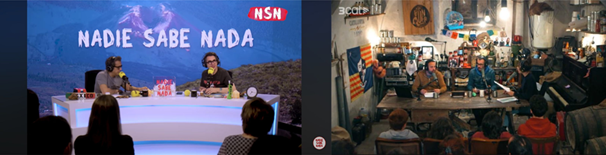
and YouTube, such as Nadie sabe nada from Cadena SER or El búnquer from
Catalunya Ràdio.
Figure 1. The Nadie sabe nada and El búnquer sets
Source: YouTube and Spotify.
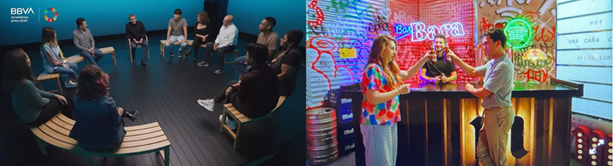
Another notable research finding concerning production is the presence of spaces promoted by brands, known as branded podcasts. Examples include Aprendemos juntos, sponsored by BBVA, and Una caña con…, sponsored by Mahou beer (see Figure 2). This highlights the potential of videopodcasting as a vehicle for branded content. At present, however, the number of companies investing in video podcasting remains limited—likely due to the novelty of the format and its comparatively higher production costs.
Figure 2. The Aprendemos juntos and Una caña con… sets
Source: YouTube and Spotify.
In response to RQ2, the majority of video podcasts are presented by one or two individuals, with a marked predominance of male hosts. Nevertheless, there are successful podcasts hosted exclusively by women and supported by a strong feminist community, such as Deforme Semanal Ideal Total and Estirando el chicle (López-Villafranca, 2024). This male dominance echoes findings from both national and international research into the podcast format (Antunes & Salaverría, 2018; Gamir-Ríos & Cano-Orón, 2022; Werner et al., 2020), indicating that disparities by sex persist at the forefront of these spaces. Video podcasting also appears to serve as a platform for individuals without prior media experience to enter the audiovisual field. Most current presenters do not come from the audiovisual industry, yet they are gradually gaining visibility and influence through their involvement in these productions. Also noteworthy is the emergence of figures from other domains—such as fashion, music, and social media influencers—taking on hosting roles in video podcasts. One such example is designer Vicky Martín Berrocal, who hosts A Solas Con…, a video podcast that received the 2024 Ondas Global Podcast Award in the Newcomer category.
Addressing RQ3, the most common video podcast format is the conversational style centered on general topics delivered in an entertaining tone. New podcasts of this type and theme continue to emerge at a steady pace (López-Villafranca, 2024). At the same time, the growing presence of narrative monologues with an educational tone focused on emotional wellbeing is noteworthy. These emotional wellbeing and self-help podcasts demonstrate a clear continuity in video podcast form and reflect an increasing trend toward not only listening, but also watching, as part of the user experience.
Regarding RQ4, which refers to formal aspects, most video podcasts are published weekly and run for between one and two hours. Conversational podcasts tend to be longer, aligning with the findings of López-Villafranca (2024), who attributes this in the case of Spotify to the “achievement of that sense of belonging to the community and interaction that most of these sound productions aim to foster” (2024: 246). On YouTube, consumption habits vary, but they point to user loyalty. In fact, there is a trend towards longer runtimes than traditional audio podcasts, which usually do not exceed 50 minutes (Terol-Bolinches et al., 2022).
As for RQ5, concerning technical aspects, given that the format incorporates video in addition to audio, it requires a recording set-up that involves specific technical and audiovisual resources. The professionalisation of the format is reflected in the fact that most video podcasts are recorded on professional sets and include audiovisual production, although some initially began on home setup sets. This set-up enables the use of graphic elements, decoration, and color palettes, which contribute to building the format’s brand identity and help foster a stronger connection with audiences (López-Villafranca, 2024). This also extends to those podcasts recorded in the hosts’ homes, which, although mostly unproduced, convey a sense of intimacy by allowing viewers into their private space. In fact, many professional sets deliberately recreate domestic settings to project that same feeling of closeness.
In the case of
professional sets, audiences are sometimes present, al-
though this is not the norm and often depends on the nature of the set itself.
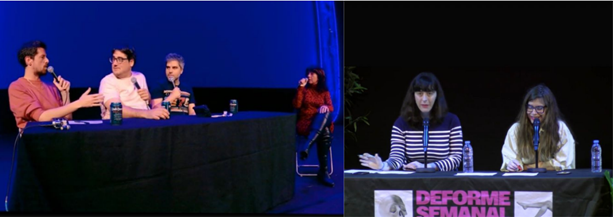
Notable examples include Deforme Semanal Ideal Total and La Ruina,
both of which are recorded with an audience in a theater setting (see Figure
3).
Figure 3. La Ruina and Deforme Semanal Ideal Total sets
Source: YouTube and Spotify.
Another key finding of the study is that TikTok is emerging as a platform for video podcast distribution to broaden reach. In fact, more than 60% of the video podcasts analyzed are present on TikTok, with conversational formats dominating. This reflects a strategic repurposing of audiovisual content into short clips distributed across multiple channels—such as TikTok—to reach a wider audience and employ platform-specific narrative styles, as observed in areas like science communication and institutional messaging (Alonso-López et al., 2024; Muñoz-Gallego et al., 2024).
In conclusion, the video podcast format has grown significantly, especially in conversational formats, and now demonstrates a higher degree of professionalisation. This development is supported by YouTube’s integration of the format—offering audiovisual access to content that was traditionally audio-only—along with its indexing and search engine optimization features, which enhance visibility. As López-Villafranca (2024) notes, digital natives are increasingly accustomed to image-based media and therefore value the option to both listen and watch. Originally audio-only, podcasts are now progressively integrating video to improve visibility, fueled by mobile and smartphone-based consumption. On Spotify alone, nearly half a million video podcast episodes were uploaded in the first half of 2024 (Stenberg, 2024). In this context, the present research enables a clearer characterization of the predominant video podcast formats on the two leading platforms: YouTube and Spotify. These formats are largely native, conversational, and generalist in theme with an entertainment focus. They are independently produced, professionally executed, typically last between one and two hours, and are hosted by individuals without previous experience in cultural industries.
Another noteworthy development is the increasing presence of video podcasting on Spotify and YouTube, pointing to a convergence in user behavior. Users can access audiovisual content on either platform and choose to watch or listen without losing content, allowing for consumption tailored to personal habits. There is also convergence in production, as conversational podcasts are now being conceived with video in mind from the outset.
This study is not without limitations. The sample size required selection based on popularity, and some spaces were difficult to compare due to the varied functionality and access conditions across platforms.
Nonetheless, the findings open up new avenues for further research into the development of video podcasting and its relationship with content distribution on visual-centric platforms such as TikTok and Instagram.
Ethics and Transparency
Acknowledgements
We are grateful for the work of Liza D'Arcy, translator of the text of the article into English.
Conflict of Interest
The authors of this article declare that there is no conflict of interest.
Funding
This research has not received specific funding from any public or private entity.
Author Contributions
|
Contribution |
Author 1 |
Author 2 |
Author 3 |
Author 4 |
|
Conceptualization |
X |
X |
|
|
|
Data curation |
X |
X |
X |
|
|
Formal Analysis |
X |
X |
X |
|
|
Funding acquisition |
|
|
|
|
|
Investigation |
X |
X |
X |
|
|
Methodology |
|
|
X |
|
|
Project administration |
X |
|
|
|
|
Resources |
|
X |
|
|
|
Software |
|
|
|
|
|
Supervision |
X |
|
|
|
|
Validation |
X |
X |
X |
|
|
Visualization |
X |
X |
X |
|
|
Writing – original draft |
X |
X |
X |
|
|
Writing – review & editing |
X |
|
X |
|
Data Availability Statement
For access to the data underlying this article, please contact the authors directly.
References
Alonso-López, N., Sidorenko Bautista, P. & Ferruz-González, S. A. (2024). Administraciones públicas en TikTok. Comunicación, narrativa y frecuencia de publicación de los perfiles de los ministerios de España. Revista De Comunicación, 23(1), 33–51. https://doi.org/10.26441/RC23.1-2024-3451
Antunes, M. J. & Salaverría, R. (2018). PodcastSpain: análisis de los pódcast de audio más populares en iTunes de España. In: VV. AA., Actas del VI Congreso Internacional de la AE-IC, Comunicación y Conocimiento. Libro de comunicaciones (pp. 1753-1770). Asociación Española de Investigación de la Comunicación. https://dadun.unav.edu/handle/10171/55806
Berelson, B. (1952). Content analysis in communication research. Free Press.
Berry, R. (2016). Part of the establishment: reflecting on 10 years of podcasting as an audio medium. New Media Technologies, 22(6), 661-671. https://doi.org/10.1177/1354856516632105
Bonini, T. (2015). The «Second Age» of Podcasting: reframing Podcasting as a New Digital Mass Medium. Quaderns del CAC, 41(14), 23-32: https://www.cac.cat/sites/default/files/2019-01/Q41_Bonini_EN_0.pdf
Burns, M.J. & Blancaflor, S. (11 de enero de 2023). Podcasters first wanted your ears. Now they want your eyes too. Morning consult. https://links.uv.es/Do5DwiD
Calvo, J. (12 de julio de 2022). Spotify expande sus funciones de vídeo pódcast a España. El Economista. https://tinyurl.com/3hk44p74
Cheta,
W. & Eberechukwu,
A.S. (2018). Podcast versus
vodcast and student’s academic achievement in information and communication
technology (ICT) a research course. British Journal of Education, 6(1).
https://tinyurl.com/mr33duzu
Cumulus Media and Signal Hill
Insights (2022). Podcast Download - Spring 2022 Report from the cumulus podcast
network.
https://tinyurl.com/ykdpxafy
Díaz Monsalvo, M.A. (2024). Modelo metodológico de uso de pódcast y vodcast como material académico universitario. Vivat Academia, 157. https://doi.org/10.15178/va.2024.157.e1547
Espinosa De Los Monteros, M.J. (2019). Las notas de audio de WhatsApp en la era de la audificación. The Objective. https://tinyurl.com/5n77hvw6
Freelon, D. (2013). Recal OIR: Ordinal, interval, and ratio intercoder reliability as a web service. International Journal of Internet Science, 8(1), 10–16. https://tinyurl.com/4e555urc
Gallego Pérez, J.I. (2010). Podcasting: Nuevos modelos de distribución para los contenidos sonoros. Editorial UOC.
Gamir-Ríos, J. & Cano-Orón, L. (2022). Characteristics of the Spanish podcast sphere. Between democratization and commercial logic. Profesional de la Información, 31(5), https://doi.org/10.3145/epi.2022.sep.05
García-Marín, D. (2022). Entre la radio y YouTube. Fenómenos de remediación en la identidad del pódcast. In: (Ed.). P. Sidorenko Bautista, J. M. Herranz de la Casa, R. Terol Bolinches y N. Alonso López Narrativas emergentes para la comunicación digital ISBN: 978-84-1122-375-1
García-Marín, D. & Aparici, R. (2018). Nueva comunicación sonora: cartografía, gramática y narrativa transmedia del podcasting. Profesional de la Información, 27(5), 1071–1081. https://doi.org/10.3145/epi.2018.sep.11
Guerrero-Navarro, D., Cristófol-Rodríguez, C. & Aguilera-Borrego, A., (2023) El formato podcast en la nueva comunicación en moda: casos Ivoox y Spotify. Redmarka. Revista De Marketing Aplicado, 27(2), 19–37. https://doi.org/10.17979/redma.2023.27.2.9898
IAB (2023). Top Tendencias Digitales. https://tinyurl.com/5uszap94
Igartua Perosanz, J.J. (2006). Métodos cuantitativos de investigación en comunicación. Bosch.
Infoadex (2024). Estudio de la inversión publicitaria en España. https://www.infoadex.es/home/
Izuzquiza, F. (2019). El Gran Cuaderno de Podcasting: Cómo crear, difundir y monetizar tu pódcast. Kailas Editorial.
Johansson, C. (2021). YouTube podcasting, the new orality, and diversity of thought: intermediality, media history, and communication theory as methodological approaches. In: S. Petersson (Ed.). Digital human sciences: new objects-new approaches. Stockholm University Press, (pp. 253-284). https://doi.org/10.16993/bbk.k
Krippendorff, K. (2004). Content analysis: An introduction to its methodology. Sage.
López-Villafranca, P. (2024). El video podcast en Spotify España. Un formato dirigido a la generación Z que marca tendencia en la industria del audio digital. Revista Mediterránea de Comunicación, 15(1), 235–250. https://doi.org/10.14198/MEDCOM.25498
Martínez-Costa, M.P., Amoedo-Casais, A., & Moreno-Moreno, E. (2022). The value of podcast to journalism: analysis of digital native media brands´ offerings, production and publishing in Spain. Profesional de la Información, 31(5). https://doi.org/10.3145/epi.2022.sep.03
Martínez Otón, L., Castillo Lozano, E., Martín-Nieto, R., Pedrero Esteban, L.M. & Pérez-Escoda, A. (2023). La producción de branded podcast en España: análisis de la oferta original en las plataformas de audio digital en 2022. Ámbitos: Revista Internacional de Comunicación, 62, 49-68. https://doi.org/10.12795/Ambitos.2023.i62.03
Miranda, L. (21 de julio de 2020). Los videopodcast llegan por fin a Spotify para hacerle frente a YouTube. Hipertextual. https://links.uv.es/wfUj5aE
Moreno-Espinosa, P., Román-San Miguel, A. & Flores-Vivar, J.M. (2021). The evolution of audiovisual news in the opinion of its creators: From on-demand television to vodcasting. Revista de Comunicacion, 20(2), 303–318. https://doi.org/10.26441/RC20.2-2021-A16
Muñoz-Gallego, A., Giri, L., Nahabedian, J.J. & Rodríguez, M. (2024). Narrativas audiovisuales en Tik Tok: nuevos desafíos para la comunicación pública de la ciencia y la tecnología. Revista Mediterránea De Comunicación, 15(1), 144–162. https://doi.org/10.14198/MEDCOM.25481
Neuendorf, K. A. (2002). The content analysis guidebook. Sage.
Newman,
N. & Gallo,
N. (2019). News podcast and the opportunities for publishers. Reuters
Institute, University of Oxford, 8–9.
https://tinyurl.com/459ecz49
Novoa-Jaso, M.F., Sierra A., Labiano, R. & Vara-Miguel, A. (2024): Digital News Report España 2024. Calidad periodística y pluralidad: claves para la confianza informativa en la era de la inteligencia artificial (IA). Pamplona: Servicio de Publicaciones de la Universidad de Navarra. https://doi.org/10.15581/019.2024
Pedrero-Esteban, L.M. (2024). Cómo suenan los podcasts en España y Argentina. Radiografía de la producción original plataformas y productoras de audio en 2023. Fundación Antonio de Nebrija. https://links.uv.es/CIDjJt8
Pedrero-Esteban, L.M., Martínez Otón, L. & Escobedo Pareja, E. (2023). El audio digital en la era omnicanal: contenidos, formatos y métricas. In M. Perlado Lamo de Espinosa, N. Papi Gálvez y M. Bergaz Portolés (Coords.), Audiencias y medios digitales: más allá del dato, (pp. 83–94). Tirant Lo Blanch.
Pérez-Alaejos, M., Terol-Bolinches, R. & Barrios-Rubio, A. (2022). Podcast production and marketing strategies on the main platforms in Europe, North America, and Latin America: Situation and perspectives. Profesional de la Información, 31(5). https://doi.org/10.3145/epi.2022.sep.22
Prodigioso Volcán (2023). IV Estudio de audio y voz. Evolución del sector en España: cifras y perspectivas. https://links.uv.es/GJh5RFv
Sellas, T. (2009). La voz de la Web 2.0. Análisis del contexto, retos y oportunidades del podcasting en el marco de la comunicación sonora. [Tesis Doctoral inédita]. Universidad Internacional de Catalunya. http://hdl.handle.net/10803/9351
Stenberg, M. (2024). Spotify Is Ready to Compete for Video Advertising. Adweek. https://links.uv.es/bZ1Flmw
Terol Bolinches, R., Pedrero Esteban, L.M. & Alonso López, N. (2021). Educasting: El pódcast como herramienta de expansión educativa universitaria. In M. Pallarés, J. Gil-Quinta y E. Santisteban (Eds.), Docencia, ciencia y humanidades: hacia una enseñanza integral en la universidad del siglo XXI. (pp. 274-293). Dykinson.
Toffler, A. (1980). La tercera ola. Plaza y Janes.
Tur
Ferrer, G. (2013). Percepciones del alumnado de grado de educación
infantil en torno a la creación de audio y vídeo podcast para la enseñanza y
aprendizaje de lenguas extranjeras. Edutec, Revista Electrónica De
Tecnología Educativa, (46), a257.
https://doi.org/10.21556/edutec.2013.46.42
Werner, J. L., Lewiss, R.E., Pensa, G. & Mcgregor, A.J. (2020). Women in podcasting: we should tune in. The Permanente journal, 24, 1–3. https://doi.org/10.7812/TPP/19.241