index●comunicación
Revista científica de comunicación aplicada
nº 15(2) 2025 | Pages 191-220
e-ISSN: 2174-1859 | ISSN: 2444-3239
Organisational Culture as a Key Intangible Asset: A Descriptive Review
La cultura organizacional como intangible clave: una revisión descriptiva
Received on 10/10/2024 | Accepted on 19/03/2025 | Published on 15/07/2025
https://doi.org/10.62008/ixc/15/02Lacult
Natalia Abuín Vences| Universidad Complutense de Madrid
nabuinve@ucm.esailto | https://orcid.org/0000-0002-4153-9390
Daniel Francisco García Rosales | IUNIT Centro de
Educación Superior de Negocios,
Innovación y Tecnología
daniel.garcia@iunit.edu.es | https://orcid.org/0000-0002-6022-9021
Abstract: Organisational culture is essential for creating brand value and reputational positioning. This intangible asset helps to ensure a strong competitive advantage and enhanced credibility with stakeholders. To conduct the descriptive review, a methodology based on the SALSA Framework was used. This study analyses the evolution of organisational culture, as well as its key levels, categories, purposes, design, and benefits, the aim of which is to clarify the concept. Despite ambiguity related to the term organisational culture, the findings reveal a recurrence of common attributes, as well as a variety of proposed categories, and a long-standing debate regarding the benefits of one type of culture over another. Moreover, the present research provides a structured and up-to-date view of the existing knowledge pertaining to this intangible asset.
Keywords: Corporate Communication; Organizational Culture; Intangible Resources;
Corporate Reputation.
Resumen: La cultura organizacional resulta clave en la generación de valor a las marcas y en el posicionamiento reputacional. Este recurso intangible ayuda a garantizar el aprovechamiento de ventajas competitivas fuertes y a ganar reconocimiento por parte de los grupos de interés. Para la realización de esta revisión descriptiva se aplica una metodología basada en Framework SALSA. En este trabajo se analiza la evolución de la cultura organizacional y sus principales niveles, clasificaciones, funciones, construcción y beneficios, con el objetivo de clarificar este concepto. Los resultados revelan la repetición de atributos comunes, a pesar de su ambigüedad, la variedad de clasificaciones propuestas y el debate prolongado con relación a los beneficios que puede aportar un tipo de cultura frente a otro. Esta investigación proporciona una visión estructurada y actualizada del conocimiento existente sobre este recurso intangible.
Palabras clave: comunicación corporativa; cultura organizacional; recursos
intangibles;
reputación empresarial.
To quote this work: Abuín, Natalia & García, Daniel Francisco. (2025). Orgasinational Culture as a Key Intangible Asset: A Descriptive Review. index.comunicación, 15(2), 191-220. https://doi.org/10.62008/ixc/15/02Lacult
1. Introduction
A total of 90% of corporate capitalisation in the Standard & Poor's 500 index consists of intangible assets, with only 10% derived from financial sources, a situation that was just the opposite 40 years ago (Ocean Tomo, 2022). Nowadays, measuring the profitability of intangible assets is especially complex for organisations (De Freitas, 2021). The problem is that these assets have no value on their own, but must be combined in order to become a source of economic benefit. Consequently, intangibles are interconnected and have a mutual influence on each other.
Given this situation, the management and care of intangibles is a source of financial and commercial value. Developing strategies focused on respect for relationships, quality in services and products, and the management of social responsibility programmes, is the key to creating brand value. Corporate communication contributes to reputational positioning and credibility with stakeholders, who simultaneously demand proper management of the corporate culture and a strategic direction for communication (Báez et al., 2017).
The foregoing issues reflect the need to analyse the role of organisational culture as a key intangible asset for generating value for companies, by highlighting its design, purpose, and benefits. Organisational culture has been widely studied in the field of communication as a key factor in the creation, dissemination, and transformation of values, norms, and beliefs in an organisation. The present study has compiled and organised diverse information regarding organisational culture, thereby enabling the concept to be understood, while at the same time avoiding ambiguities by differentiating this type of culture from related terms such as organisational climate, corporate values, and corporate reputation. Accordingly, this research is structured around five thematic blocks as follows: an approach to the concept of organisational culture; its levels; its classifications; its creation and purposes; and the benefits it offers.
2. Methodology
This article is based on a descriptive review of the literature that analyses organisational culture as a key intangible asset of companies. The review is descriptive, as it analyses the evolution of the concept of organisational culture and its main levels, classifications, purposes, creation, and benefits.
For this review, the SALSA Framework was used to explore the relationships and patterns between key concepts within organisational culture. Firstly, the pertinent literature regarding organisational culture was identified, which was indexed in prominent databases, including scientific articles in JCR, Scopus, ESI, CIRC, and Latindex, as well as books and book chapters issued by renowned publishers, which are indexed in SPI and BCI. The search was aimed at studies that focus on the definition of organisational culture and its features, which include values, norms, beliefs and symbols, as well as the relationship of this concept with other key factors such as leadership, innovation, performance and change management, along with its main theoretical models. To conduct the search, the key phrase organisational culture was used, both in English and Spanish, in the databases of Google Scholar, Scopus and Web of Science. This choice may have limited the scope of the literature, as related concepts such as organisational climate, corporate values, organisational identity, and dynamics were left out of the review. However, this constraint was useful in establishing a clear and manageable framework, thereby avoiding thematic dispersion and ensuring that the selected studies focused on organisational culture as the central concept of the analysis.
In conducting this review, the main scientific publications on the subject were selected, mostly covering the period from the 1980s to the present day, in order to reflect the most recent developments of the concept. In total, 88 papers were consulted, the oldest having been published in 1966, with the most recent from the current year of 2025. Given that company communication is one of the pillars of organisational culture, the start date of the search began with the 1960s, a period preceded by the emergence of studies in communication and organisational theory. Although the concept of organisational culture was consolidated by Schein (1984), its ideas regarding values, norms and symbolism in organisations were already being discussed in the 1960s. The point of departure for the present research was set in 1966, starting with Katz and Kahn (1966), who applied systems theory to the study of organisations in order to explore how norms, values and structures of interaction within organisations influence their behaviour, which is an aspect directly linked to organisational culture.
To consolidate the references, the following parameters were used: author and year of publication, study objective, methodology, main findings, conclusions, and relevance of the research. To ensure a comprehensive analysis of the topic, and to obtain essential information from each reference, the following criteria were applied: definitions proposed by different authors; differences between organisational culture and related concepts; models that describe the levels of organisational culture; the relationship between cultural levels and organisational change; the most commonly used typologies of organisational culture; and finally, factors that influence the construction of organisational culture.
Once the most pertinent articles and studies had been collected, they were analysed in order to identify common patterns and differences in theoretical approaches. From this analysis, the studies were arranged into five thematic blocks:
a) Approach to the concept of organisational culture.
b) Its levels.
c) Its classifications.
d) Its construction and purposes.
e) Its benefits.
The structure of this research reflects a progressive and systematic logic that has allowed the development of a comprehensive understanding of organisational culture based on the literature reviewed. Each block addresses a fundamental aspect of the concept.
After the structure was established, the information obtained was combined and condensed in order to summarise the main findings of the theoretical models and empirical studies, and to develop a conceptual framework of organisational culture. Finally, a discerning appraisal of the current state of knowledge on organisational culture is offered, highlighting the strengths and limitations of existing research.
3. Results
3.1. Approaching the concept of organisational culture
Organisational culture is gaining importance, while at the same time becoming more ambiguous, as it is used to refer to multiple aspects, examples of which include the environment and values of a company. It is therefore essential to clearly define and understand its meaning.
Research on corporate culture began in the 1930s. The final phase of Hawthorne's well-known studies at the Western Electric Company was the first systematic attempt to use the concept of culture to understand the work environment. Although the pioneering efforts of Hawthorne represented a major breakthrough in qualitative research, scarce progress was made in the following decades. In the 1970s, interest in corporate culture reappeared, mainly due to the arrival of many foreign companies in the United States, which generated a strong competitive environment. The success of Japanese companies in various sectors encouraged experts to investigate whether this was due to differences in values, attitudes and behaviour (Tharp, 2009).
In 1982, Tom Peters and Robert Waterman published a book titled, In Search of Excellence, in which they assert that the key to business success lies in corporate culture (Fisher, 2000). The book aroused great interest in both popular and professional spheres. Since then, corporate culture has become one of the most influential concepts in business management, yet one of the most debated as well (Crane, 1995; Jarnagin & Slocum, 2007).
Many companies focus on instilling social and solidarity-related values in future generations. Respect for the environment is communicated, either implicitly or explicitly, in the new advertising paradigm. Corporations are disclosing their values in order to share their beliefs with their audience and regain lost trust. The new approach to advertising and marketing communication, especially since the great recession, has been forced to focus on building trust (Viñarás et al., 2015). Such communication is not only a tool of external persuasion, but also a mirror of an organisation's identity and values, thereby making it a key medium for building its company culture. Based on this relationship, previous concepts are used to analyse how organisational culture influences communication strategy, and is influenced by it as well.
There are many ways to define corporate culture, as it is strongly impacted by factors such as the industry in which the company operates, its geographical location, the events that have occurred throughout its history, the personality of its employees, and their patterns of interaction (Sadri & Lees, 2001). Most researchers agree that shared values, or an organisational value system, are a key feature of this concept (Weiner, 1988). In this regard, organisational culture has traditionally been defined as a pattern of shared values and beliefs that persist over time, which produces standards of behaviour that are embraced by the employees for the purpose of solving problems (Owens, 1987; Chiavenato, 1989; Schein, 1990; Robbins, 2009; Salazar et al., 2009; Cújar et al., 2013; López Posada, 2016). As pointed out by Schein (1985), culture is a set of solutions to problems that have consistently worked well, which must be taught to new members as the correct way of perceiving, thinking and feeling about those problems. López Posada (2016) suggests that the culture of a company, or group of companies, implies that the employees must relate primarily to the set of values, needs, expectations, beliefs, policies and norms generated, which have been historically accepted and practised by the actors and agents of the organisation. As a way of obtaining conceptual synthesis, and following the ideas of Robbins (2009), the culture of an organisation refers to a system of shared meaning, which is shaped by the common perception of the members that make up the organisation. Along the same lines, Salazar et al. (2009) point out that the members of an organisation largely determine its culture. In this regard, the organisational climate has a direct influence on company culture, because the perception of individuals significantly determines the beliefs, myths, behaviours and values that comprise an organisation's culture. According to López Posada (2016), these beliefs and meanings become internalised by the members of the organisation, within the framework of a hegemonic order, which becomes the symbolic horizon of interpretation that guides the behaviour and practises of the workers.
This system of values and beliefs is shaped by the structure of organisations, technology, and the internal and external environments, which produce norms of thought and action that are shared by all members (Rodriguez Fernandez, 1993). This set of rules, values and ways of thinking reflects the behaviour of the staff at all levels of the organization, while at the same time displaying the institution's image to the outside world (Segredo et al., 2017). Organisational culture is a mixture of endogenous variables and exogenous factors, which is considered a socio-structural system consisting of relationships between configurations, strategies, policies and other formal management practises. It consists of a cultural system that brings together the expressive and affective aspects of the organisation into a collective system of meaningful symbols, such as viewing employees as individuals, with their talents, experiences, and personalities, and as creators, shapers and unifiers of relevance, who actively develop a coherent organisational reality from the continuous flow of events (Allaire & Firsirotu, 1992).
Organisational culture is the result of taking various external cultures, or macro cultures, which are received from the environment, such as those of a national, regional, social, or other nature, and combining them with the internal subcultures, or microcultures, of the different groups within the company (Menguzzato & Renau, 1991). Among other aspects, culture is an imprint that reflects the way companies perceive the work they carry out and their relationship with the environment, while at the same time it differentiates their company from other organisations in the same sector and geographical location (Podestá, 2009). Contemporary organisations must define their corporate identity to serve as a bridge between the external position of the organisation in its particular market, other relevant environments, and the internal meanings shaped within the company’s culture (Hatch & Schultz, 1997).
In recent years, Schein and Schein (2017) have provided an updated review in which they define corporate culture as the cumulative and shared learning of a group, which helps to resolve its problems of external adaptation and internal integration. To be considered valid, this knowledge must be used to solve the difficulties that arise. Next, it should be passed on to the new members of the group as the correct way of perceiving, thinking, feeling, and behaving with regard to these problems.
According to Smircich (1983), the organisational culture comes from the convergence of two theories: the Theory of Culture, and the Theory of Organisation. Based on this idea, Garmendia (1988) proposed three definitions of company culture:
a) Culture as a consolidation of the environment. Business management is strongly influenced by the environment, from which it receives clear guidelines for action.
b) Culture as an internal, strategic design. Culture is not only shaped and influenced by the environment, but organisations also create culture. The way of organizing work, the hierarchical structure, and all aspects of internal management determine corporate culture.
c) Culture as self-image. The image that members have of their own organisation is made up of shared values, symbols and meanings.
In the view of Van Maanen and Barley (1985), it is more appropriate to speak of “cultural organisation” rather than “organisational culture”, as multiple cultures co-exist within organisations. Thus, these authors consider the work group to be a more appropriate unit of analysis than the organisation as a whole. In this context, culture arises from the learning that takes place within groups. Organisations do not have only one culture, but several cultures, which makes it more complicated to implement change (Weick, 1995). Culture within organisations refers to the acquisition and transmission of behavioural patterns over time, which implies that organisational culture tends to be stable and not prone to fast changes (Camacho, 2007). Thus, within an organisation there may be a predominant culture along with various subcultures (Van Maanen & Barley, 1985). From this point of view, organisational culture is seen as the convergence of the interpretative systems of the diverse cultures that are present in the framework of the dominant culture. In this regard, Fleury (1989) stresses the importance of including the political aspect in the concept of culture, since power is one of its key components. Culture is made up of basic values and assumptions expressed through symbolic features which, given their ability to create an order, or rank, provide meaning and create organisational identity. Moreover, they serve not only as components of communication and consensus, but also as a means of concealment and an instrument of power relations.
Bower (1966) defined culture as the way each organisation carries out its activities, which is often expressed by the following statement: “That’s the way we do things around here”. Years later, Mayo (1991) accepted the idea and added that organisational culture results from the interaction of six distinct factors. Some are intangible and difficult to observe, while others are openly expressed in internal documents and perceptible behaviour. These factors are as follows:
a) Values and beliefs.
b) Rules of behaviour.
c) An organisation's written policies.
d) Top-down motivation.
e) Formal and informal systems and processes.
f) Internal networks within the organisation
Peiró (1997) defined organisational culture as the system of beliefs and assumptions of an organisation, as well as the interpretation of relevant events and phenomena within the entity. This definition refers to cultural content that involves a training process based on learning shared meaning (Sánchez et al., 2006). According to Álvarez-Nobell et al. (2012), organisational culture is created by the interrelationship of processes such as the adoption of the company's philosophy, the sense of belonging, adaptation, satisfaction, and shared leadership within the group. This set of categories can be identified by a matrix that includes sub-categories or concepts, along with a set of characteristics that can be observed in the internal audience.
Villafañe (1999) suggests that organisations, like individuals, have a type of corporate psyche that houses a variety of features related to behaviour, attitudes, beliefs, assumptions, rituals and customs, some of which are specific and observable, which makes them subject to intervention when needed. These features comprise what might be called corporate conscience. However, other aspects are revealed either implicitly, or through explicit behaviour, which reflect latent meanings and attitudes that can only be observed indirectly and are part of the corporate unconscious. Both features make up the culture of an organisation.
Between the corporate realms that are conscious and unconscious, there are other qualities that also express culture, such as certain behaviour patterns and customs that provide access to culture-specific meanings, which are related to the pre-conscious level of the corporate psyche (Villafañe, 1999). Along these lines, Serrate et al. (2014) assert that organisational culture is a social construct derived from two distinctly human categories—communication and activity— which are continuously influenced by the wider social system. Culture represents the set of symbols that gives meaning to activity and guides people's behaviour in the workplace, which is expressed in tangible and intangible indicators that can be measured in relation to the organisation's objectives.
Herbert (2000) defines culture as the glue that holds the organisation together, incorporating values, rules of conduct, policies and procedures. Aguirre (2004) described it as a set of essential, interactive features, which are produced and shared by the organisation in order to achieve its objectives. These elements create cohesion and provide identity, which must then be taught to new members. Hofstede (1991) describes corporate culture as the collective programming of the mind that differentiates the members of one organisation from another. The novelty of this definition is that corporate culture resides in the minds of an organisation's members, and not just in the mindset of managers and senior executives.
Erez and Early (1993) define organisational culture according to four groups of variables:
a) Cultural values and norms: criteria used to evaluate management techniques.
b) Management and motivational techniques: how these strategies help individuals achieve their goals, in addition to enhancing their self-esteem and well-being, which are defined in terms of cultural values.
c) The “Self” as an information processor and interpreter of organisational stimuli.
d) Cultural values and work behaviour, resulting from the above variables, such as different indexes of work behaviour, attitudes toward the quantity and quality of work, and isolating behaviour as opposed to an active and involved position in the organisation.
As one can see, despite the considerable number of highly distinct definitions of organisational culture, we have identified three attributes that are found in most of them (Tharp, 2009):
a) The existence of shared meaning.
b) The idea that corporate culture is socially constructed and influenced by the environment as well as the history of the organisation.
c) The assumption of its presence at all levels of the organisation.
Schein (1984) identifies three levels at which corporate culture manifests itself:
a) The level of explicit behaviour.
b) The level of values.
c) The level of basic assumptions.
3.2. Levels of organisational culture
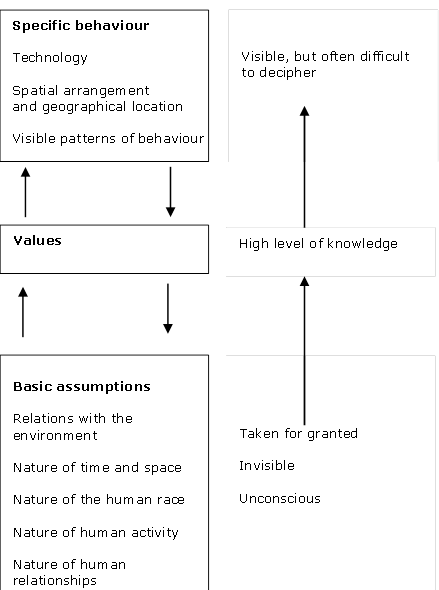
Explicit behaviour, which Schein (1984) calls “artefacts”, is the most visible and external level of organisational culture, and is determined by the structure and processes of the organisation, including the physical environment and the people who make up the entity. These features are both observable and tangible, which enables the organisation's culture to be studied. This includes the spatial arrangement of the members, the geographical location of the organisation, the staff's dress, behaviour patterns, language, visible symbols, style, work processes, and written rules. This level reflects the expression of culture, yet not its essence, which makes the culture difficult to evaluate, because although the data is easy to obtain, it is difficult to understand.
Shared values allow the behaviour of a specific group to be understood. They are difficult to observe directly, so they must be inferred from explicit behaviour. The basic assumptions, or underlying suppositions, reflect the deepest level of the culture and allow it to be truly understood. Not only are they unconscious, but they also determine the way members perceive, think and feel. They have their origin in shared values. The levels of culture developed by Schein (1984) are shown below (Figure 1).
Figure 1. The levels of organisational culture and their interaction
Source: prepared by the authors based on the work of Shein (1984).
This distinction between levels is not always clear nor easy to identify on a practical level. Hatch (1993) challenges the rigidness of the level distinction proposed by Schein (1984) and introduces instead a model in which organisational culture is seen as a dynamic and interdependent process. In this circular and continuous system, four basic components are continually interrelated and provide feedback: artefacts, values, basic assumptions, and context. Along the same lines, the approach by Martin (2001) also opposes the vision offered by Schein (1984), with regard to static levels of culture, as she emphasises the diversity, conflict, and multiple interpretations that exist within the same organisation. Her contributions are based on the idea that culture is multidimensional.
Complementing the previous approach, Denison (1990) does not emphasize the levels of organisational culture offered by Schein (1984), but instead focuses on how cultural traits impact organisational effectiveness by identifying four key dimensions:
a) Involvement: the level of commitment and empowerment of employees.
b) Consistency: the presence of shared values and systems that foster cohesion.
c) Adaptability: the organisation's degree of responsiveness to changes occurring in the surrounding environment.
d) Mission: clarity in strategic objectives and a long-term vision.
These cultural traits have a direct impact on an organisation’s performance, as they are related to profitability, growth, and employee satisfaction.
3.3. Classifications of organisational culture
Over the years, various classifications of corporate culture have been proposed. Among the most frequently cited are those of Harrison (1972), Handy (1993), Quinn and Rohrbaugh (1983), and Hofstede (1983), whose ideas are outlined below.
For Harrison (1972) and Handy (1993), culture is a kind of corporate ideology expressed by how each organisation manages certain processes. These include its ways of thinking and learning, the power relationships within the organisation, the ways of influencing and achieving change, and the instruments of motivation and reward. These factors can be grouped into four general variables:
a) Supra-cultural values.
b) Relationships of influence and power.
c) Ways of thinking and learning.
d) Instruments of motivation and reward.
Based on these variables, Handy and Harrison identify four types of corporate culture:
a) Power culture.
b) Purpose culture.
c) Task culture.
d) People culture.
Power culture is described as highly centralized yet very informal (Salumaa, 2007). Power in the organisation resides in an autocratic leader who, like a spider in a web, steers the organisation. There are few rules and scant bureaucracy. The members of the organisation tend to move as close as possible to the centre, which is the source of power. Consequently, the internal climate of the organisation is highly susceptible to manipulation and intrigue. In this system, the main logic is the hierarchical differentiation of power and status (Trompenaars & Woolliams, 2002).
Purpose culture is also highly centralized, but very formal (Salumaa, 2007). This type of culture is highly structured, where control is exercised through rules, legal procedures, and the assignment of rights and responsibilities. The bureaucracy and high degree of formality make these organisations rigid and very inflexible (Trompenaars & Woolliams, 2002).
Task culture is very formal, yet only slightly centralized (Salumaa, 2007). In an ideal scenario, this type of rational culture is oriented toward tasks and projects. Organisational relationships are results driven, based on rational and instrumental considerations, and they focus on specific, role-based aspects of the people involved. Management of the organisation is considered a continuous problem-solving task (Trompenaars & Woolliams, 2002).
In the People culture, the levels of both formality and centralisation are low (Salumaa, 2007). In these organisations, the individuality of the members is the key feature. The aim of the organisation is to satisfy the specific needs of the individuals, and it has no inherent values beyond this objective (Trompenaars & Woolliams, 2002). It bears mentioning that the genuine culture of an organisation is always a combination of these four types, as there is no such thing as a pure culture (Villafañe, 1999).
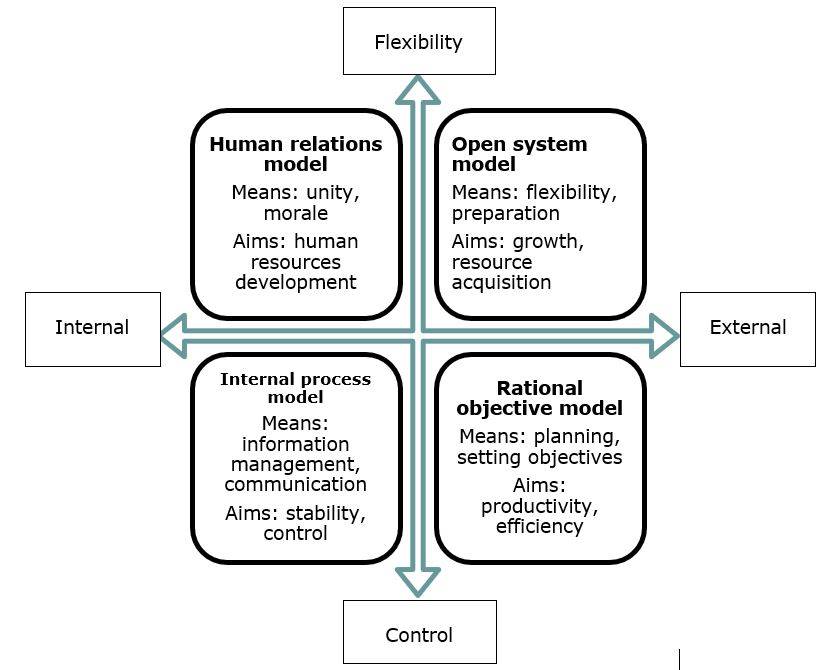
In 1983, Quinn and Rohrbaugh laid the groundwork for the Competing Values Framework (CVF), with the intention of identifying indicators of corporate efficiency. In a review of the scientific literature on the subject, Campbell (1977) identified 30 different criteria of organisational efficiency. Quinn and Rohrbaugh (1983) argued that the choice of specific criteria generally reflects personal values in the domain of efficiency. These authors invited 52 organisational researchers to rank the criteria listed by Campbell (1977), after which the scholars described three dimensions of value: internal-external, control-flexibility, and means-ends.
The CVF models developed by Cameron and Quinn (2006) are shown below (Figure 2).
Figure 2. Competing Values Framework
Source: prepared by the authors based on Cameron and Quine (2006).
The Competing Values Framework analyses individual leadership behaviour, as well as how this behaviour engenders competencies and, most importantly, how these skills create specific types of value. In their research, Quinn and Rohrbaugh point out that efficient companies manage two balancing acts: the first is focus, in which some companies become efficient by prioritising internal processes, while others are efficient because they maintain an external competitive position; the second balancing act is stability, as some organisations are efficient because they are flexible and adaptable, while others achieve efficiency through stability and control.
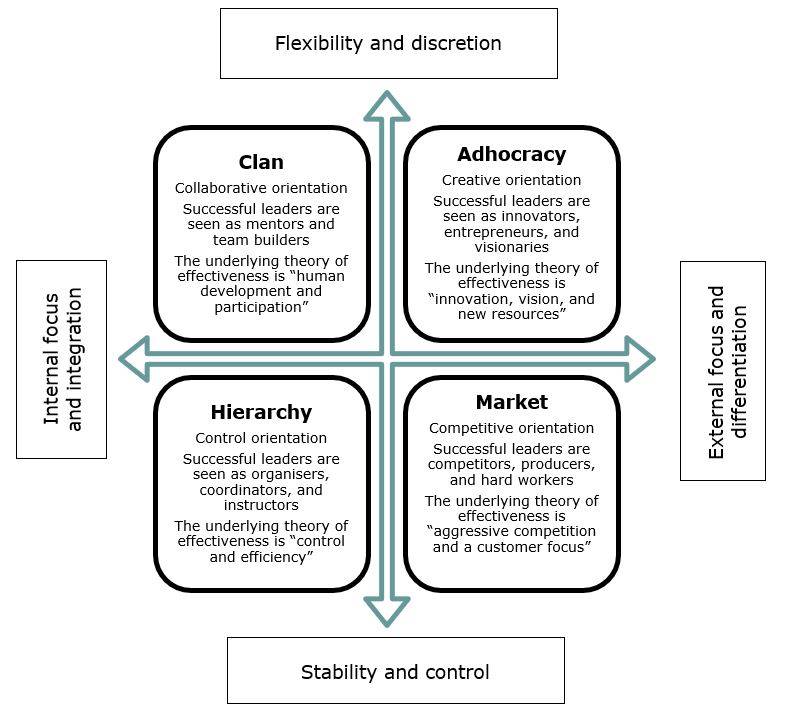
Using the CVF as a reference, Cameron and Quinn (2006) identified four types of corporate culture: hierarchy (control); clan (collaboration); adhocracy (creation); and market (competition). These types of culture are detailed below in Figure 3.
Figure 3. Types of corporate culture
Source: prepared by the authors based on Cameron and Quinn (2006).
Although one of the most widely referenced theoretical frameworks is the Competency-Based Value Model, research studies have acknowledged shortcomings in the adaptation of traditional instruments (Reyes & Patlán, 2024). According to Durán et al. (2025), there is no ideal, universal model for measuring organisational culture, as each company has its own unique characteristics. These authors propose a hybrid model that integrates the most relevant features of existing models to obtain a model that can be adapted to different business contexts. Depending on the style of organisational culture developed, companies promote key variables of stability, organisation, adaptability, market orientation, consistency, uncertainty, and hierarchy, with the aim of improving their performance and competitiveness.
Hofstede (1983) postulated that a culture could be classified by comparing the degree of individualism with collectivism, which is the apparent metric of the distance of the employees from the power structure, and the tendency to avoid uncertainty. As a result, this author outlines six practical features related to orientation:
a) Process vs. results.
b) Employee vs. work.
c) Local vs. professional.
d) Open system vs. closed system.
e) Lax control vs. strict control.
f) Normative control vs. pragmatic control.
However, according to Earley & Gibson (1998), individualism and collectivism are not diametrically opposed. Instead, these authors believe the two can coexist within an organisation, depending on the context and type of task in question. In this regard, Hampden-Turner & Trompenaars (1997) suggest that individualism and collectivism can be combined to varying degrees within an organisation, depending on the situation and industry.
Along the same lines, as the values and individual characteristics of employees converge with organisational values to influence the performance, culture, and well-being of an organisation, Schneider (1990) explored the concepts of organisational climate and culture. In his work, he presents a conceptual framework that focuses on how the fit between a person and the organisation (P-O Fit) is influenced by perceptions of the company environment, as well as the underlying values of the organisational culture. Schneider's theory, known as ASA (Attraction-Selection-Attrition) (1987), proposes three key processes that influence the creation of an organisation’s culture:
a) Attraction: People are attracted to organisations that share their values and traits.
b) Selection: Once people become attracted to an organisation, the latter selects the candidates who best fit in with its organisational culture and needs.
c) Attrition: People who do not fit in well with the organisational culture in terms of values, attitudes or behaviour tend to leave the company.
In this context, an organisational culture that encourages collaboration and continuous learning fosters the creation and effective flow of knowledge within the organisation. In their SECI model, Nonaka & Takeuchi (1995) describe how knowledge is created, shared and managed within organisations, thereby driving innovation and learning in four key stages:
a) Socialisation: the process of sharing implied knowledge between people through shared experience.
b) Externalization: the stage in which implied knowledge is converted into explicit knowledge through a process of codification, in which non-codified ideas and experiences are transformed into explicit concepts or models.
c) Combination: in this phase, different types of explicit knowledge are combined to create new explicit knowledge.
d) Internalisation: the process by which explicit knowledge is converted back into implied knowledge through its practical application.
Along the same lines, Senge (1999) believes that a culture of knowledge is a key component of the organisational culture of companies that make a strong effort to foster learning. Knowledge not only resides in individuals, but also in the organisational system, its processes, and culture. Organisational culture must facilitate learning and knowledge management so that the organisation can develop in a sustainable way. This implies changing traditional paradigms of control and hierarchy for a more collaborative and adaptable vision.
3.4. The creation and purpose of organisational culture
Over the years, there has been a long-standing debate regarding the benefits of one type of culture over another. However, the most widely accepted view in today's corporate environment is that there is not just one culture that is right for an organisation. Instead, there are a variety of cultures that more or less fit a particular situation at a given time (Recklies, 2001).
Likewise, one must also consider that creating a culture is never instantaneous. The founder's vision and mission reflect their values and beliefs, which lead to the formation of the initial culture. During the selection process, personnel managers have a preference for individuals with values similar to those preached and practised by the organisation (Adkins et al., 1994). After joining, values are instilled in the newcomers through training courses, mentoring, advice, interaction with other employees, participation in corporate events, and case studies (Suar & Khuntia, 2010).
In this development process, Schein (1985) explains that the founders and initial leaders establish the vision, values, and norms that comprise the basis of the organisational culture. Van Maanen & Schein (1979) describe how new employees learn and adopt the organisational culture through socialisation activities such as training and mentoring. Deal & Kennedy (1982) argue that organisational symbols, rituals, heroes and myths strengthen identity and cultural cohesion within companies. Kotter & Heskett (1992) explain how organisational cultures can be flexible or rigid, and how successful companies reinforce their culture by aligning it with their own business strategy. In reference to his ASA model, Schneider (1990) explains how organisations attract, select, and retain people who are compatible with their views, thereby reinforcing the culture over time.
It is necessary to point out that corporate culture has four basic purposes (Kreiner & Kinicki, 2004):
a) It confers a corporate identity on members, thereby giving meaning to their activity within the organisation.
b) It fosters a collective commitment: Organisational development is the result of a group effort, or in other words, there is an invisible link of emotion and feeling that unites employees to develop a collective commitment.
c) It promotes stability of the social environment, reflecting the extent to which the work climate is perceived as positive and reinforcing, thereby leading to effective management of conflict and change.
d) It shapes behaviour: This purpose helps employees understand why the organisation does what it does, and how it intends to achieve its long-term goals.
From a discursive approach, Alvesson (1993) points out that culture is not a permanent set of values or beliefs, but a dynamic process that is developed and negotiated through communication and discourse within the organisation. Organisational culture is constantly shaped and transformed through communication between members of the entity. In other words, verbal interaction, rituals, narratives and organisational symbols are fundamental for building collective meaning. By engaging in discourse, organisations create and maintain an identity that is shared by its members. Weick (1995) explores how individuals and organisations interpret and give meaning to their experiences and environment. This author uses the term sensemaking to describe the continuous social process by which people interpret events and actions, thereby constructing a shared understanding that guides organisational behaviour. He identifies seven key features of this process within organisations:
a) Identity and identification: The way individuals perceive themselves affects how they interpret events and situations.
b) Retrospect: People interpret what happens by observing what has happened in the past.
c) Action: The acts of individuals are not only responses to events, but also a way of creating the events themselves.
d) Social interaction: Engagement among people is fundamental for sharing and creating the meaning of events.
e) Continuity: This refers to the process on continuous evolution, depending on changes that take place regarding information and context.
f) Clues: The process of interpretation depends on the clues or signals that individuals gather from the environment.
g) Plausibility over accuracy: This feature pursues a plausible interpretation that makes sense to the members of the organisation, even in cases where it is neither perfect nor completely accurate.
Organisational culture and philosophy are concepts that sometimes overlap, yet they have different focuses and objectives. Schein (1985) defines organisational culture as a system of shared assumptions that develop over time and guide behaviour in the organisation. By contrast, organisational philosophy is more explicit and is usually imposed by leaders as a set of formal values and principles. For Deal and Kennedy (1982), culture is developed through rituals, symbols and myths that affect the behaviour of employees on the emotional and social level. Although philosophy establishes a clear direction for the company, it is not always reflected in the true culture of the organisation.
The interaction between emotion and organisational culture is crucial for developing a positive working environment. Härtel and Ashkanasy (2010) explore how emotion plays a key role in organisational communication, thereby contributing to the well-being and effectiveness of the working environment. Positive emotion encourages open and effective communication, while negative emotion can hinder interaction between team members. Moreover, corporate culture influences how emotions are experienced and expressed within the organisation. A healthy and positive organisational culture fosters the emotional well-being of employees and promotes collaboration and innovation. Zhang et al. (2023) explain that certain factors of organisational culture, such as psychological safety, collectivism, and the distance of employees from the power structure, influence the managerial contexts of social matters and performance which, in turn, improves innovation. An organisational environment that is well-structured, together with adequate resources and a culture that fosters psychological safety, can enhance innovation and efficiency.
Kotter and Heskett (1992) differentiate between organisational culture and philosophy, arguing that the former can be either adaptable or rigid, thereby influencing long-term success, while the latter represents a strategic direction of the company. However, if the company’s philosophy is not compatible with the existing corporate culture, it can be difficult to implement. Cameron and Quinn (2006) distinguish between the types of organisational culture indicated in the CVF, and those of philosophy, the latter of which is more focused on idealized norms defined by company leaders.
3.5. The benefits of organisational culture
According to a large part of the scientific literature, the main advantages of a positive corporate culture for the effective functioning of an organisation are the following, among others: organisational culture enables the company to achieve its objectives; it significantly influences the employees with regard to performance, morale, job satisfaction, commitment, loyalty, attitude, motivation, and mobility; and, it enhances the company’s efforts to attract and retain talented professionals (Denison, 1990; Fisher, 2000; Marcoulides & Heck, 1993; Rollins & Roberts, 1998; Weiner, 1988).
According to Sadri and Lees (2001), when members of an organisation identify with the culture, the work environment becomes more pleasant, which enhances employee morale. With more interaction between employees, learning and continuous improvement are encouraged, because information flows more freely. Furthermore, this type of culture helps to attract and retain the best employees (Greger, 1999), due to being considered one of the main reasons why workers choose certain employers.
Schneider (1995) suggests that the efficiency of employees is mainly the result of organisational culture. This author found evidence to suggest that practises conducive to encouraging productive behaviour among employees led to higher levels of goal-focused behaviour, self-control, and trust in both the organisation and co-workers. In fact, Schneider (1995) uses the term collaborative culture to describe the phenomenon, and suggests that placing the emphasis on harmony, cohesion and teamwork lays the groundwork for maximum employee involvement. Furthermore, this author points out that such participation reflects a strong identification with the organisation, and shows a willingness to go beyond the job description to make an effective contribution to the corporate objectives. Schneider (1995) concludes by saying that culture establishes the conditions for determining internal effectiveness, as it stipulates whether performance is effective or ineffective, in addition to the very meaning of what is effective and ineffective for the organisation
Roos and Van Eeden (2008) found a direct relationship between employees' perception of organisational culture and their level of work satisfaction. Their focus on human resources generated highly favourable views, followed by positive opinions regarding the decision-making culture, relationships within the organisation, and the orientation toward performance. In the case of work satisfaction, the main driving forces were organisational functioning, feelings about compensation and benefits, and professional issues. Corporate culture has a positive impact on motivation, as long as managers and leaders are able to foster a sense of belonging among employees and involve them in achieving the company’s objectives (Moynihan & Pandey, 2007).
Another benefit of corporate culture is its contribution to improving a company's performance and employee commitment (Denison & Mishra, 1995; Irefin & Mechanic, 2014; Boon & Aruguman, 2006). In a study conducted by Nikpour (2017), the results indicate that organisational culture not only has a direct and positive impact on company performance. In fact, it also has an indirect influence on enhanced employee commitment. Moreover, he concluded that the latter impact is stronger than the former.
Ahmed and Sahfiq (2014) confirm that culture plays a fundamental role in achieving corporate objectives. They also assert that in cases where culture is increasingly used to avoid uncertainty in an organisation, the company's performance is stronger.
Corporate culture also has a positive effect on the innovative capability of organisations. Naranjo et al. (2019) recently demonstrated that culture acts as a catalyst for innovative strategies. Furthermore, they found that adhocracy cultures promote innovative strategies, while hierarchical cultures encourage imitation.
Another advantage of corporate culture is that it fosters the inclusion of sustainability policies in organisations. According to Linnenluecke and Griffiths (2010), minor cultural changes such as the publication of sustainability reports, the integration of sustainability measures in the evaluation of employee performance, and the training of employees, can provide a positive context for changes in the values and beliefs of workers, or even in basic assumptions related to these aspects.
The relationship between communication and corporate culture within an organisation must also be addressed. Frequent debate and interaction among members aimed at reaching a consensus and resolving differences tends to improve communication. The consistency between beliefs and practises fosters the exchange of information and the ability to carry out coordinated activity at all levels (Denison, 1990).
Likewise, it has been discovered that the stronger the culture, the greater the corporate efficiency. A robust organisational culture paves the way for better communication, and better communication improves efficiency, which implies that corporate culture has an impact on efficiency through communication (Gochhayat et al., 2017).
4. Discussion and conclusions
An analysis of the literature review has helped clarify the concept of organisational culture as a key intangible asset. Moreover, this study has delved into its main levels, classifications, purposes, creation, and benefits.
Based on the review, although corporate culture has become a fundamental concept in business management, its growing prestige has also contributed to greater ambiguity in its definition. However, the identification of common features of the various definitions reviewed suggests that organisational culture is primarily a shared and socially-constructed phenomenon.
The diversity of typologies proposed over time reflects the multiple approaches taken in order to address this phenomenon, the aim of which has been to understand the cultural dynamics of organisations. However, these classifications might be limited, as organisational culture is a dynamic phenomenon. This intangible asset requires proactive and flexible management that is adaptable to changes in the environment, and aligned with corporate objectives, as its level of effectiveness depends on the context in which it develops.
The following conclusions have been drawn from the present study:
a) As the definition of organisational culture increases in ambiguity with its expansion, it is not only used for different purposes, but is subject to various interpretations as well. However, three attributes regularly appear in most definitions of the concept: the existence of shared meaning; the idea that corporate culture is socially created and influenced by the organisation's environment and history; and its assumed presence at all levels of the organisation (Tharp, 2009).
b) Over the years, several classifications of corporate culture have been set forth. Among the most frequently cited are the following: The categorisation proposed by Harrison (1972) and Handy (1993) encompasses power culture, role culture, task culture, and people culture; Quinn and Rohrbaugh (1983) offer another view in their concept known as Competing Values Framework; and the six practical dimensions of Hofstede (1983) assert that organisational culture is mostly concerned with the following dual orientations: process vs. results; employees vs. work; local vs. professional; an open system vs. a closed system; relaxed control vs. strict control; and rules-based control vs. pragmatic control.
c) Over time, there has been a long-standing debate regarding the benefits of one type of culture over another. However, the most widely accepted view in today's corporate environment is that no single culture is right for an organisation. Instead, there are various cultures that conform to specific situations, more or less, which vary according to a given context (Adkins et al., 1994; Recklies, 2001; Suar & Khuntia, 2010).
The foregoing data reaffirm the growing importance of organisational culture, as well as the need for companies to manage this asset in an integrated way. Such management is necessary in order to conduct a detailed appraisal of a company’s culture, the aim of which is to align it with the business project at hand, and to allow the organisation to benefit from its contribution to the achievement of corporate objectives.
Ethics and transparency
Acknowledgements
The authors extend their gratitude to Charles
Edmond Arthur for his careful review of the English version.
Conflict of
interest
The authors declare no conflicts of interest.
Funding
The authors received no funding for the
preparation of this work.
Contributions of each author
|
Contribution |
Author 1 |
Author 2 |
Author 3 |
Author 4 |
|
Conceptualisation |
X |
|
|
|
|
Data curation |
X |
X |
|
|
|
Formal analysis |
X |
X |
|
|
|
Funding acquisition |
|
|
|
|
|
Investigation |
X |
X |
|
|
|
Methodology |
X |
X |
|
|
|
Project administration |
X |
|
|
|
|
Resources |
X |
|
|
|
|
Software |
X |
X |
|
|
|
Supervision |
X |
|
|
|
|
Validation |
X |
X |
|
|
|
Visualisation |
X |
X |
|
|
|
Writing - original draft |
X |
X |
|
|
|
Writing - review & editing |
X |
X |
|
|
Bibliographic references
Adkins, C., Russell, C. & Werbel, J. (1994). Judgments of fit in the selection process: the role of work value congruence. Personnel Psychology, 47(3), 605–623. http://dx.doi.org/10.1111/j.1744-6570.1994.tb01740.x
Aguirre, A. (2004). La Cultura de las Organizaciones. Ariel.
Ahmed, M. & Shafiq, S. (2014). The impact of organizational culture on organizational performance: A case study on telecom sector. Global Journal of Management and Business Research, 14(3), 65-72.
Allaire,Y. & Firsitoru, M. (1992). Teorías sobre la cultura organizacional. Legis.
Álvarez-Nobell, A., Romero-Calmache, M., Sánchez-Sanvicente, M., & Aragüés-Dufol, P. (2012). Desarrollo cultural en las organizaciones: un modelo de estudio basado en la Grounded Theory. Revista Mediterránea de Comunicación, 3(2), 111-127. https://doi.org/10.14198/MEDCOM2012.3.11
Alvesson, M. (1993). Cultural perspectives on organizations. Cambridge University Press.
Báez, V., Pauker, L., Pasquel, G. & Apolo, D. (2017). Comunicación Corporativa e intangibles. En M., Túñez, & C., Costa (Eds.), Gestionar comunicación. Avances y experiencias. Cuadernos Artesanos de Comunicación.
Boon, O. & Arumugam, V. (2006). The influence of corporate culture on organizational commitment: Case study of semiconductor organizations in Malaysia. Sunway Academic Journal, (3), 99–115.
Bower, M. (1966). The Will to Manage. Corporate Success Through Programmed Management. McGraw-Hill.
Camacho Álvarez, V. (2007). Cultura de las organizaciones. Xihmai, 2(4).
Cameron, K. & Quinn, R. (2006). Diagnosing and Changing Organizational Culture: Based on the Competing Values Framework. China Renmin University Press.
Campbell, J. (1977). On the Nature of Organizational Effectiveness. En P., Goodman, & J., Pennings (Eds.), New Perspectives on Organizational Effectiveness. Jossey-Bass.
Chiavenato, I. (1989). Introducción a la teoría general de la administración México. Hill Interamericana de México S.A.
Crane, A. (1995). Rhetoric and reality in the greening of organizational culture. Greener Management International, 12, 49–62.
Cújar, A., Ramos, C., Hernández, H. & López, J. (2013). Cultura organizacional: evolución en la medición. Estudios Gerenciales, 29(128), 350-355. https://doi.org/10.1016/j.estger.2013.09.009
Deal, T. E., & Kennedy, A. A. (1982). Corporate cultures: the rites and rituals of corporate life. Addison-Wesley.
De Freitas, S. (2021). Valoración de activos intangibles basados en la metodología de opciones reales para evaluar inversiones tecnológicas. Actualidad Contable Faces, 24(42), 36-94. https://doi.org/10.53766/ACCON/2021.42.02
Denison, D. (1990). Corporate culture and organizational effectiveness. Wiley.
Denison, D. & Mishra, A. (1995). Toward a theory of organizational culture and effectiveness. Organization Science, 6(2), 204–223. https://doi.org/10.1287/orsc.6.2.204
Durán Ganchoza, F. V., Alfaro Saiz, J. J., & Rojas Lema, X. (2025). Medición de la cultura organizacional: mapeo del conocimiento y análisis (2016-2023). Revista Venezolana de Gerencia, 30(109), 107-128. https://doi.org/10.52080/rvgluz.30.109.8
Earley, P. C., & Gibson, C. B. (1998). Taking stock in our progress on individualism-collectivism: 100 years of solidarity and community. Journal of Management, 24(3), 265–304. https://doi.org/10.1177/014920639802400302
Erez, M. & Early, P. C. (1993). Culture, Self-identity and Work. Oxford University Press.
Fleury, M. (1989). Cultura y poder en las organizaciones. McGraw-Hill.
Fisher, C. (2000). Like it or not . . . culture matters. Employment Relations Today, 27(2), 43-52. https://doi.org/10.1002/1520-6459(200022)27:2<43::aid-ert5>3.0.co;2-8
Garmendia, J. (1988). La cultura de la empresa: una aproximación teórica y práctica. Reis, 1, 7-23. https://doi.org/10.2307/40183309
Gochhayat, J., Giri, V. N., & Suar, D. (2017). Influence of organizational culture on organizational effectiveness: the mediating role of organizational communication. Global Business Review, 18(3), 691-702. https://doi.org/10.1177/0972150917692185
Goffee, R. & Jones, G. (1996). What holds the modern company together? Harvard Business Review, 74(6), 133-48.
Greger, K. (1999). A positive corporate culture is the soul of retention. Hotel and Motel Management, 214(17), 10.
Hampden-Turner, C., & Trompenaars, F. (1997). Riding the waves of culture: understanding diversity in global business. McGraw-Hill.
Handy, C. (1993). Understanding organizations. London: Penguin.
Harrison, R. (1972). How to describe your organization. Harvard Business Review, 50(3), 119-28.
Härtel, C., & Ashkanasy, N. (2010). Healthy human cultures as positive work environments. En N. M. Ashkanasy, C. P. Wilderom, M. F. Peterson (Eds.). Healthy human cultures as positive work environments (2 Ed., pp. 85-100). Sage Publications, Inc. https://doi.org/10.4135/9781483307961
Hatch, M. J. (1993). The dynamics of organizational culture. Academy of Management Review, 18(4), 657-693. https://doi.org/10.2307/258594
Hatch, M. J. & Schultz, M. (1997). Relations Between Organizational Culture, Identity and Image. European Journal of Marketing, 31(5/6), 356-365. https://doi.org/10.1108/03090569710167583
Herbert, G. (2000). Corporate culture. Great businesses turn on a little pin. En C., Mitchell (Ed.), A short course in international business culture. World Trade Press.
Hofstede, G. (1983). The cultural relativity of organizational practices and theories, Journal of International Business Studies, 14(2), 75-89. https://doi.org/10.1057/palgrave.jibs.8490867
Hofstede, G. (1991). Cultures and Organizations: Software of the Mind. McGraw-Hill.
Irefin, P. & Mechanic, M. (2014). Effect of employee commitment on organizational performance in Coca Cola Nigeria Limited Maiduguri, Borno state. IOSR Journal of Humanities & Social Science, 19(3), 33–41. https://doi.org/10.9790/0837-19313341
Jarnagin, C. & Slocum, J. (2007). Creating corporate cultures through mytho- poetic leadership. Organizational Dynamics, 36, 288–302.
Katz, D., & Kahn, R. L. (1966). The Social Psychology of Organizations. Wiley.
Kotter, J. P., & Heskett, J. L. (1992). Corporate culture and performance. Free Press.
Kreiner, R. & Kinicki, A. (2004). Organizational Behavior. McGraw-Hill.
Linnenluecke, M. & Griffiths, A. (2010). Corporate sustainability and organizational culture. Journal of World Business, 45(4), 357-366.
López Posada, L. M. (2016). Cultura organizacional: entre el individualismo y el colectivismo. Universidad del Tolima.
Marcoulides, G. & Heck, R. (1993). Organizational culture and performance: Proposing and testing a model. Organization Science, 4(2), 209-225. https://doi.org/10.1287/orsc.4.2.209
Martin, J. (2001). Organizational culture: mapping the terrain.
Sage Publications.
Mayo, A. (1991). Managing Careers. Strategies for Organizations. Institute of Personnel Management.
Menguzzato, M. & Renau, J. J. (1991). La dirección estratégica de la empresa. Ariel.
Moynihan, D. & Pandey, S. (2007). Finding workable levers over work motivation: Comparing job satisfaction, job involvement, and organizational commitment. Administration & Society, 39(7), 803–832. https://doi.org/10.1177/0095399707305546
Naranjo, J., Jiménez, D. & Sanz, R. (2019). Organizational culture effect on innovative orientation. Management Decision, 49(1), 55-72.
Nikpour, A. (2017). The impact of organizational culture on organizational performance: The mediating role of employee’s organizational commitment. International Journal of Organizational Leadership, 6, 65-72. https://doi.org/10.33844/ijol.2017.60432
Nonaka, I.,
& Takeuchi, H. (1995). The
knowledge-creating company: how Japanese companies create the dynamics of
innovation. Oxford
University Press.
Ocean Tomo (2022). Intangible Asset Market Value Study https://bit.ly/3XOAxfT
Owens, R. (1987). Organizational Behavior in Education. Prentice-Hall.
Peiró, J. (1997). Psicología de la organización. UNED.
Podestá, P. (2009). La cultura en las organizaciones: Un fenómeno central en el saber administrativo. Cuadernos de Difusión, 14(26), 81-92. https://doi.org/10.46631/jefas.2009.v14n26.04
Quinn, R. & Rohrbaugh, J. (1983). A Spatial Model of Effectiveness Criteria: Towards a Competing Values Approach to Organizational Analysis. Management Science, 29(3), 363-377. https://doi.org/10.1287/mnsc.29.3.363
Recklies, O. (2001). Mergers and Corporate Culture. https://bit.ly/4eG5ryP
Reyes Hernández, J., & Patlán Pérez, J. (2024). Instrumentos y escalas para medir la cultura organizacional: una revisión sistemática de la literatura en el período 2013-2023. Psicogente, 27(52). https://doi.org/10.17081/psico.27.52.6745
Robbins, S. (2009). Comportamiento organizacional. Pearson.
Rodríguez Fernández, A. (1993). La cultura en las organizaciones públicas y privadas. Psicothema, 5, 237-260.
Rollins, T. & Roberts, D. (1998). Work culture, organizational performance, and business success. Quorum Books.
Roos, W. & Van Eeden, R. (2008). The relationship between employee motivation, job satisfaction and corporate culture. SA Journal of Industrial Psychology, 34(1), 54-63. https://doi.org/10.4102/sajip.v34i1.420
Sadri, G. & Lees, B. (2001). Developing corporate culture as a competitive advantage. Journal of Management Development, 20(10), 853-859. https://doi.org/10.1108/02621710110410851
Salazar Estrada, J. G., Guerrero Pupo, J. C., Machado Rodríguez, Y. B. & Cañedo Andalia, R. (2009). Clima y cultura organizacional: dos componentes esenciales en la productividad laboral. ACIMED, 20(4), 67-75. https://bit.ly/4bkijYz
Salumaa, T. (2007). Changes in organisational culture in schools and readiness of teachers for those changes. Journal of Teacher Education for Sustainability, 8, 5-13. https://doi.org/10.2478/v10099-009-0008-3
Sánchez, J., Tejero, B., Yurrebaso, A. & Lanero, A. (2006). Cultura organizacional: Desentrañando vericuetos. AIBR: Revista de Antropología Iberoamericana, 1(3), 3. https://doi.org/10.11156/aibr.010304
Schein, E. (1984). Coming to a New Awareness of Organizational Culture. Sloan Management Review, 25(2), 3-16.
Schein, E. (1985). Organizational Culture and Leadership. Jossey-Bass.
Schein, E. (1990). Organizational Culture. American Psychologist, 45(2), 109-119. https://doi.org/10.1037/0003-066x.45.2.109
Schein, E. & Schein, P. (2017). Organizational culture and leadership. John Wiley and Sons.
Schneider, B. (1987). The people make the place. Personnel Psychology, 40(3), 437-453. https://doi.org/10.1111/j.1744-6570.1987.tb00609.x
Schneider, B. (1990). Organizational climate and culture. Jossey-Bass.
Schneider, W. (1995). Productivity improvement through cultural focus. Consulting Psychology Journal, 47, 3-27. https://doi.org/10.1037/1061-4087.47.1.3
Segredo Pérez, A. M., García Milian, A. J., León Cabrera, P. & Perdomo Victoria, I. (2017). Desarrollo organizacional, cultura organizacional y clima organizacional. Una aproximación conceptual. Infodir, (24), 86-99.
Senge, P.M. (1999).
The dance of change: the challenges of
sustaining momentum in learning organizations: a fifth discipline resource.
Nicholas Brealey.
Serrate Alfonso, A., Portuondo Velez, A., Sánchez Puigbert, N. & Suarez Ojeda, R. (2014). Evaluación de la cultura organizacional y su incidencia en la efectividad grupal. Ingeniería Industrial, 35(1), 2-12. https://bit.ly/3KWWByU
Smircich, L. (1983). Concepts of Culture and Organizational Analysis. Administrative Science Quaterly, 28, 339-358. https://doi.org/10.2307/2392246
Suar, D. & Khuntia, R. (2010). Influence of personal values and value congruence on unethical practices and work behavior. Journal of Business Ethics, 97(3), 443–460. https://doi.org/10.1007/s10551-010-0517-y
Tharp, B. M. (2009). Defining “culture” and “organizational culture”: from anthropology to the office. Haworth.
Trompenaars, F. & Woolliams, P. (2002). A new framework for managing change across cultures. Journal of Change Management, 3(4), 361-375. https://doi.org/10.1080/714023847
Van Maanen, J. & Barley, S. (1985). Culture Organization: Fragments of a Theory. Sage.
Van Maanen, J., & Schein, E. H. (1979). Toward a theory of organizational socialization. Research in Organizational, 1, 209-264.
Villafañe, J. (1999). La gestión profesional de la imagen corporativa. Pirámide.
Viñarás, M., Cabezuelo, F. & Herranz, J. M. (2015). Filosofía corporativa y valores de marca como ejes del nuevo paradigma comunicativo. Prisma Social, (14), 379-410. https://bit.ly/3KVX3O3
Weick, K. (1995). Sensemaking in organizations. Sage.
Weiner, Y. (1988). Forms of value systems: A focus on organizational effectiveness and cultural change and maintenance. Academy of Management Review, 13(4), 534-545. https://doi.org/10.5465/amr.1988.4307410
Zhang, W.; Zeng, X.; Liang, H.; Xue, Y.; & Cao, X. (2023). Understanding how organizational culture affects innovation performance: a management context perspective. Sustainability, 15, 6644. https://doi.org/10.3390/su15086644