index●comunicación
Revista científica de comunicación aplicada
nº 15(2) 2025 | Pages 325-351
e-ISSN: 2174-1859 | ISSN: 2444-3239
Doctoral Programs in Communication in Spain: Current Situation and Research Trends
Los programas de doctorado en comunicación en España: situación actual y líneas de investigación
Received on 05/12/2024 | Accepted on 14/05/2025 | Published on 15/07/2025
https://doi.org/10.62008/ixc/15/02Lospro
María Victoria Carrillo-Durán | Universidad de Extremadura
vicduran@unex.es | https://orcid.org/0000-0002-1256-8870
Juan Luis Tato-Jiménez | Universidad de Extremadura
jltato@unex.es | https://orcid.org/0000-0003-2074-6777
Resumen: Este estudio explora los 39 programas de doctorado en comunicación en España tras la aprobación del RD 99/2011 y RD 576/2023, analizando su nivel de especialización vs interdisciplinariedad y sus principales líneas de investigación. Se realiza un estudio del caso, aplicando el análisis de redes semánticas con Voyant Tools y Gephi 0.10.1. Los resultados muestran una organización interdisciplinar que abarca áreas como educación, documentación y humanidades, pero con una clara especialización en periodismo, comunicación audiovisual y publicidad. El periodismo se orienta hacia la digitalización, estudios críticos y ética; la publicidad hacia el entorno digital, y la comunicación audiovisual hacia las nuevas narrativas. Además, se observa una convergencia de las tres áreas en torno a conceptos como Tecnología, Innovación, Sociedad y Estrategias, y una reinterpretación incipiente que estrecha la relación entre las tres áreas tradicionales.
Palabras clave: doctorado; comunicación; periodismo; audiovisual; publicidad; digitalización.
Abstract: This study explores the 39 doctoral programs in communication offered in Spain since the approval of Royal Decrees 99/2011 and 576/2023, analysing their level of specialization versus interdisciplinarity and their main lines of research. A case study is conducted using semantic network analysis with Voyant Tools and Gephi 0.10.1. The results show an interdisciplinary organization encompassing areas such as education, documentation science, and the humanities, but with clear specialization in journalism, audiovisual communication, and advertising. Journalism is oriented toward digitalization, critical studies, and ethics, advertising toward the digital environment, and audiovisual communication toward new narratives. In addition, a convergence of all three areas is observed around concepts such as Technology, Innovation, Society, and Strategies, along with an emerging reinterpretation that strengthens the relationship among the three traditional fields.
Keywords: Doctorate; Communication; Journalism; Audiovisual; Advertising; Digitalization.
To
quote this work: Carrillo-Durán,
M.V. & Tato-Jiménez, J.L.
(2025). Doctoral Programs in Communication in Spain: Current
Situation and Research Trends.
index.comunicación, 15(2), 325–351. https://doi.org/10.62008/ixc/15/02Lospro
1. Introduction
Studies of communication research to date have generally focused on scholarly output (Carrasco Campos et al., 2018). Such studies first achieved a certain degree of consolidation in the 1990s (Martínez Nicolás et al., 2019), which García Marín & Salvat Martinrey (2022) suggest may have been due to the growth in the number of university faculties with specific programs in communication studies at that time. As Lotero Echeverri et al. (2020) point out, it was also the decade when institutions began promoting interdisciplinary studies, while at the same time consolidating approaches that treated the traditional divisions of journalism, audiovisual communication, and advertising as basic pillars of communication studies in Spain (Martínez Nicolás et al., 2019).
However, although studies have been conducted on the academic environment of communication studies in Spain (1985-2017) (Martínez Nicolás, 2020), such studies have not explored the specific context of doctoral programs. This paper therefore presents an analysis of the current reality of doctoral programs as hubs for trends in communication research, with the following objectives:
1. To identify the level of interdisciplinarity versus specialization in doctoral programs in communication in Spain; and
2. To analyse trends evident in the lines of research pursued in doctoral programs in communication.
These objectives were chosen based on the conviction that communication would not exist as a discipline if it were not for a system of reference objects (derived from other disciplines) that have helped to explain it. Interdisciplinarity is therefore an element that has been identified as necessary since the origins of the discipline, whereby «the coexistence of different theories and methodologies derived from the social sciences, humanities, psychology, administrative science, and other fields, has determined the approach to communication phenomena. » Indeed, «the interdisciplinary framework is so complex and vast that it is sometimes hard to identify the intersections between disciplines» (Arévalo Martínez, 2022: 1). Reflecting on the role of interdisciplinarity in the creation of doctoral programs in communication is therefore essential to tackle the challenges of research training.
However, interdisciplinarity is not free of conflict, as Parentelli points out (2020: 2): «There is a tension between the intrinsically interdisciplinary nature of communication and training initiatives,» which translates into a distinction between scientific interdisciplinarity (related to affinities between areas) and organizational interdisciplinarity (resulting from the physical coexistence of different disciplines at institutions that provide communication training).
Moreover, interdisciplinarity is not at odds with specialization in the field of communication, as this refers not only to research that adds to the corpus of studies in each area within the field of communication (audiovisual communication, journalism, and advertising) but also to the interconnections between them. For Deuze (2021a), the general trend in communication studies points toward an increased integration of methods and paradigms; however, cohesion in communication studies, as in other fields, depends not just on the establishment of generally agreed methods (Castillo Esparcia & Castillero Ostio, 2019; Gómez Escalonilla, 2021) but on the articulation of a narrative of its own that groups together the different ways of approaching its object of study.
At the same time, it is important to identify the key topics present in the lines of research pursued in doctoral programs in communication and to analyse, to the extent possible, the relationships between the main approaches within and beyond the traditional disciplinary boundaries (audiovisual, advertising, and journalism).
2. Methodology
This study uses a qualitative research design that is descriptive and exploratory in nature (Sampieri et al., 2010), based on the case study method often used in communication studies (Gómez Escalonilla, 2021). The methodology is structured in two main phases: data collection and semantic network analysis.
The data collection phase was broken down into the following stages:
1. Background: doctoral programs were identified using the Spanish Ministry of Education’s official database, QEDU (https://siiu.universidades.gob.es/QEDU/), which contains information on degree programs verified by the Council of Spanish Universities.
2. Purpose: the aim was to identify the programs related to communication studies in Spain.
3. Units of analysis: the search criteria applied were (1) level of study: Doctorate (the search included all of Spain); and (2) fields of study: Arts and Humanities, Social Sciences, and Law. These criteria were selected based on the principle of thematic and disciplinary relevance. As Gómez Escalonilla (2021) points out, the study sample should be aligned with research practices and the object of study in the field of communication. The choice of these fields was therefore due to their affinity with communication as an academic discipline. Other fields whose main objects of study are not related to communication were excluded, such as Computer Science, Engineering, Industry and Construction, Agriculture and Veterinary Medicine, Health and Social Services. Within the fields of the Arts and Humanities, Social Sciences, and Law, the searches screened for programs related to «communication» and «journalism», as the terms «audiovisual» and «advertising» yielded no results.
All of the programs were then reviewed manually to identify the ones that were interdisciplinary (combined with other social sciences) and the ones that focused exclusively on the field of communication, traditionally understood in Spain as the common core around which audiovisual communication, journalism, and advertising studies converge (Table 1) (Martínez Nicolás et al., 2019; Gómez Escalonilla, 2021; García Marín & Salvat Martinrey, 2022).
Finally, once the programs were identified, the official information posted on their websites was accessed in order to compile the active lines of research as stated in the programs themselves.
The second phase involved the analysis of the lines of research. First, words were extracted and analysed using the Voyant Tools application (https://voyant-tools.org/) to identify the most frequently used terms, which were visualized in the form of a word cloud. The words were then manually extracted and grouped into categories and word families. Mixed criteria were adopted to define the categories, mainly combining lexical families (words that share lexemes) with semantic fields (grouping related words) and compound terms made up or two or more words that function as a semantic unit (e.g., «mass media»). For the word families some categories were also grouped together based on their association with a particular field (e.g., «company» and «strategy»). This classification allowed for the organization of words based not only on their morphological structure but also on their conceptual relationships within the field of communication.
The tool also made it possible to calculate the relationships between terms based on co-occurrence (proximity of each term in the context analysed), while also offering quantitative data on significance (most important terms based on their weight in the network) and correlation (degree of relationship between terms, facilitating the identification of unobvious associations and emerging trends).
Next, the previously extracted data was processed in Gephi 0.10.1. (https://gephi.org/) and a graph was created using the Fruchterman-Reingold algorithm, which enables the distribution of nodes (terms) in a way that minimizes overlapping and optimizes visualization. According to Massarani et al. (2024), this free software is notable for its interactive display capacity in the analysis of advanced networks. It can detect communities, show how nodes are reorganized according to different algorithms, and calculate the following metrics:
Modularity: measures the presence of thematic communities in the network.
Average degree: indicates the average number of connections per term, reflecting its centrality, i.e., its importance within the network.
Clustering coefficient: shows the level of local cohesion, i.e., how connected related terms are to each other.
Density: indicates the general level of interconnection in the network, whereby the existing ties are calculated as a percentage of the total number of possible ties.
Unlike other metrics, these offer a structural analysis of the network in terms of thematic communities, centrality, and cohesion, providing data on how the network is structured, how words are grouped together and what the central terms are within thematic areas.
3. Results and Discussion
In 2023, there were 44 universities with doctoral programs in communication. Of this total, two programs had the term «communication» in their name but did not explore lines of research that would contribute to the development of communication studies. The first was the Doctorate in Historical and Social Studies of Science, Medicine, and Scientific Communication offered by the Faculty of Medicine and delivered as an inter-university program at Universidad de Alicante, Universidad Miguel Hernández de Elche, and Universitat de València (Estudi General). This program set out five lines of research, only one of which was related to science communication, aimed at healthcare workers. The second program was the Doctorate in Psychology of Communication and Change offered by Universidad de Barcelona and Universidad Autónoma de Barcelona, which also did not clearly identify any lines of research in communication and was aimed at graduates in psychology or similar degrees.
As a result, the list was reduced to 39 programs. All of these programs are offered by a single university except for the inter-university Doctorate in Communication program offered jointly by the Universities of Málaga, Sevilla, Huelva and Cádiz.
The specific results related to the classification of the programs by field of study are detailed below, initially suggesting a certain degree of interdisciplinarity (Table 1). A total of 36% of the programs combine communication studies with other fields. Fourteen of the 39 programs thus exhibit a clear coexistence of communication with certain fields, most notably Information and Documentation Sciences (18%), Education (7%), the Humanities (7%), and, to a lesser extent, Anthropology (2%) and Philology (2%).
Table 1. Interdisciplinarity of doctoral programs
|
Interdisciplinarity |
University |
Program |
Highlights |
|
Information and Documentation |
Universidad de Zaragoza |
Doctorate in Information and Communication |
Program exploring lines of research in communication and information |
|
Universidad de Alcalá |
Doctorate in Communication, Information, and Technology in the Network Society |
Program exploring aspects of documentation
and |
|
|
Universidad de A Coruña |
Doctorate in New Perspectives in Documentation, Communication, and Humanities |
Program presenting lines of research
related to |
|
|
Universidad de Barcelona |
Doctorate in Information and |
Program combining research on libraries and information services with audiovisual media and communication |
|
|
Universidad de Extremadura |
Doctorate in Information and Communication |
Program exploring aspects of communication, archival science, heritage, assessment of scholarly output, sources, information management, and neural networks |
|
|
UCM |
Doctorate in Journalism |
Program covering one line of research related exclusively to documentation |
|
|
Anthropology |
Universidad Rovira i Virgili |
Doctorate in |
Program offering specialization in anthropology and communication, with topics such as transnationalism, gender, health, risk, and social movements, from multidisciplinary perspectives |
|
Philology |
Universidad de Valladolid |
Doctorate in Linguistics, Literature, and Communication |
Program pursuing comprehensive training in research methods of the Arts, Humanities, and Social Sciences |
|
Humanities |
Universidad de Burgos |
Doctorate in Humanities and Communication |
Program researching phenomena of social change through the study of new forms of relating, communication, and artistic expression |
|
Universitat Internacional de Catalunya |
Doctorate in Communication, Education, and Humanities |
Program between communication and education, and between communication and humanities, converging on an anthropological view of society |
|
|
Universitat de València, Estudi General |
Doctorate in Communication and Interculturalism |
Program exploring our understanding of the basic principles of communication and the construction of worldviews through language and culture |
|
|
Education |
Universidad Internacional de La Rioja |
Doctorate in Knowledge Society and Action in the Fields of Education, Communication, Rights, and New Technologies |
Social sciences program with a particular focus on education, communication, law, and educational uses of technology |
|
Universidad de Málaga |
Doctorate in Education and Social Communication |
Program positing the integration of communication and education as social spheres that share an interest in innovation and social change, from the perspective of equity and social justice |
|
|
Universidad de Málaga, Sevilla, Granada, and Huelva |
Communication Program (inter-university) |
Inter-university program also delivered at Universidad de Huelva, which, although it does not offer undergraduate studies in Communication does offer a Master’s, with a line of research in Educommunication |
Source: prepared by authors.
Although interdisciplinarity exists in these doctoral programs, it is not clear whether it is more organizational than scientific. It may be assumed to be organizational, given that it does not seem to be evident in the scholarly output (Viñarás Abad & Llorente Barroso, 2020; Hidalgo Marí & Segarra Saavedra, 2021). The results of this study on lines of research can be compared with studies on scholarly output, given that the work published is the product of the research conducted in the research groups that support the doctoral programs at the universities. Under Royal Decree 99/2011, in order to ensure the quality of the doctoral program, each university must provide proof that they have active research teams in the field in question.
In any case, the number of interdisciplinary programs is outweighed by the number specific to communication: a total of 25 programs (64%), only one of which contains the word «journalism» in its name, while the most common name is «Doctorate in Communication». As Viñarás Abad & Llorente Barroso (2020) point out in their study of scholarly output, there is a clear need for a field of communication studies that dissolves the boundaries of the university degree programs, referring to the traditional studies of audiovisual communication, advertising and public relations, and journalism.
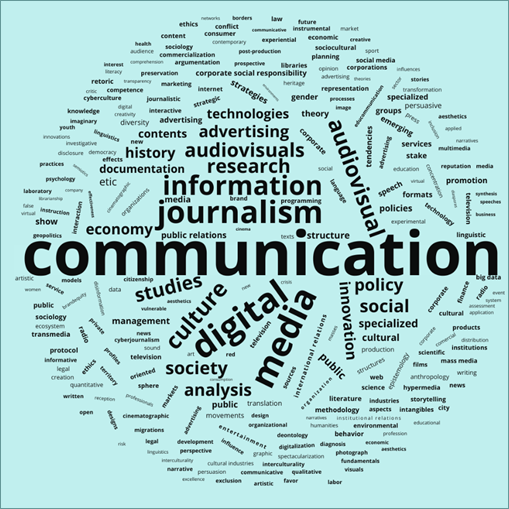
The evidence also shows that although programs are adopting perspectives of different disciplines, lines of research in communication stand out as differentiated. A word cloud created from all of the lines of research (Figure 1) shows the most representative areas of interest. «Communication» is especially prominent, along with other key words such as «journalism», «audiovisual», «digital», «media», «culture», and «advertising», reflecting the three traditional areas (García Marín & Salvat Martinrey, 2022) associated with the common core of the discipline, although there are also terms from other fields.
Figure 1. Word cloud of most common words
Source: prepared by authors.
Next, the frequency of each word in the lines of research was determined. All of the words extracted were manually screened, eliminating empty words (prepositions, conjunctions), followed by words referring to study methods and methodologies, as well as research processes. The rationale behind the exclusion of these words were, on the one hand, because the original aim was to find general content areas, and on the other, because according to Deuze (2021b), consensual methods are not what give a discipline its unity. A second reason was their low frequency (always less than ten repetitions, except for just three cases: «studies», «management», and «research»). The other words eliminated are listed below, in order of frequency (all appeared less than ten times): studies, management, research, analysis, theory/ies, content/s, translation, structure, discourse/s, effects/effectiveness, trends, experimental/experiential, processes, formats, structures, quantitative/qualitative, applied/application, evaluation/diagnosis, models, texts, methodology, practices, competency, epistemology, graph, foundations, reception, training, sources, dissemination, argumentation.
The remaining words in the list were then grouped into categories (also eliminating the distinctions between masculine/feminine and singular/plural in Spanish). This resulted in 80 categories (Table 2), including the word «communication», which appeared more often than any other word (118).
As Table 2 shows, the traditional areas of communication in Spain appear among the most frequently used words (15%, between 10 and 24 appearances): «audiovisual» (24), «journalism» (19), along with another very contemporary word, «disinformation/information» (16) and «advertising» (17), also associated with words such as «organization/organizational» (11).
Thus, the highest numbers of repetitions in this study cannot be considered very high. This finding is in keeping with the study by Hidalgo Marí & Segarra Saavedra (2021) on academic articles, where, for example, the term «audiovisual» appeared in only 17% of the articles analysed.
Other prominent words are «society, sociocultural, social» (24 appearances), «media» (22), «digital/digitalization/virtual» (22), and «culture/cultural/cyberculture/interculture» (21). These words do not appear in especially high numbers either, as was also found in the study by Viñarás Abad & Llorente Barroso (2020), where, for example, the term «media» was only present in 16% of the academic articles in the sample. Along the same lines, Deuze (2021a) suggests that although the importance of the media in society is profound, their influence is nevertheless limited to what at most may be recognized as an amplifying role, an insight that leads many researchers to focus on what people do with the media rather than studying the media themselves.
On the other hand, although «social» is one of the most frequently used words in the lines of research of the programs analysed in this study, it is less prominent than in the study by Viñarás Abad & Llorente Barroso (2020), who found it to be the second most common term, appearing in 25.52% of the articles analysed. The significant presence of the word «social» reflects the fact that it is a topic of interest as well due to its association with «social media», which for this analysis was isolated in a separate category in the first part of the study.
In any case, the findings here support Hidalgo Marí & Segarra Saavedra’s (2021) assertion that «social media» is as yet an under-represented concept, given its limited appearance in the lines of research (among the 70% of words that are repeated between 1 and 5 times) and in academic articles, as the aforementioned authors find them in only 8.3% of their sample.
Another word that makes a low number of appearances is «internet», present in just 4.61% of all articles analysed by Hidalgo Marí & Segarra Saavedra (2021), while in the present study it is among the 70% of words appearing between 1 and 5 times.
Among the remaining words, appearing between 5 and 10 times (15% of the sample), it is striking to note the minimal presence of words such as «television» (8), «cinema/cinematic/film» (7), «media/mass media/masses» (7) and «public/audience» (6).
Although the concept of «audience» is a prominent in television studies, present in 17.18% of the articles analysed by Hidalgo Marí & Segarra Saavedra (2021), its appearance in the lines of research of the programs is not significant. This is also true of the term «convergence» (2.6%) and the word «public», which makes very few appearances in the lines of research and only appears in 13% of the articles analysed by the aforementioned authors.
Even more remarkable is the minimal presence of other key words in communication studies that appear between 1 and 5 times (70% of words). These include «public relations» (4), «image/imaginary» (4), «photograph» (1), «radio» (2), «sound/sonic» (2), «interactive/interaction» (4), «creativity/creative/creation» (4), «programming» (3), «cultural industries» (3), «multimedia/transmedia/hypermedia» (3), «intangibles/reputation/Corporate Social Responsibility» (3), «public opinion» (2), and others of frequent use in the public sphere but much rarer in lines of research, such as «gender/woman» (5), which appears in only 2% of the articles analysed by Hidalgo Marí & Segarra Saavedra (2021).
With the aim of further reducing the list to the programs’ main work areas, the categories in Table 2 were then classified into word families. This reduced the list to 37 families of words (Table 3). The most frequent terms were «audiovisual» (24 appearances), «culture/cultural/cyberculture/interculture/cultural industries» (24), «digital/digitalization/virtual» (22), «journalism/journalistic/press/cyberjournalism» (22), and «media» (22), while a new family also emerged, encompassing categories such as «organization/organizational/corporative/corporations/entrepreneurial/company/business/strategies/strategic» (24), related to the area of corporate communication.
Thus, although the most common terms in the category analysis appear again as the most frequent terms in the word families, others also gain prominence, such as «cultural industries» and «cyberjournalism». The terms «information» and «fake news» do not have a strong individual presence, but when combined in the same family they are slightly more prominent, appearing a total of 18 times. Similarly, the study by Hidalgo-Marí & Segarra Saavedra (2021) found that the term «information» appears in only 10.41% of their sample of research articles, while «news» appears in only 8.85%.
Table 2. Word categories and frequencies
|
Frequencies % Words and thematic areas |
||
|
Words with 10-24 appearances (12) |
15% |
0. Communication (118) 1. Audiovisual (24) 2. Society, sociocultural, social (24) 3. Media (22) 4. Digital/digitalization/virtual (22) 5. Culture/cultural/cyberculture/interculture (21) 6. Journalism/journalistic/press (19) 7. Innovation/new/development (18) 8. Advertising (17) 9. Information/disinformation/transparency (16) 10. Politics/geopolitics (11) 11. Technology/ies (10) 12. Organization/organizational/corporate (11) |
|
Words with 6-9 appearances (12) |
5% |
13. History (9) 14. Economy/economic/s (9) 15. Marketing/market/commercialization/commercial/product/promotion (9) 16. Ethics, deontology (9) 17. Television (8) 18. Education/educational/educommunication/literacy (8) 19. Cinema/cinematic/film (7) 20. Media/mass media/masses (7) 21. Politics/communication policy (6) 22. Entrepreneurial/company/business (6) 23. Public/audience/s (6) 24. Citizenry/city (6) |
|
70% |
25. Net/web/internet (5) 26. Documentation (5) 27. Production/post-production (5) 28. Design (5) 29. Narrative/s (5) 30. Aesthetic/s (5) 31. Science/scientific (5) 32. Gender/women (5) 33. Literature/rhetoric and semiotics (5) 34. Public relations (4) 35. Image/imaginary (4) 36. Interactive/interaction (4) 37. Strategies/strategic (4) 38. Creativity/creative/creation (4) 39. Linguistic/s/language (4) 40. Crisis/conflict/risk (4) 41. Librarianship/libraries/services (3) 42. Cyberjournalism (3) 43. Vulnerable environments (3) 44. Heritage (3) 45. Programming (3) 46. International relations (3) 47. Corporations/corporate (3) 48. Art/artistic (3) 49. Consumption/consumer (3) 50. Legal/law (3) 51. Cultural industries (3) 52. Profession/profiles/professionals (3) 53. Spectacularization/spectacle/entertainment (3) 54. Social movements (3) 55. Multimedia/transmedia/hypermedia (3) 56. Intangibles/reputation/Corporate Social Responsibility (3) 57. Sound/sonic (2) 58. Diasporas/migrations (2) 59. Big data/data (2) 60. Democracy (2) 61. Participation/social participation (2) 62. Humanities (2) 63. Social diversity (2) 64. Public opinion (2) 65. Radio (2) 66. Institutional relations (2) 67. Persuasive/persuasion (2) 68. Protocol/events (2) 69. Sociology (2) 70. Anthropology/psychology (2) 71. Social media (2) 72. Ecosystem/system (2) 73. Brand equity/brand (2) 74. Fake news (2) 75. Photograph (1) 76. Storytelling (1) 77. Health (1) 78. Sport (1) 79. Environmental (1) 80. Youth (1) |
|
Source: prepared by authors.
Table 3. Word Families
|
Word Families |
|
|
118 |
|
|
2. Audiovisual |
24 |
|
3. Culture/cultural/cyberculture/intercultural-cultural industries |
24 |
|
4. Organization/organizational/corporate/corporations/entrepreneurial/company/business-strategic/strategy |
24 |
|
5. Digital/digitalization/virtual |
22 |
|
6. Media |
22 |
|
7. Journalism/journalistic/press/cyberjournalism |
22 |
|
8. Innovation/new/development |
18 |
|
9. Information/disinformation/transparency/fake news |
18 |
|
10. Vulnerable environments/social movements/diasporas/migrations-diversity-participation/participation-democracy-citizenry/city |
18 |
|
11. Advertising |
17 |
|
12. Aesthetic/s-creativity/creative/creation-art/artistic-design/s |
17 |
|
13. Public relations-protocol/events-persuasive/persuasion-institutional relations-public opinion-international relations |
15 |
|
14. Net/web/internet-social media-big data/data-interactive/interaction |
15 |
|
15. Television-programming-spectacularization/spectacle/entertainment |
14 |
|
16. History/heritage |
12 |
|
17. Ethics-deontology/legal/law |
12 |
|
18. Cine/cinematic/film/photograph/image/imaginary |
12 |
|
19. Structures/profession/profiles/professionals |
11 |
|
20. Politics/geopolitics |
11 |
|
21. Technology/ies |
10 |
|
22. Politics/communication policy-crisis/conflict/risk |
10 |
|
23. Economy/economic/s |
9 |
|
24. Marketing/market/commercialization/commercial/product-promotion |
9 |
|
25. Narrative/s-multimedia/transmedia/hypermedia-storytelling |
9 |
|
26. Literature/rhetoric and semiotics-linguistic/s/language |
9 |
|
27. Public/audience/consumption/consumer |
9 |
|
28. Education/educational/educommunication/literacy |
8 |
|
29. Documentation-librarianship/libraries/information services |
8 |
|
30. Media/mass media/masses |
7 |
|
31. Intangibles/reputation/Corporate Social Responsibility/brand equity-brand |
7 |
|
32. Gender/woman/youth |
6 |
|
33. Production/post-production |
5 |
|
34. Science/scientific |
5 |
|
35. Sound/sonic-radio |
4 |
|
36. Humanities/sociology/anthropology/psychology |
4 |
|
37. Health/sport/environmental |
3 |
Source: prepared by authors.
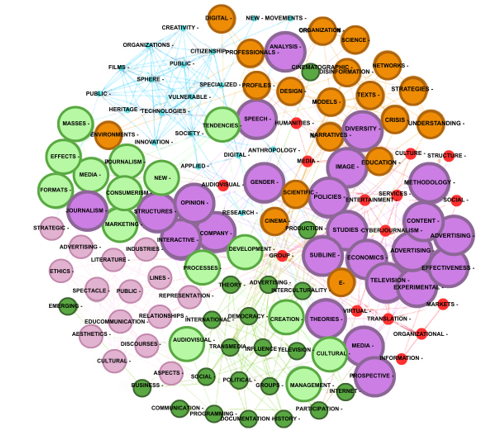
Finally, with the aim of exploring not only the frequency of terms in isolation but also the relationships between them, Figure 2 represents a semantic network generated using the Gephi 0.10.1 software package based on the analysis of all the words present in the lines of research extracted using Voyant Tools. The extraction results provided a total of 492 relationships between pairs of terms that exhibit semantic connections, with these relationships between terms potentially reflecting common themes. For example, the relationship between «digital» and «communication» might indicate an area with a shared focus.
The analysis was complemented with statistical information (significance and correlations between terms) that made it possible to measure the strength of the relationships and confirm their statistical importance, which was useful for prioritizing important concepts based on meaningful correlations.
Of all the pairs extracted using Voyant Tools, 26 (5.3%) exhibit a perfect correlation (1.0) and maximum statistical significance (0.0), while 466 (94.7%) have correlation values different from 1.0 (perfect correlation) and significance different from 0.0 (lower values indicate higher significance). This means that most of the relationships have correlations and significances that are not perfect, reflecting variability in the intensity of relationships between terms. However, the vast majority (493 pairs) have a correlation value higher than 0.5 and a significance close to 0.0.
In Figure 2 each node represents a term, and the edges represent connections between them, reflecting the co-occurrence, significance, and correlation among all terms.
Figure 2. Semantic Network of Correlation and Significance
Source: prepared by authors.
To optimize the results, four metrics were calculated to help explain the quality of the network, its structure, the central terms, and how the words are grouped together. The first metric is the average degree (3.844), which indicates that each node has an average of around four direct connections with others. This points to the existence of a network with moderate connectivity, in which the nodes are sufficiently connected to form clear clusters without being saturated, making it possible to identify specific semantic communities. This in turn facilitates the identification of cross-cutting concepts that integrate general thematic areas, such as digitalization, innovation and society.
The second metric is modularity (0.674), which refers to the tendency of a network to divide into communities or clusters. This value indicates a network with clearly defined semantic communities and coherent subgroups, but with important connections that reflect interdisciplinary collaboration, as analysed below.
The third metric, the clustering coefficient (0.254), measures the probability that a node’s neighbours are connected to one another. This value indicates a low to moderate level of grouping. Adjacent terms are not always directly connected to one another, suggesting that the clusters are not completely closed. This favours semantic heterogeneity (so that the terms within a single cluster are not redundant), which reflects thematic diversity within the areas of specialization and supports the interconnection of areas rather than overlapping.
Finally, the fourth metric is density (0.03), for which a high value would suggest an integrated network. This value indicates a scattered network, which also reflects a high level of specialization because although the nodes are connected, not all possible relationships are present, reinforcing the idea that terms only have significant relationships with other relevant terms. Far from being negative, this avoids semantic noise and ensures that each connection represents a substantial correlation between clusters without saturating the network. A low density is therefore consistent with a modular network where the terms are grouped into different communities with occasional connections between areas.
In short, in this network the average degree representing moderate connectivity (3.844) and the modularity suggesting a greater tendency to divide into clusters (0.674) indicate that there are subgroups that are clearly defined but not isolated, favouring interconnection without sacrificing specialization. The low-moderate clustering coefficient (0.254) together with the low density (0.03) reinforce the finding that the key nodes are semantically relevant and do not have redundant connections, making it possible to clearly identify areas of interest.
Figure 2 thus shows various clusters (groupings of nodes) that have been labelled according to their dominant areas:
Audiovisual and cultural cluster (purple), the most numerous (18.75% of nodes according to its modularity class): this group is the biggest and densest (providing the most connections between terms) and is concentrated around terms such as «discourse», «media», «gender», «image», «diversity», and «content».
Corporate communication and journalism cluster (green), representing 16.41% of nodes: this group is created around terms such as «journalistic», «marketing», «structures», «consumption», and «effects» and exhibits a high level of internal cohesion.
Digital technologies and networks cluster (orange), grouping together 14.84% of nodes: this group has moderate cohesion and although it is relatively compact, its nodes are more connected with other clusters, indicating a role of interconnection. It is related to terms such as «digital», «networks», «strategies», «models», and «organization».
Education, culture and ethics cluster (pink), representing 14.84% of nodes: this group is the smallest and most dispersed; it includes terms such as «educommunication», «ethics», «cultural», and «literature».
Organizational (institutional, corporate or governmental) communication structures cluster (red), with 11.72% of nodes: although this group has a lower internal cohesion, it plays a key role in the analysis. Terms such as «organization», «markets», and «virtual» point to a focus on the organization and structures of communication. This cluster appears to be a space of convergence for concepts associated with the analysis of organizational structures and their influence on culture, information, and communication.
In addition, Figure 2 shows that although communication studies constantly intersect with fields such as anthropology, economics, digital technologies, and other social sciences, the discipline maintains its specializations in audiovisual communication, advertising, and journalism (García Marín & Salvat Martinrey, 2022), which are in turn interconnected.
Audiovisual communication: the nodes related to «image», «television», and «content» (purple cluster) reflect key aspects of this area and are connected with «cinema», «networks», «digital», and «strategies» (orange cluster), reflecting the fact that audiovisual production benefits from digital networks and technological convergence in the quest for new narratives.
Advertising: the nodes «marketing», «consumption», «processes», «creation», and «effects» (green cluster) are directly linked to advertising, which maintains a relationship with the red cluster (communication structures in organizations and «markets») and the purple cluster, where advertising plays a prominent role in processes of audiovisual creation and culture, highlighting the importance of strategies for the development of the structures of social, corporate, and governmental organizations.
Journalism: the green cluster includes terms such as «journalism», «masses», and «media», although «journalism» also appears interconnected with the purple cluster (related to audiovisual communication), the red cluster (related to communication structures and which includes «cyberjournalism»), and the pink cluster (related to «ethics»). This highlights the fact that journalism as such is not isolated in a single cluster; in fact, it is also close to the orange cluster (digital technology), reflecting its dependence on digital networks and technological innovation. Overall, journalism exhibits an interconnection and cross-cutting relationships in the field of communication as a science, aimed at the critical deconstruction of information and its structures.
In general, there are clear trends toward an interest in digitalization and innovation in all disciplines, given that technology, innovation, and society are common pillars. Although the terms can be grouped together naturally by discipline (audiovisual, journalism, advertising), the semantic network reveals a high level of interconnection, geared toward a more integrative practice adapted to a digitalized and globalized environment.
Certain trends can be identified across the lines of research pursued in doctoral programs in communication in Spain. These trends reflect the thematic priorities of the three pillars of audiovisual communication, journalism, and advertising, with an emphasis on innovation and the opportunities emerging in social and digital contexts (Papí Gálvez et al., 2019; Franciscato, 2023).
The first trend is referred to here as «Audiovisual Communication and Digital Narratives». Terms such as «narratives», «cinema», «production», «audiovisual», and «image» are close together in the network. There are also significant correlations of terms such as «innovation» with «film» (correlation 0.8), referring to how innovation is transforming traditional media. This reflects a trend toward new visual languages, transmedia design, and interactive narratives as strategies to capture audiences on digital platforms, which are related to technological innovation and digital creation in advertising.
This trend toward new narratives has already begun to appear in scholarly output (Vicente Torrico, 2017), although the analysis of traditional audiovisual narratives and content will also continue to be necessary in order to examine how certain topics are represented in the media (Hidalgo Marí & Segarra Saavedra, 2021), in formats such as radio (Repiso Caballero et al., 2011) and television (Gaitán Moya et al., 2016).
The second trend is labelled «Communication Management in Contexts of Crisis». The adjacent terms «crisis», «diversity», «politics», and «education» reveal an interest in the construction of responsible narratives and in ethical and strategic management of information to combat disinformation and fake news, exhibiting connections with the analysis of digital discourses and media education, as can already be seen in scholarly output, for example, on radio used for educational purposes (Celaya et al., 2020) and as an instrument of media education (Marta Lazo et al., 2021).
The third trend is labelled «Digital Journalism and New Formats». It is now a reality that academic research in journalism is gradually abandoning traditional approaches in favour of empirical studies with complex methodologies (Martínez Nicolás et al., 2019). In his study of academic articles, Franciscato (2023) identifies three periods of evolution in this area: the first (1997-2001), when technological changes are evident; the second (2007-2011), characterized by more open definitions of the digital phenomenon; and the third (2017-2021), where interest turns to digital journalism, with research on «mobile and immersive journalism», «360-degree video», «virtual reality», «data-driven journalism», and «automated journalism». In this sense, adjacent terms such as «disinformation», «networks», and «texts» reflect an interest in the analysis of new formats, such as podcasts (Galán Arribas et al., 2018), short videos, data journalism, and mobile journalism (López García & Vizoso, 2021) and the application of AI to journalistic practices (Calvo Rubio & Ufarte Ruiz, 2021; Parratt Fernández et al., 2021). Journalism also exhibits a clear convergence with advertising, in terms of measuring the impact and application of digital strategies used to expand the reach of the information, as reflected in the relationship of journalism with the green cluster (advertising).
The fourth trend is referred to as «Digital and Interactive Advertising». Terms exhibiting close connections include: «strategies» and «networks» (correlation of 1); «advertising» and «effectiveness» (correlation of 1) and «internet» (correlation of 0.7); «digital» and «professional profiles» (correlation of 0.7); and «consumption» and «formats» (correlation of 0.9) and «media» (correlation of 0.7). This reflects clear associations with the use of big data and algorithms to personalize advertising messages, in addition to connections with production to create effective campaigns. Researchers are therefore exploring how to enhance the effectiveness of advertising strategies on social media (Lee et al., 2020) and the way ads are tracked and targeted at users based on their online behaviour through programmatic advertising (Papí Gálvez et al., 2019). This new type of advertising has revolutionized planning and creation processes, increasing the interest in new professional profiles. Lee & Cho (2020) and Baek (2023) also highlight the growing interest in the impact of AI on the production and dissemination of advertising, especially in the case of virtual influencers. Moreover, the relationship between advertising and the production of audiovisual and journalistic content should be explored, for example, in the context of native advertising and sponsored content (Ahn, 2020). In general, the main research trends in advertising are related more to advertising practices than as a central topic of academic research (Liu et al., 2021).
The fifth trend is defined as «Ethics and the Regulation of Communication Strategies». Terms such as «ethics» and «politics» are associated with «advertising» while «organizations» are linked to «markets» (correlation of 1), suggesting an interest in transparency and corporate social responsibility through regulation to combat questionable practices such as greenwashing. The relationship between advertising and intangible assets such as corporate social responsibility are a topic of interest, as brands are now communicating their commitment to social and environmental issues. In this respect, Viñarás Abad & Llorente Barroso (2020: 16) point out that intangibles such as «brand, identity, or corporate reputation have risen to prominence in academic research in communication in a dramatic way. »
Finally, there also appear to be a few cross-cutting trends:
Digitalization and Society: the fact that «innovation», «society», and «digital» appear in Figure 2 between clusters and connecting them suggests a trend in research on the social transformations being driven by digitalization, such as its impact on consumer habits, civic participation, and the analysis of how technology is redefining social dynamics, with special attention on vulnerable groups.
Innovation in communication: «innovation» stands out as a concept that is interconnected with numerous terms with which it has a significant relationship. This reveals a trend toward the adoption of innovative approaches through the use of AI, automation, and new methodologies to optimize communication.
Critical and political analysis: in Figure 2, «politics», «discourse», «education», «gender», and «diversity» emerge as areas of interest, reflecting a trend toward the study of the relationship between communication, power structures, and the role of communication in building democracy, and in fostering hate speech and social polarization.
4. Conclusion
With respect to its first objective, this study has identified a degree of interdisciplinarity in doctoral programs that combine communication studies with other disciplines, particularly information and documentation sciences. However, the three traditional areas of communication (journalism, audiovisual communication, and advertising) maintain some consistency around the common core of communication studies and in relation to the other social sciences and humanities.
In relation to the second objective, a clear convergence of audiovisual communication, advertising, and journalism around society, digitalization, and innovation has been identified in the lines of research analysed. At the same time, although different approaches are adopted in each area, there are common points between them, while their scientific connections with other disciplines are minimal.
In the case of audiovisual media, there are significant connections that underscore the importance of new narratives and their use in social education, with the collaboration between audiovisual narratives and digital advertising strategies being particularly notable.
Journalism has integrated specialized theories and models that break with the traditional stability. These will continue to focus on the profession and on deontology, but with attention to aspects such as crisis management and relationships with vulnerable groups. Challenges faced in journalism research include data journalism, the battle against disinformation, and the need for verification methods, which will improve criticism of journalistic practices. Citizen journalism and the relationship with social media will be other key areas, along with the adoption of AI in the field.
In the area of advertising, connections have been identified with audiovisual communication in terms of the necessary relationship between audiovisual narratives and advertising strategies. A connection is also observed between journalism and market and audience research, which is a new development. Above all, digitalization has transformed advertising practices, with programmatic advertising shifting the focus from advertising exposure toward the identification of interest-based profiles.
While this study of doctoral programs has taken a semantic perspective, it could be complemented with interviews with the designers of the programs to determine, above all, whether interdisciplinarity is organizational or scientific. It could also be expanded with further analysis of scholarly output and research projects as a way of measuring the impact of researcher training on research results.
Ethics and Transparency
Acknowledgements
Translator: Martin Boyd.
Conflict of Interest
The authors of this article declare that there is no conflict of interest.
Funding
This research has been co-financed at 85% by the European Union, the European Regional Development Fund, and the Regional Government of Extremadura. Managing authority: Department of Finance. Grant reference number: GR24014.
Project PID2023-153339NA-I00.
Author Contributions
|
Contribution |
Author 1 |
Author 2 |
Author 3 |
Author 4 |
|
Conceptualization |
X |
|
|
|
|
Data curation |
|
X |
|
|
|
Formal analysis |
X |
|
|
|
|
Funding acquisition |
X |
|
|
|
|
Investigation |
X |
X |
|
|
|
Methodology |
|
X |
|
|
|
Project administration |
X |
|
|
|
|
Resources |
X |
|
|
|
|
Software |
|
X |
|
|
|
Supervision |
X |
X |
|
|
|
Validation |
X |
X |
|
|
|
Visualization |
X |
X |
|
|
|
Writing - original draft |
X |
X |
|
|
|
Writing - review & editing |
X |
X |
|
|
Data Availability Statement
For information on the availability of the data, please contact the authors.
References
Ahn, J. B. (2020). A study on advertising future development roadmap in the fourth industrial revolution era. International Journal of Internet, Broadcasting and Communication, 12(2), 66-76. http://doi.org/10.7236/IJIBC.2020.12.2.66
Arévalo Martínez, R. I. (2022). Carta de la Directora del Centro de Investigación de la Comunicación Aplicada. Sintaxis, (9), 7-8. https://doi.org/10.36105/stx.2022n9.01
Baek, T. H. (2023). Digital advertising in the age of generative AI. Journal of Current Issues & Research in Advertising, 44(3), 249-251. https://doi.org/10.1080/10641734.2023.2243496
Calvo Rubio, L. M., & Ufarte Ruiz, M. J. (2021). Artificial intelligence and journalism: Systematic review of scientific production in Web of Science and Scopus (2008-2019). Communication & Society, 34(2), 159-176. https://doi.org/10.15581/003.34.2.159-176
Carrasco Campos, Á., Saperas, E., & Martínez Nicolás, M. (2018). How do scholars perform communication research in Spain? Public and private universities in the Spanish scientific publications of communication (1990-2014). adComunica, 45-63. https://doi.org/10.6035/2174-0992.2018.15.4
Castillo Esparcia, A., & Castillero Ostio, E. (2019). Communication research. Methodologies, themes and sources. Revista Internacional de Relaciones Públicas, 9(18), 197-218. https://doi.org/10.5783/revrrpp.v9i18.622
Celaya, I., Ramírez Montoya, M. S., Naval, C., & Arbués, E. (2020). Uses of the podcast for educational purposes. Systematic mapping of the literature in WoS and Scopus (2014-2019). Revista Latina de Comunicación Social, (77), 179-201. https://doi.org/10.4185/RLCS-2020-1454
Deuze, M. (2021a). Challenges and Opportunities for the Future of Media and Mass Communication Theory and Research: Positionality, Integrative Research, and Public Scholarship. Central European Journal of Communication, 14(1(28), 5-26. https://doi.org/10.51480/1899-5101.14.1(28).1
Deuze, M. (2021b). On the ‘grand narrative’ of media and mass communication theory and research: A review. Profesional de la Información, 30(1), e300105. https://doi.org/10.3145/epi.2021.ene.05
Franciscato, C. E. (2023). Three Scenarios in 25 Years of Journalism Research (1997-2021). Brazilian Journalism Research, 19(1), e1573. https://doi.org/10.25200/BJR.v19n1.2023.1573
Gaitán Moya, J. A., Lozano Ascencio, C. H., Caffarel Serra, C., & Piñuel Raigada, J. L. (2016). Research in communication in R&D projects in Spain from 2007 to 2018. Revista Latina de Comunicación Social, (79), 1-25. https://doi.org/10.4185/RLCS-2020-1486
Galán Arribas, F., Herrero Gutiérrez, M., Vergara Fregoso, M., & Martínez Arcos, F. (2018). Radio podcasting: Studies on radio podcasting: A systematic literature review in WOS and Scopus that reveals a low scientific production. Revista de Comunicación, 8(2), 22-43. https://doi.org/10.4185/RLCS-2018-1313
García Marín, D., & Salvat Martinrey, G. (2022). Trends in scientific production on disinformation in Spain. Systematic literature review (2016-2021). adComunica, (23), 23-50. https://doi.org/10.6035/adcomunica.6045
Gómez Escalonilla, G. (2021). Research methods and techniques employed in Communication Studies in Spain. Revista Mediterránea de Comunicación, 12(1), 115-127. https://doi.org/10.14198/MEDCOM000018
Hidalgo Marí, T., & Segarra Saavedra, J. (2021). Scientific production on television in communication: a systematic study via Web of Science. Doxa Comunicación, (33), 363-376. https://doi.org/10.31921/doxacom.n33a858
Jiménez Ramírez, M. (2017). New doctoral studies in Spain: progress and challenges for convergence with Europe. Revista Iberoamericana de Educación Superior, 8(21), 123-137. https://doi.org/10.22201/iisue.20072872e.2017.21.217
Lee, H., & Cho, C. H. (2020). Digital advertising: Present and future prospects. International Journal of Advertising, 39(3), 332-341. https://doi.org/10.1080/02650487.2019.1642015
Lee, H. M., Park, J. W., & Lee, J. K. (2020). How has social media been studied in the academic field of advertising and public relations? A semantic network and topic modeling analysis. Journal of Practical Research in Advertising and Public Relations, 13(1), 130-158. https://scholar.kyobobook.co.kr/article/detail/4050027633251
Liu, Z., Choi, M., & Han, M. (2021). An analysis of research trends of Chinese advertising published in Korea: Articles registered in KCI from 2011 to 2020. Korean Journal of Journalism & Communication Studies, 65, 328-366. https://doi.org/10.20879/kjjcs.2021.65.5.009
López García, X., & Vizoso, Á. (2021). High-tech journalism: a sign of the digital era of the third millenium. Profesional de la Información, 30(3). https://doi.org/10.3145/epi.2021.may.01
Lotero Echeverri, G. L., Romero Rodríguez, L. M., & Pérez Rodríguez, M. A. (2020). Analysis of Latin American research in the field of communication and public opinion. Correspondencias & Análisis, (11), 4-14. https://dialnet.unirioja.es/servlet/articulo?codigo=7504581
Marta Lazo, C. M., Gómez López, J., Segura Anaya, A., & Ortiz Sobrino, M. Á. (2021). Two decades of university radio in Spain (2000-2020) the reinvention of the media as an educational project in a digital environment. Revista de Comunicación de la SEECI, (54), 145-162. https://doi.org/10.15198/seeci.2021.54.e684
Martínez Nicolás, M. (2020). Communication Research in Spain (1985-2015). Institutional Context, Academic Community and Scientific Production. Revista Latina de Comunicación Social, (75), 383-414. https://doi.org/10.4185/RLCS-2020-1432
Martínez Nicolás, M. M., Saperas, E., & Carrasco Campos, Á. (2019). Communication research in Spain over the past 25 years (1990-2014). Objects of study and research methods in the papers published by Spanish peer-reviewed communication journals. Empiria. Revista de Metodología de las Ciencias Sociales, 42, 37-69. http://doi.org/10.5944/empiria.42.2019.23250
Massarani, L., Alvaro, M., Magalhães, D., & Valadares, P. (2024). Research in Science Communication: A Study on Scientific Articles in Latin America. Revista Iberoamericana de Ciencia, Tecnología y Sociedad-CTS, 19(56), 33-57. https://doi.org/10.52712/issn.1850-0013-377
Papí Gálvez, N., López Berna, S., Hernández Ruiz, A., Escandell Poveda, R., & Ortiz, M. J. (2019). Tecnologías en publicidad y relaciones públicas: Competencias, perfiles, recursos y expectativas formativas en comunicación digital. In R. Roig-Vila (Ed.), Investigación e innovación en la enseñanza superior. Nuevos contextos, nuevas ideas (pp. 1236-1246). Octaedro.
Parentelli, V. (2020). La interdisciplina como aspecto transversal en la formación de los licenciados en comunicación: El caso de la Licenciatura en Comunicación de la Universidad de la República. In Comunicación y Diversidad. Libro de comunicaciones del VII Congreso Internacional de la Asociación Española de Investigación de la Comunicación (pp. 296-313). Asociación Española de Investigación de la Comunicación. https://dialnet.unirioja.es/servlet/articulo?codigo=8042491
Parratt Fernández, S., Mayoral Sánchez, J., & Mera Fernández, M. (2021). The application of artificial intelligence to journalism: an analysis of academic production. Profesional de la Información, 30(3). https://doi.org/10.3145/epi.2021.may.17
Repiso Caballero, R., Delgado López-Cózar, E., & Torres Salinas, D. (2011). Análisis bibliométrico de la producción española de tesis doctorales sobre cine 1978-2007. In I. Bort Gual, S. García Catalán, & M. Martín Núñez (Eds.), Nuevas tendencias e hibridaciones de los discursos audiovisuales en la cultura digital contemporánea: Actas del IV Congreso Internacional sobre análisis fílmico (pp. 976-987). Ediciones de las Ciencias Sociales. https://doi.org/10.6035/978-84-87510-57-1.2011.80
Sampieri, H. R., Fernández Collado, C., & Baptista Lucio, P. (2010). Metodología de la investigación (5ta ed.). McGraw-Hill.
Vicente Torrico, D. (2017). Bibliometric study of the scientific production on transmedia narrative in Spain until 2016: Descriptive analysis of the 20 communication main journals in Spain according to Google Scholar Metrics. adComunica, 141-160. https://doi.org/10.6035/2174-0992.2017.14.8
Viñarás Abad, M., & Llorente Barroso, C. (2020). Advertising and public relations research in Spain: trends in content (2000-2020). index.comunicación, 10(3), 153-180. https://doi.org/10.33732/ixc/10/03Lainve