index●comunicación
Revista científica de comunicación aplicada
nº 16(1) 2026 | Pages 229-252
e-ISSN: 2174-1859 | ISSN: 2444-3239
Analysis of La Revuelta: Audiences, Content, and Narrative Structure
Análisis de La revuelta: audiencias, contenidos
y
estructura narrativa
Received on 26/02/2025 | Accepted on 28/07/2025 | Published on 15/01/2026
https://doi.org/10.62008/ixc/16/01Analis
Joaquín Sotelo González | Universidad Complutense de Madrid
jsotelo@ucm.es | https://orcid.org/0000-0001-5116-4345
Javier Sierra Sánchez | Universidad Complutense de Madrid
jsierr01@ucm.es | https://orcid.org/0000-0001-8572-7564
Sheila Liberal Ormaechea | Universidad Francisco de Vitoria
s.liberal.prof@ufv.es | https://orcid.org/0000-0003-0449-3204
María del Carmen Bravo Llatas | Universidad Complutense de Madrid
mcbravo@pas.ucm.es | https://orcid.org/0000-0002-0873-5277
Abstract: This study analyses the first 64 programmes of the television programme La Revuelta, broadcast on La 1 de TVE between September 2024 and January 2025. The objectives are to examine the audience composition by age group and gender, to explore the relationship between audience and content, and to evaluate the competitive framework established. A quantitative approach, employing statistical techniques, is used, based on audience data from Kantar Media, sourced through Barlovento Comunicación. The programme has significantly increased La 1’s audience share in its broadcast time slot and has attracted Generation Z and Millennial audiences. The inclusion of emerging and established artists, alongside prominent media figures, promotes audience engagement and retention. The format has revitalised La 1 de TVE and established itself as a benchmark for the renewal of traditional television consumption.
Keywords: La Revuelta; Television; Audience; Young Audiences; Television Content.
Resumen: Se analizan los primeros 64 programas del programa de televisión La revuelta emitidos por La 1 de TVE entre septiembre de 2024 y enero de 2025. Los objetivos del trabajo son conocer la composición de su audiencia por grupos de edad y por sexos; relacionar audiencias y contenidos y analizar el marco de competencia creado. Se emplea análisis cuantitativo mediante técnicas estadísticas a partir de datos de audiencia de Kantar Media obtenidos a través de Barlovento Comunicación. Este programa ha incrementado significativamente la audiencia de La 1 en su franja de emisión y ha atraído a público de la generación Z y millennials. La presencia de artistas emergentes y consolidados y de figuras mediáticas de larga trayectoria favorece la atracción y retención de audiencias. El formato ha revitalizado a La 1 de TVE y se ha posicionado como un referente en la estrategia de renovación del consumo televisivo tradicional.
Palabras clave: La revuelta; televisión; audiencia; jóvenes; contenidos televisivos.
To quote this work: Sotelo,
Joaquín, Sierra, Javier, Liberal, Sheila & Bravo, María del Carmen. (2026).
Análisis de La revuelta: audiencias, contenidos y estructura narrativa. index.comunicación,
16(1), 229-252.
https://doi.org/10.62008/ixc/16/01Analis
1. Introduction
From the 1960s until the end of the twentieth century, television was the most frequent subject of communication studies. However, in the twenty-first century, the majority of researchers have shifted their focus to the phenomenon of virtual communication. While traditional television may have lost some of its appeal as a research subject for many scholars, and audiovisual consumption has become increasingly multimedia, numerous recent sociological studies (e.g., CIS, 2023; European Parliament, 2023) demonstrate that, for the vast majority of citizens, television remains a key medium in fulfilling its historically attributed threefold role: to inform, educate, and entertain.
According to its Barometer: The Social Perception of Free-to-Air Television (2023), based on 1,226 interviews, UTECA (Unión de Televisiones Comerciales en Abierto/Union of Commercial Free-to-Air Televisions) highlights the strength of free-to-air television as a source of information, a medium for entertainment, and a channel for accessing cultural content. Nearly seven out of ten Spaniards prefer television for daily information, and 51.7% consider television the medium that provides the most companionship, far ahead of radio (36%). Television is chosen by citizens (62.8%) as the medium that most entertains and offers escapism, followed at a distance by social media (31.7%).
The rise of streaming platforms has led to a shift towards non-linear consumption of audiovisual content, particularly among younger audiences (Singh, 2023). It is undeniable that new on-demand content platforms and online video-sharing services have challenged the traditional linear television model (Rozados-Lorenzo, 2022). Nevertheless, over 72% of the Spanish population still considers free-to-air television their primary television model (UTECA, 2023). The current surge in new channels dedicated exclusively to audiovisual offerings has not yet ended television’s dominance over other media, as evidenced by various reports (e.g., Barlovento Comunicación, 2024).
Despite the aforementioned shift in research focus towards objects more closely related to emerging technologies, there is no doubt that television continues to generate interest. Within this context, the present study examines a phenomenon of returning to the origins of conventional (linear) television consumption, exemplified by the television programme La Revuelta (The Revolt).
2. State of the Art and Theoretical Framework
Recent research on young television audiences in Spain includes, among others, the work of Casado-del-Río et al., (2023), which examines the strategic shifts by television operators to reconnect with young viewers. Studies on the progressive disengagement of young audiences from linear television include those by Guerrero-Pérez (2018), García-Jiménez et al., (2018), Navarro-Robles and Vázquez-Barrio (2020), and, more recently, Sahoo (2024) and Caffarel-Rodríguez and Oliva-Gordillo (2024). López-Vidales and Gómez-Rubio (2021) identify the widespread use of digital technologies, particularly those related to mobile devices, as a cause of this growing detachment among young audiences from traditional television. They note that young people now engage more as users rather than consumers and are more involved in the distribution and dissemination processes of audiovisual content.
Regarding preferences in youth television consumption, the studies by López-Vidales et al., (2019) stand out, which explore the television formats most consumed by Spanish youth aged 20 to 24. Similarly, Cortés-Quesada et al., (2022) analyse the audiovisual consumption preferences of Millennials and Generation Z. In this vein, the work of Pavón-Arrizabalaga et al. (2016) focuses on the audiovisual consumption patterns of adolescents aged 12 to 16, with particular emphasis on fictional television content, while Evens et al. (2021) examine the habits, preferences, and consumption patterns of adolescents aged 13 to 17.
Concerning the transformations of the television medium in Spain in recent years, the studies by Béjar-Cortes and Rufí-Pérez (2020) are noteworthy, analysing the successes and failures of various entertainment formats on Spanish linear television. Similarly, Manuel Palacio (2024) provides an overview of changes in commercial and political strategies linking television programmes and society.
For the purposes of this research, the studies by Díaz-Monsalvo et al., (2025) are particularly relevant, as they analyse the programming strategies of Spanish generalist television channels between 2014 and 2024. They point to a lack of proactivity among operators in targeting new audience segments and highlight strategies focused on retaining audiences through established formats or by leveraging veteran media figures to attract followers from competitors. Aguilera-García (2020) examines the success of programmes such as El Intermedio and La Resistencia among young viewers, a topic also explored by Gascón (2016) in search of the keys to the success of such programmes. This study also aligns closely with audience research (e.g., Martínez-Rolán, 2012; Quintas & González-Neira, 2016) and the current role and immediate challenges of public service television (García-de-Madariaga et al., 2016; Labio-Bernal et al., 2025).
In line with these and other related studies, this research investigates the audiences and content of a television programme, La Revuelta, which premiered on La 1 de TVE in September 2024. The relevance of this study lies in the programme’s successful outcomes, both in terms of audience figures and its impact on public discourse.
Late-night talk shows, such as La Revuelta, are traditionally considered entertainment content, but their role in shaping public discourse has grown significantly. These programmes typically feature a star presenter, monologues, contributions from collaborators, and comedic sketches, alongside interviews as the core of each episode. They hinge on spontaneous conversations led by the presenter, which are less regulated than those in more purely informational formats (Iobishvili, 2024). Humour is a central element in this type of programme, often used to explore and challenge social norms. Presenters such as Johnny Carson and David Letterman have employed comedy to address and critique social issues, blending entertainment with subtle or overt ideological commentary (Buxton, 1987, 1991).
This genre is almost as old as television itself. Umberto Eco described it as «a kind of television concentrate» (1986: 83). Originating in the United States in the mid-twentieth century to fill broadcast hours with a cost-effective formula (Gómez-Martín, 2006), it remains attractive to channel executives and holds significant potential for engaging viewers (Diego & Guerrero-Pérez, 2020).
3. Formal Features
The origins of La Revuelta can be traced to 1 February 2018, when it was launched on the #0 channel of Movistar Plus+ under its original name, La Resistencia. This late-night talk show, hosted by David Broncano and characterized by irreverent humour and unconventional interviews, was broadcast on Movistar Plus+ until 4 July 2024. Its success was not primarily driven by viewership of its linear broadcasts. As a pay-TV channel, its audience figures in that window were relatively modest. According to Kantar Media data, the programme achieved a peak average audience of 53,000 viewers (0.6% share) during its third season (2019–2020). However, the programme garnered significant impact on YouTube and social media, where its views and mentions reached millions. As evidenced by the programme’s YouTube channel, twenty of its episodes have exceeded 4.5 million views.
Throughout 2024, plans emerged to bring the La Resistencia format to TVE. For months, numerous news reports covered this development, which was also linked, in journalistic circles, to a major crisis in RTVE’s leadership. In April 2024, this crisis culminated in the dismissal of RTVE’s interim president, Elena Sánchez, and the departure of the director general of content, José Pablo López (elperiodico.com, 2024).
Negotiations between TVE and the production companies responsible for La Resistencia, Encofrados Encofrasa and El Terrat, began in February 2024. By adopting this format, TVE aimed to attract younger audiences to its channel through the introduction of new narrative approaches, which could also enhance the public broadcaster’s visibility on social media. Above all, TVE’s objective was to secure content capable of competing with El Hormiguero on Antena 3 in the same time slot, namely the so-called Spanish access prime time (approximately 21:30 to 22:30).
The first week of La Revuelta’s broadcast (Table 1) achieved an average audience of 2,357,000 viewers, positioning the La 1 de TVE programme among one of the two most-watched broadcasts across all television operators in its time slot during those initial four days. These figures for La Revuelta nearly quadrupled the audience of the programme that occupied much of the same time slot on La 1 the previous week, the fictional series 4 Estrellas.
It might be assumed that this significant audience increase resulted from a transfer of viewers to La 1 from other television offerings, particularly from the other four major free-to-air generalist channels. However, Kantar Media data indicate that El Hormiguero (Antena 3) did not lose viewers that week, while other programmes experienced only modest declines: El Intermedio (La Sexta) saw an average drop of 176,000 viewers compared to the previous week, while First Dates (Cuatro) and Babylon Show (Telecinco) lost 5,000 and 158,000 viewers, respectively. Thus, the declines in El Intermedio, First Dates, and Babylon Show alone do not account for the nearly one million additional viewers gained by La 1 between one week and the next in the 21:45 to 23:00 time slot.
Table 1. Audience data for the launch week of La Revuelta
|
|
Average Audience (AA) |
Screen Share |
|
La Revuelta (09/09/2024) |
2.152.000 viewers |
17,1% |
|
La Revuelta (10/09/2024) |
2.127.000 viewers |
17,4% |
|
La Revuelta (11/09/2024) |
2.548.000 viewers |
19,9% |
|
La Revuelta (12/09/2024) |
2.601.000 viewers |
19,2% |
Source: Authors’ compilation
based on data from Barlovento Comunicación
(Kantar Media).
These data suggest that La Revuelta has attracted new television viewers, specifically new linear television audiences. In other words, this programme has succeeded in engaging the so-called Generation Z or Centennials or Zoomers (born approximately between 1997 and 2012) and Generation Y or Millennials (born approximately between 1981 and 1996), whose primary consumption is typically oriented towards social media and streaming platforms, convincing some of these individuals to watch traditional television.
Given that the least frequent television-consuming age cohorts in Spain, in order of lowest to highest consumption, are those aged 13 to 24 years, followed by the 4 to 12 years cohort, and then the 25 to 44 years cohort (Barlovento Comunicación, 2024: 12), it can be inferred that these new viewers primarily come from the 13–24 age group (Generation Z). Additionally, since linear television viewership in Spain is higher among women than men (Barlovento Comunicación, 2024: 11), it might also be expected that these new viewers are predominantly male.
4. Objectives and Methodology
The first objective of this study (O1) is to examine the composition of the audience of La Revuelta by age group and gender. The second objective (O2) is to analyse the relationship between audiences and the programme’s primary content (the guest or guests). The third objective (O3) is to correlate audience data with the programme’s progression, segmented into three phases based on the classic audiovisual narrative structure of introduction, development, and resolution (Ortiz Díaz-Guerra, 2021). Finally, the fourth objective (O4) is to evaluate the potential contributions of La Revuelta to La 1 within the competitive framework of the two other major generalist free-to-air channels in Spain (Antena 3 and Telecinco).
The study analyses the audiences of the first 64 episodes of La Revuelta broadcast on La 1 de TVE, using both quantitative and qualitative approaches. The analysis is disaggregated by gender, standardized age cohorts used in professional audience studies, and ad hoc broadcast time slots created by the authors. For the fourth objective, variables standardized in such studies, including the audience’s socioeconomic index, are incorporated (Barlovento Comunicación, 2024, p. 17).
For the analyses, audience figures and screen share data were purchased by the authors for this research from the consultancy Barlovento Comunicación, which, in turn, obtains them from Kantar Media, the official television audience measurement company in Spain. Kantar Media is recognised and accepted by the entire sector (traditional television operators, advertisers, and audiences) and by academia as the sole reference in this field (Cortés-Quesada & Barceló-Ugarte, 2019). Although changes in audience measurement research have emerged in the current media ecosystem (Hernández-Pérez & Rodríguez-Mateos, 2016; González-Neira et al., 2020), the reality is that Kantar Media’s audimeter-based system remains relevant. The ease of access to the company, its pricing, and the format of data presentation were the determining factors for using Barlovento Comunicación, rather than Kantar Media directly, as the primary source for this study.
The analysis covers the period from 9 September 2024—the programme’s first broadcast—to 15 January 2025. The unit of analysis is the minute-by-minute data of each of the 64 episodes (4,960 minutes of broadcast analysed), segmented by gender and age groups of viewers. Graphs and tables present average values or 95% confidence intervals of the mean. Inferential statistics are used to detect differences between groups.
To analyse differences in screen share by viewer gender, age group, or broadcast time slot, repeated-measures linear models are applied, as the screen shares of different groups refer to the same programme or minute of broadcast. Differences between male and female viewers are analysed using a paired Student’s t-test, while differences between age groups or broadcast time slots are examined using repeated-measures analysis of variance. This is followed by pairwise comparison tests, with Sidak correction applied to p-values, to assess differences between pairs of groups. To detect differences in screen share based on various programme categorizations, such as high- versus low-performing episodes or the gender of guests, linear models are employed. A Student’s t-test is used when comparing two groups, and analysis of variance is applied when comparing multiple groups. In the latter case, multiple comparison analysis using the Ryan-Einot-Gabriel-Welsch method is conducted to identify differences between groups. The pre-set significance level is p<0.05. Statistical analyses are performed using IBM SPSS Statistics v. 29 software.
5. Results: Description and Analysis
5.1. Audience Composition by Age Groups and Gender
By age cohort (Table 2), the 25–44 age group exhibits the highest average viewership of La Revuelta (data in the final row of Table 2), followed, in descending order of average viewership, by the 13–24 age group, the 45–64 age group, the 4–12 age group, and, lastly, the 65+ age group.
Table 2. Average audience per programme and age group. Average audience by age group for the five programmes with the highest audiences
|
Programme |
4-12 |
13-24 |
25-44 |
45-64 |
65+ |
|
Aitor Francesena |
14.7 |
25.9 |
29.2 |
18.5 |
9.4 |
|
Alex de la Iglesia-Inés Hernand |
9.6 |
22.7 |
19.2 |
16.1 |
7.7 |
|
Ana Mena-Belén Esteban-María Patiño |
15.4 |
23.0 |
33.0 |
18.7 |
9.0 |
|
Andrés Pajares-Lorena Nogal |
16.2 |
20.4 |
27.0 |
17.4 |
7.8 |
|
Anne Igartiburu |
11.2 |
17.3 |
22.2 |
14.7 |
7.8 |
|
Belén Esteban |
13.4 |
27.5 |
29.5 |
18.1 |
11.2 |
|
Belén Esteban-Duki-Dabiz Muñoz |
20.8 |
27.4 |
26.4 |
18.6 |
8.9 |
|
Berto Romero-Andreu Buenafuente |
19.7 |
27.8 |
27.6 |
19.7 |
8.9 |
|
C.Tangana & Yerai Cortés |
10.9 |
21.3 |
26.8 |
17.3 |
9.3 |
|
Carmen Machi |
6.3 |
22.5 |
25.4 |
19.1 |
10.1 |
|
Carolina Marín-Emilio Gavira |
15.0 |
15.9 |
25.3 |
17.6 |
9.2 |
|
Clara Galle |
21.6 |
21.9 |
26.4 |
17.0 |
8.0 |
|
Cristóbal-Regis-Jordi Molla-La Pili |
14.5 |
25.7 |
24.3 |
18.3 |
9.0 |
|
Cucurella-Rita payes |
19.4 |
24.9 |
25.9 |
19.1 |
9.0 |
|
Dafne&Marta-Arturo Coello |
17.6 |
19.5 |
26.1 |
18.3 |
8.5 |
|
Dani Martin |
16.3 |
26.8 |
28.9 |
18.3 |
8.9 |
|
Danna |
15.5 |
26.5 |
29.6 |
16.9 |
7.9 |
|
David Bustamante |
17.7 |
25.5 |
26.1 |
17.2 |
7.8 |
|
Diego González Rivas |
10.7 |
25.5 |
27.3 |
18.4 |
9.0 |
|
Diego González Rivas-María Galiana- |
17.8 |
17.9 |
25.5 |
17.8 |
8.5 |
|
Eduard Fernández-Israel Fernández |
13.8 |
23.1 |
26.0 |
17.4 |
8.2 |
|
El mago pop-Chloe de la Rosa |
13.3 |
18.8 |
21.6 |
18.0 |
8.8 |
|
Women's fencing team -Miguel Ángel Muñoz |
15.6 |
19.3 |
24.4 |
15.4 |
7.2 |
|
Ester Expósito- Dani Fernández |
12.5 |
15.0 |
24.3 |
15.2 |
7.7 |
|
Gabriela Andrada- Rels b |
12.1 |
20.1 |
22.9 |
16.6 |
8.9 |
|
Gerard Piqué-Silvia Alonso-Amaia |
16.4 |
19.0 |
27.3 |
15.7 |
9.0 |
|
Hermanos Williams- Judeline |
9.0 |
24.4 |
24.9 |
15.9 |
9.0 |
|
Hugo Silva-Biznaga |
15.5 |
27.2 |
31.1 |
18.1 |
8.4 |
|
Iker Pou-Eneko Pou |
15.4 |
15.5 |
28.0 |
16.4 |
6.5 |
|
Irene & Elisabet |
19.4 |
30.6 |
32.6 |
20.6 |
10.8 |
|
Jhayco |
12.7 |
23.1 |
25.9 |
18.9 |
9.7 |
|
Jorge Martin-Cariel & Paco Amoroso |
16.6 |
29.5 |
31.0 |
17.8 |
7.5 |
|
Juan Carlos Ibarra-Ana Belén |
15.1 |
18.3 |
26.0 |
17.3 |
9.7 |
|
Juan Enrique Soto-Bad Gyal |
10.7 |
17.4 |
23.9 |
16.9 |
8.2 |
|
Juan Floristan- Vicky López |
9.3 |
15.8 |
22.1 |
11.9 |
8.1 |
|
Julio Maldonado-Alejandro Montalvo |
21.3 |
25.8 |
23.8 |
18.8 |
9.0 |
|
Kira Miro-Carolina Durante |
19.5 |
26.2 |
27.8 |
15.8 |
8.6 |
|
Lola Índigo-Sara Sálamo |
10.6 |
21.8 |
24.1 |
15.0 |
9.3 |
|
Luis Figo |
17.6 |
20.8 |
24.4 |
18.0 |
7.5 |
|
Malcolm Treviño-Sitte-Aymar Navarro |
14.9 |
18.4 |
23.8 |
16.4 |
7.9 |
|
Manuel Carrasco |
8.5 |
21.9 |
27.3 |
15.6 |
8.2 |
|
Manuel Turizo |
14.6 |
20.4 |
27.3 |
17.2 |
7.0 |
|
María Becerra-Ana Moura |
17.1 |
23.7 |
21.9 |
17.0 |
7.9 |
|
María José & Marcos-Adriana Torrebejano |
12.6 |
20.6 |
27.7 |
16.9 |
9.1 |
|
Mario Casas-Carin León |
14.0 |
21.8 |
24.6 |
16.1 |
7.8 |
|
Merche García-Silvia Abril |
17.4 |
19.7 |
29.1 |
17.3 |
8.0 |
|
Milena Smit-Hovik Keuchkerian |
15.0 |
19.9 |
24.5 |
17.0 |
8.2 |
|
Millas&Arsuaga |
20.8 |
33.2 |
34.0 |
21.4 |
9.4 |
|
Mina el Hammani-Laura Escanes |
11.7 |
26.5 |
29.1 |
17.9 |
8.2 |
|
Miquel Montoro-Luisa Mayol y Luis Tosar |
13.4 |
23.2 |
22.5 |
15.4 |
8.4 |
|
Najwa Nimri |
18.4 |
30.3 |
29.0 |
19.5 |
7.8 |
|
Nathy Peluso |
10.7 |
24.3 |
25.3 |
17.4 |
7.9 |
|
Uninvited (the deer rut) |
15.8 |
17.1 |
22.9 |
14.9 |
8.0 |
|
Noah Higon-Coque Malla |
17.3 |
16.1 |
25.2 |
17.3 |
9.4 |
|
Norman Reedus-Marina Rivers |
12.9 |
29.2 |
27.2 |
18.0 |
7.8 |
|
Pablo Álvarez-Karla Sofia Gascón |
12.5 |
24.9 |
23.4 |
16.8 |
9.6 |
|
Paula Leiton |
7.5 |
21.7 |
27.9 |
16.9 |
8.4 |
|
Paz Vega |
16.8 |
24.2 |
28.1 |
18.7 |
7.5 |
|
Pedro Alonso |
9.2 |
21.6 |
25.8 |
16.4 |
7.9 |
|
Pito Camacho-Juan Gómez-Jurado-Kiko |
19.2 |
20.9 |
22.9 |
16.2 |
8.6 |
|
Raúl Cimas |
13.7 |
29.2 |
33.0 |
20.1 |
10.4 |
|
Rigoberta Bandini-Raúl Cimas |
15.6 |
26.0 |
31.8 |
18.8 |
9.9 |
|
Sonya Yoncheva |
16.6 |
21.0 |
21.9 |
16.9 |
8.3 |
|
Yolanda Ramos |
12.9 |
20.5 |
28.5 |
17.8 |
7.7 |
|
Average of all programs |
14.7 |
22.7 |
26.3 |
17.3 |
8.6 |
Source: Authors’ compilation
based on data from Barlovento Comunicación
(Kantar Media).
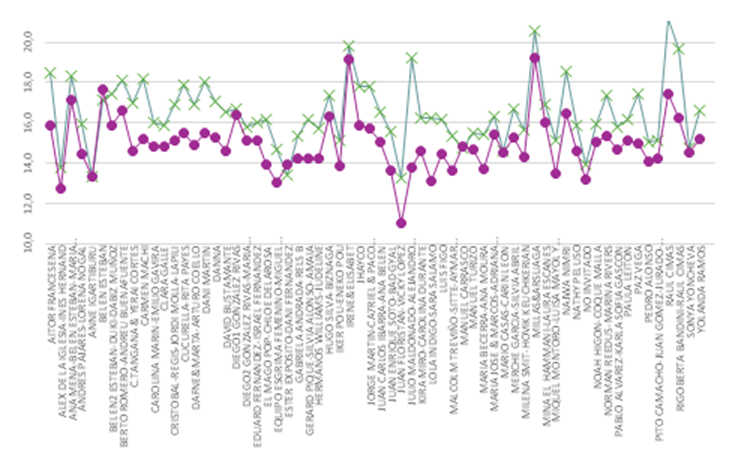
Regarding viewership by gender (Figure 1), it can be stated that male viewership is significantly higher (p<0.001). The programme’s average screen share is 16.47% for men and 14.93% for women. In all analysed programmes, except for five, male viewership predominates. In three of these five programmes, there are no significant differences in viewership between genders, and only in the remaining two does female viewership surpass male viewership, specifically in: 1) the programme featuring Belén Esteban, and 2) the programme featuring Ester Expósito followed by the singer Dani Fernández (p<0.001).
Figure 1. Average audience per programme and viewer gender (green: men)
Source: Authors’ compilation
based on data from Barlovento Comunicación
(Kantar Media).
5.2. Audiences and Content
While the 25–44 and 13–24 age groups are the most responsive to guests (Table 2), the youngest and oldest age cohorts exhibit more stable viewing patterns, though their responses vary depending on the programme’s primary content (the guest or guests). The analysis of audience segments thus reveals distinct behaviours across age groups in relation to the characteristics of the guests.
For the 25–44 age group, significant dynamism is observed, with peaks in screen share associated with high-profile media figures such as Ana Mena or the joint appearance of Belén Esteban and María Patiño; comedians such as Raúl Cimas; or popular actors and musicians such as Danna Paola or Irene Escolar and Elisabet Casanovas. These individuals generate some of the highest screen share values for the programme, demonstrating their appeal to this age group. In contrast, the 13–24 age group appears to respond to guests with diverse profiles, making it difficult to identify a clear pattern of appeal for this cohort.
The 4–12 age group exhibits more homogeneous and stable consumption, with less variation based on guests, though greater attention is observed for guests such as Clara Galle, Alejandro Montalvo, Julio Maldonado, or Duki. Contrary to what might be expected, episodes with an apparently family-oriented focus, such as those featuring Carolina Marín and Emilio Gavira or El Mago Pop and Chloe de la Rosa, showed only moderate impact on this group.
The 45–64 age group shows interest in established figures and nostalgic themes, such as those represented by guests like the former footballer Luis Figo, the chess player Juan Carlos Ibarra, or the veteran singer Ana Belén, all associated with traditional culture. These guests generate specific peaks, highlighting their relevance to this age cohort.
Finally, the 64+ age group exhibits the lowest level of viewership for this programme, though slight increases are observed with guests such as Belén Esteban, actresses Irene Escolar and Elisabet Casanovas, or comedian Raúl Cimas. The programme with the highest combined peak across all age cohorts was the premiere, which, beyond the anticipation generated by the launch of La Revuelta on TVE, featured the writer Juan José Millás and the palaeoanthropologist Juan Luis Arsuaga.
Taking the five programmes with the highest audience levels as a reference (Table 2, highlighted in green), it is observed that four of the five most-watched programmes for the 4–12 age group include guests with long professional careers (e.g., Belén Esteban, Andreu Buenafuente, or Julio Maldonado). The child audience thus does not appear to be influenced by the age of guests or to seek generational identification with them. Similarly, the 13–24 age group does not seem to be classifiable based on a specific guest typology, as they show interest in highly diverse figures (from Irene Escolar and Elisabet Casanovas to Juan José Millás and Juan Luis Arsuaga). The 25–44 age group appears to seek a balance between pure entertainment (e.g., Raúl Cimas or Belén Esteban) and a degree of thematic depth (e.g., Juan José Millás and Juan Luis Arsuaga), with programmes featuring guests of professional, artistic, or cultural significance (e.g., Diego González Rivas) standing out. For the 45–64 age group, affinity is oriented towards content with a nostalgic component or guests widely recognised in the media for their long and established careers (e.g., Andreu Buenafuente or Carmen Machi). Finally, the 64+ age group appears to prioritise content linked to highly recognisable popular figures with a long-standing television presence, such as Belén Esteban or Carmen Machi, or the humour of Raúl Cimas.
By gender, male viewers exhibit more marked variability in audience peaks (Figure 1), suggesting that male viewers generate more extreme responses in terms of viewership. Female viewers’ behaviour is more stable, though notable peaks are also observed in specific programmes, particularly those featuring guests with strong media profiles, such as Belén Esteban, Najwa Nimri, or Hugo Silva, or comedians such as Raúl Cimas or Andreu Buenafuente and Berto Romero. Both genders experience declines in certain programmes, particularly the episode featuring the musician Juan Floristán and the footballer Vicky López, which may suggest these guests have less relevance to the general audience.
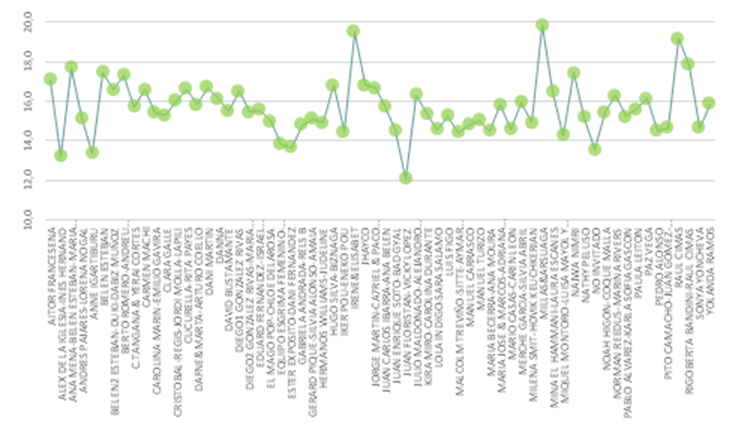
Figure 2 shows that the programme’s average audience fluctuates based on content. The extremes are a minimum screen share of 12.5% and a maximum of 20% in the analysed series. Beyond identifying certain peaks (minimums and maximums), the data indicate that the programme maintains a relatively stable average screen share of 15.7% across the analysed cycle, translating to an average audience of 12,997,000 viewers for the 64 programmes, with relatively few significant fluctuations.
Significant audience peaks coincide with guests such as Juan José Millás and Juan Luis Arsuaga (noting the «premiere effect»), the comedian and actor Raúl Cimas, or actresses Irene Escolar and Elisabet Casanovas. Other guests with above-average screen shares include, among others, the visually impaired surfer Aitor Francesena, Ana Mena, Belén Esteban, Berto Romero, Najwa Nimri, and Rigoberta Bandini.
Figure 2. Average audiences in relation to guests in each analysed programme
Source: Authors’ compilation
based on data from Barlovento Comunicación
(Kantar Media).
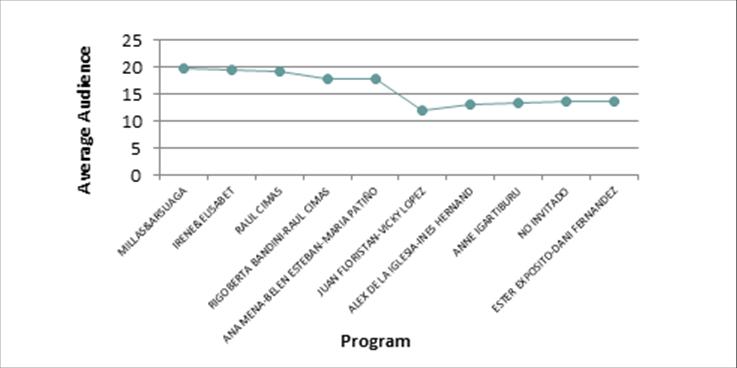
The highest-performing La Revuelta programmes (Figure 3) have significantly higher audience values than the lowest-performing group (p<0.001), indicating notable variation in audience appeal across programmes. The audience range for the highest-performing programmes is consistently high (~18% to ~20% screen share), demonstrating success in these episodes. In contrast, the lowest-performing programmes have a much lower range (~12% to ~14% screen share), reflecting a clear disconnection with certain audiences.
Figure 3. Average audience of the highest- and lowest-performing programmes in the analysed sample
Source: Authors’
compilation based on data from Barlovento Comunicación
(Kantar Media).
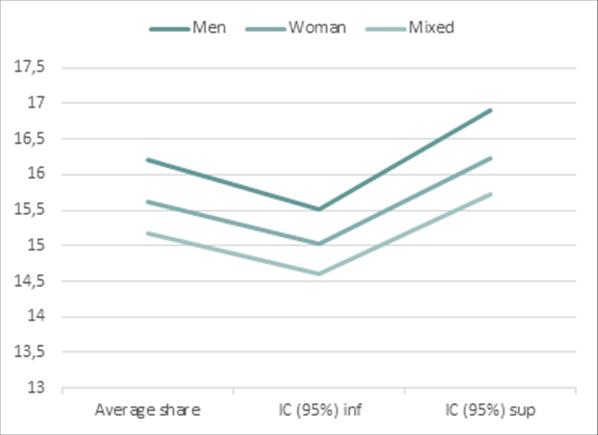
A categorisation was conducted based on whether the programme featured a male guest, a female guest, or a mixed group, as some episodes include multiple guests of different genders. In 23 programmes (35.9%), there was one or more male guests (11 with a single male guest); in 22 programmes (34.4%), there was a mixed group of male and female guests; and in 18 programmes (28.1%), there was one or more female guests (11 with a single female guest). In one programme (“Deer Rutting”), there were no guests. Analysis of variance shows statistically significant differences in average screen shares based on the gender of the guests (male, female, mixed) (p<0.05). This suggests that the differences observed in Figure 4 are not random and that the type of guest (in terms of gender) significantly influences screen share. The mixed guest group generates significantly lower screen shares than programmes with only male guests (p<0.05), particularly in the 13–24 age group, where the screen share difference is 3.8% (p=0.006). Another difference is that male guests have a higher average audience share than female guests.
Figure 4. Average audience share by guest gender with 95% confidence intervals
Source: Authors’
compilation based on data from Barlovento Comunicación
(Kantar Media).
5.3. Audiences and Programme Development
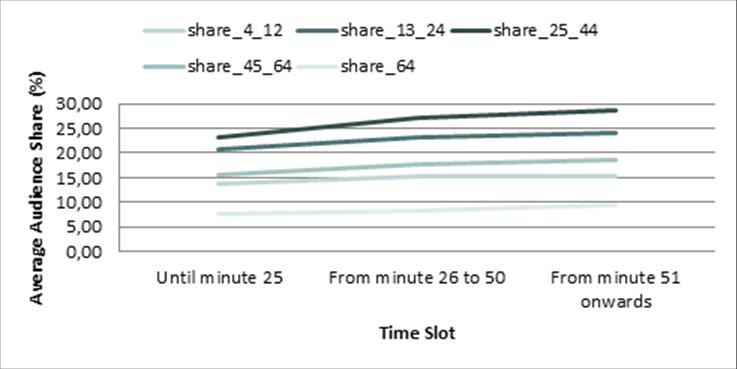
Figure 5 illustrates the audience behaviour of the programme based on its division into three segments. The results indicate that, across all age groups, there are increasing differences between time slots, except for the youngest group, which only increases during the development segment and then stabilises (analysis of variance, p<0.001).
The analysis of the average screen share reveals that the 25–44 age group is the most loyal in relation to the programme’s progression, as it records the highest share and exhibits the least variability (lower audience churn) in the data. This suggests high stability in their consumption behaviour, establishing them as the most consistent and engaged audience for the broadcast.
The 13–24 and 45–64 age groups show a trend of progressive growth in screen share as the broadcast progresses. In contrast, the youngest (4–12) and oldest (65+) viewers demonstrate lower levels of engagement with the programme. Both groups exhibit reduced retention over time, which may be attributed to factors specific to these age cohorts, such as their daily rest habits.
Figure 5. Average screen share by age group and programme time slot
*La Revuelta typically begins around 21:45 and ends around 23:00.
Source: Authors’ compilation
based on data from Barlovento Comunicación
(Kantar Media).
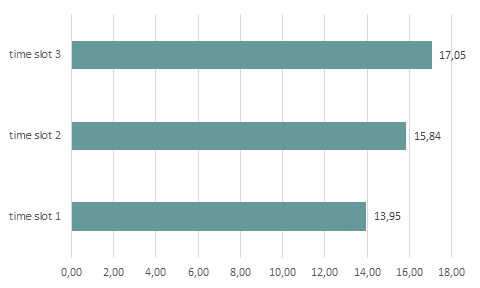
Figure 6 shows the average audience shares for three distinct time slots (Slot 1: up to minute 25; Slot 2: minutes 26 to 50; Slot 3: from minute 51 onwards), along with their respective standard deviations, which represent the variability of the data within each slot. The data were analysed using a repeated-measures design, considering that the audiences of a single programme contribute to the measurements in each slot. The standard deviation indicates that audience shares have slightly greater dispersion in Slot 3, though the differences between slots are consistent.
There is a clear increase in average shares from Slot 1 to Slot 3. This suggests that audiences tend to grow as the time slots progress. This behaviour may be related to television consumption habits in Spain, traditionally linked to greater audience availability in later time slots (Spanish prime time). This trend of increasing average shares as the programme progresses also allows for considerations regarding the concept of «audience carryover» from the immediately preceding programme (Telediario 2).
According to the analysis of variance, the differences between time slots are significant (p<0.001). This confirms that the observed increase is not due to chance but reflects a real effect associated with the time slot. Although standard deviations are similar across the slots, Slot 3 exhibits slightly greater dispersion (1.61 compared to 1.52 and 1.57), which may indicate greater variability in audiences during this slot, possibly due to differences in the content broadcast.
Figure 6. Overall average screen shares by time slot
Source: Authors’ compilation
based on data from Barlovento Comunicación
(Kantar Media).
5.4. Contributions in Relation to the Competition
The average age of La Revuelta viewers is 49 years, compared to 58 years for traditional television viewers in Spain and 61 years for viewers of La 1 de TVE (Barlovento Comunicación, 2024).
A comparison between the typical viewer profile of La 1 de TVE (Barlovento Comunicación, 2024, p. 17) (Table 3) and that of La Revuelta reveals that the programme not only maintains the channel’s leadership in the 13–24 age group but strengthens it over Antena 3 and Tele 5. In the 25–44 age group, where the channel is the third option behind Tele 5 and Antena 3, La Revuelta emerges as the leader in its broadcast slot, with over 5 percentage points of screen share advantage over Antena 3 in the same slot. La Revuelta positions La 1 as the leader in the 45–64 age group during its broadcast slot, where the channel as a whole is second, behind Antena 3. In the 65+ age group, La Revuelta does not secure leadership for La 1, which is held by Antena 3.
Table 3. Leadership by screen share and channels
|
Targets |
Lider |
2nd Option |
3rd Option |
|
Ind. 4+ (inv) |
A3 |
La1 |
T5 |
|
HOM (Men) |
La1 |
A3 |
La Sexta |
|
MUJ (Women) |
A3 |
La1 |
T5 |
|
4-12 |
Boing |
Disney Channel |
A3 |
|
13-24 |
La1 |
A3 |
T5 |
|
25-44 |
T5 |
La1 |
A3 |
|
45-64 |
A3 |
La1 |
T5 |
|
>64 |
A3 |
T5 |
La1 |
|
T. COMERCIAL |
La1 |
A3 |
T5 |
|
IA+IB |
A3 |
La1 |
T5 |
|
IC+ID |
A3 |
T5 |
La1 |
|
IE |
A3 |
T5 |
La1 |
Source: Barlovento Comunicación (Kantar Media), 2024, p. 17.
In terms of socioeconomic indices, La Revuelta secures leadership for La 1 in its broadcast slot for the highest (IA+IB) and middle (IC+ID) indices, while the channel as a whole ranks second in the highest indices (IA+IB), behind Antena 3, and third in the middle indices (IC+ID), behind Antena 3 and Tele 5. La Revuelta maintains the channel’s overall leadership in its broadcast slot for the so-called commercial target. By gender, La Revuelta sustains La 1’s overall leadership as the most-watched channel among men, ahead of Antena 3 and La Sexta.
6. Conclusions and Discussion
A significant portion of the new audience attracted by La Revuelta during its premiere on TVE consists of viewers who are not traditional consumers of linear television but rather young individuals newly engaging with this form of consumption (O1). These are likely, to a large extent, former followers of La Resistencia on YouTube and other social media platforms, and, to a lesser extent, perhaps followers of the radio programme La Vida Moderna (which David Broncano hosted on Cadena Ser until 2022). The programme has thus contributed to the engagement (or re-engagement) of young audiences (13–24 years) with linear television consumption and, consequently, to the rejuvenation of the audience, particularly for TVE. The analysed sample reveals higher consumption of the programme among men.
The data suggest that the success of a programme with the characteristics of La Revuelta depends significantly on how the primary content (guest or guests), secondary content, format, and narrative align with the preferences of each age group (O2). Adapting these elements is crucial for optimising screen share in each segment. The programming strategy of La Revuelta appears to deliberately include guests (and other narrative elements) that maximise the interest of key segments (those aged 13–44 years) while not neglecting content appealing to more traditional audiences (aged 45 years and older).
The inclusion of popular actors and musical artists with a strong presence on digital platforms generates significant appeal and broadens the programme’s reach towards younger audiences, highlighting the importance of diversifying guest profiles to maximise screen share.
The combination of entertainment and celebrities appears to be a successful formula, as does the ever-present humour. The strong audience results of Raúl Cimas and Belén Esteban stand out in general. Greater audience interest in male guests is observed. It is confirmed that guests are an important factor in attracting or retaining viewers, though the descriptive study presented here does not allow for the assertion that the programme’s success depends solely on the choice or success of the guest or guests.
Time slots (O3) significantly influence audience shares, with an ascending pattern as the programme progresses. The narrative structure of La Revuelta facilitates the capture and retention of the 13–34 and 45–64 age groups, possibly due to the alignment of content, broadcast format, or the relevance of topics addressed with their interests and audiovisual consumption habits. Overall, it can be said that La Revuelta succeeds with its running orders. This finding has implications for future studies on television content management and strategic planning in an increasingly competitive media environment.
The premiere of La Revuelta has provided La 1 de TVE (O4) with leadership in its broadcast slot for age and socioeconomic targets where the channel as a whole lacks leadership compared to its two main competitors (Antena 3 and Tele 5).
Among the limitations of this study, a more detailed minute-by-minute analysis of the programme, beyond just the guest or guests, could be considered, as the programme is somewhat packed with diverse content, with the time dedicated to guests sometimes accounting for less than 50% of the total content. This study does not include a parallel analysis of the competition, which, if conducted, could provide new insights. Nor does it consider factors such as social media campaigns, the programme’s presence in other media, or appearances on other RTVE programmes, which could influence audience figures.
As future lines of research, a more longitudinal analysis extended over time is proposed. Regarding the potential success factors mentioned in this study, further exploration through other techniques, such as audience questionnaires or focus groups, would be desirable. Additionally, while the study confirms that the programme has attracted Generation Z and Millennials, it does not deeply analyse whether these viewers will remain loyal to the format in the long term. Given that youth consumption is highly fragmented, volatile, and subject to digital trends, studying audience retention beyond the first few months of broadcasting would be valuable.
La Revuelta has established itself in its first four months of broadcasting as a media phenomenon that redefines television consumption in Spain, but its success raises questions about audience loyalty, its digital impact, and its future economic viability.
Ethics and Transparency
Acknowledgements
We express our gratitude for the support of Professor Roberto Gamonal Arroyo, Head of the Department of Journalism and New Media at the Faculty of Information Sciences, Complutense University of Madrid.
This article was translated into English by Diana Clavería, to whom we extend our thanks for her work.
Conflict of Interest
The authors declare no conflict of interest.
Funding
This study was funded by the Department of Journalism and New Media at the Faculty of Information Sciences, Complutense University of Madrid.
Author Contributions
|
Contribution |
Author 1 |
Author 2 |
Author 3 |
Author 4 |
|
Conceptualization |
x |
x |
x |
x |
|
Data curation |
|
x |
|
x |
|
Formal Analysis |
x |
|
x |
|
|
Funding acquisition |
x |
|
|
|
|
Investigation |
x |
x |
x |
x |
|
Methodology |
|
|
|
x |
|
Project administration |
x |
x |
|
|
|
Resources |
x |
x |
|
|
|
Software |
|
x |
|
x |
|
Supervision |
x |
|
x |
|
|
Validation |
x |
x |
x |
x |
|
Visualization |
|
x |
x |
x |
|
Writing – original draft |
x |
|
|
|
|
Writing – review & editing |
x |
x |
x |
|
Data Availability Statement
The data used in this study were purchased from the consultancy Barlovento Comunicación, which, in turn, obtains them from the official television audience measurement company in Spain (Kantar Media). These data can be accessed by anyone through the aforementioned companies. The authors of the study may also be contacted.
References
Aguilera-García,
I. C. (2020). Actualidad y comedia: El
éxito de El Intermedio y La Resistencia entre los espectadores jóvenes. Ámbitos. Revista Internacional de
Comunicación, 50, 80-95.
https://doi.org/10.12795/Ambitos.2020.i50.06
Barlovento Comunicación (2024). Informe Anual Análisis Audiencia TV 2024. https://tinyurl.com/yc4nehvp
Béjar-Cortés, J. L. y Rufí-Pérez, J. P. (2020). Éxitos y fracasos de la televisión lineal en España entre 2017 y 2019: la audiencia rechaza los nuevos formatos de entretenimiento. Razón y palabra, 24(108). https://doi.org/10.26807/rp.v24i108.1667
Buxton, R. A.
(1987). The late‐night talk show:
Humor in fringe television. Southern Speech
Communication Journal, 54(2), 377-389.
https://doi.org/ 10.1080/10417948709372704
Buxton, R. A. (1991). Dr. Ruth
Westheimer: upsetting the normalcy of the late-night talk show. Journal of Homosexuality, 21, 139-153.
https://doi.org/ 10.1300/J082V21N01_10
Caffarel-Rodríguez,
B. y Oliva-Gordillo, R. (2024). Televisión
lineal a digital: Operación Triunfo, adaptación a redes sociales y streaming:
Un cambio de paradigma en el consumo de la televisión lineal hacia las
plataformas digitales y redes sociales: Operación Triunfo un ejemplo de
transformación. VISUAL REVIEW. International Visual Culture Review
Revista Internacional de Cultura Visual, 16(2), 277–291.
https://doi.org/10.62161/revvisual.v16.5243
Casado-del-Río, M., Guimera, J. Á. y Bonet, M. (2023). Adapt or die? How traditional Spanish TV broadcasters deal with the youth target in the new audio-visual ecosystem. Critical Studies in Television. The International Journal of Television Studies, 18(3), 256-273. https://doi.org/10.1177/174960202210769
Cis [Centro de Investigaciones Sociológicas] (2023). Estudio nº 3421. Estudio sobre audiencias de medios de comunicación social. Septiembre-octubre 2023. https://tinyurl.com/2kcr89r6
Cortés-Quesada, J. A., Barceló-Ugarte, T. y Fuentes-Cortina, G. (2022). El consumo audiovisual de los Millennials y la Generación Z: preferencia por los contenidos snackables. Doxa Comunicación, 36, 303-320. https://doi.org/10.31921/doxacom.n36a1687
Cortés-Quesada, J. A. y Barceló-Ugarte, T. (2019). La medición de televisión en España: estado del arte y propuesta para el cálculo de la audiencia híbrida total. index.comunicación, 9(1), 217-242. https://doi.org/10.33732/ixc/09/01Lamedi
Díaz-Monsalvo, M. A., López-Vidales, N. y Gómez-Rubio, L. (2025). Estrategias de programación en televisión. Análisis del impacto de los referentes mediáticos en la fidelización de audiencias. Historia y comunicación social, 30(1), 221-231. https://doi.org/10.5209/hics.96690
Diego, P. y Guerrero-Pérez, E. (2020). La producción de talk shows en la televisión pública española (1990-2010): un contenido omnipresente en TVE. Revista de Comunicación, 20(1), 85-102. https://doi.org/10.26441/RC20.1-2021-A5
Eco, U. (1986). Televisión: la transparencia perdida, la estrategia de la ilusión. Lumen.
Elperiódico.com (2024, marzo 27). 'Operación Broncano': la guerra interna en RTVE que le ha costado el cargo a la presidenta y el director de contenidos. https://tinyurl.com/2wcr77jv
Evens, T., Henderickx, A. y De-Marez, L. (2021). Generation Stream: The Audiovisual Repertoire of Teenagers. Journal of Broadcasting & Electronic Media, 65(2), 185-204. https://doi.org/10.1080/08838151.2021.1944146
García-de-Madariaga, J. M., Broullón, M. A. y Lamuedra, M. (2016). La televisión pública ante los desafíos de la convergencia digital: percepciones de la audiencia y de profesionales de TVE. Mediatika: cuadernos de medios de comunicación, 15, 79-99. https://tinyurl.com/me66mwxy
García-jiménez, A., Tur-Viñes, V. y Pastor-Ruiz, Y. (2018). Consumo mediático de adolescentes y jóvenes. Noticias, contenidos audiovisuales y medición de audiencias. Revista ICONO 14. Revista científica de Comunicación y Tecnologías Emergentes, 16(1), 22-46. https://doi.org/10.7195/ri14.v16i1.1101
Gascón,
P. (2016). Claves del éxito de una década
televisiva: estudios de caso El hormiguero y El intermedio. Revista Faro,
1(23), 42-71.
https://tinyurl.com/3rxrb7v9
Gómez-Martín, M. (2006). Los nuevos géneros de la neotelevisión. Área Abierta, 13, 1-8. https://tinyurl.com/48h3k78s
González-Neira, A., Quintas-Frouce, N. y Gallardo-Camacho, J. (2020). La medición de la audiencia televisiva: desafíos ante las nuevas plataformas de video. Comunicación y sociedad, 17. https://doi.org/10.32870/cys.v2020.7284
Guerrero-Pérez, E. (2018). La fuga de los millennials de la televisión lineal. Revista Latina de Comunicación Social, (73), 1231-1246. https://doi.org/10.4185/RLCS-2018-1304
Hernández-Pérez, T. y Rodríguez-Mateos, D. (2016). Medición integral de las audiencias: sobre los cambios en el consumo de información y la necesidad de nuevas métricas en medios digitales. Hipertext.net [Online], 14.
https://doi.org/10.2436/20.8050.01
Iobishvili, N. (2024). A general structural comparison of entertainment talk show and news interview. Language and Culture, 9, 131-135.
https://doi.org/10.52340/lac.2024.09.21
Labio-Bernal,
A., Assif, M. y Romero-Ruiz-De-Castro, J.
(2025). Capítulo 1. Repensar la noción de servicio público en Españas. Espejo
de Monografías de Comunicación Social, 33, 19-40.
https://doi.org/ 10.52495/c1.emcs.33.p112
López-Vidales, N. y Gómez-Rubio, L. (2021). Tendencias de cambio en el comportamiento juvenil ante los media: Millennials vs Generación Z. Estudios sobre el Mensaje Periodístico, 27(2), 543-552. https://doi.org/10.5209/esmp.70170
López-Vidales,
N., Medina-De-La-Viña, E. y González-Aldea, P. (2019).
Los jóvenes españoles demandan una televisión con más ficción y
entretenimiento. Ámbitos. Revista Internacional de Comunicación, 22.
https://tinyurl.com/37kzuw7n
Martínez-Rolán, X. (2012). La audiencia televisiva. Una aproximación teórica a la eficiencia y legitimidad de las audiencias. Revista de Ciencias de la Comunicación e Información, 17, 12-20. https://doi.org/10.35742/rcci.2012.17(0).12-20
Navarro-Robles, M. y Vázquez-Barrio, T. (2020). El consumo audiovisual de la Generación Z. El predominio del vídeo online sobre la televisión tradicional. Ámbitos. Revista Internacional de Comunicación, 50, 10-30. https://doi.org/10.12795/Ambitos.2020.i50.02
Ortiz Díaz-Guerra, M. J. (2021). Narrativa audiovisual aplicada a la publicidad. Universidad de Alicante.
Palacio, M. (2024). La televisión en España (1990-2022). Ediciones Cátedra.
Parlamento Europeo (2023). Flash Eurobarometer Media & News Survey 2023. https://tinyurl.com/54uv9azs
Pavón-Arrizabalaga, A., Zuberogoitia, A., Astigarraga, I. y Juaristi, P. (2016). Consumo de series de televisión de los adolescentes en la era de la digitalización audiovisual: prácticas y motivaciones. Dígitos. Revista de comunicación digital, 2, 35-51. https://doi.org/10.7203/rd.v0i2.49
Quintas, N. y González-Neira, A. (2016). Consumo televisivo y su medición en España: camino hacia las audiencias híbridas. El profesional de la información, 25(3), 376-383. https://doi.org/10.3145/epi.2016.may.07
Rozados-Lorenzo, A. J. (2022). La tendencia actual del consumo audiovisual en solitario entre las nuevas generaciones: De la experiencia grupal al consumo unipersonal personalizado. VISUAL REVIEW. International Visual Culture Review / Revista Internacional de Cultura Visual, 10(3), 1-10. https://doi.org/10.37467/revvisual.v9.3610
Sahoo, S. (2024). The impact of streaming services on youth television viewing habits and media literacy. ShodhKosh Journal of Visual and Performing Arts, 5(1), 703-716. https://doi.org/10.29121/shodhkosh.v5.i1.2024.946
Singh, S. (2023). Demographic variations in media consumption: a comparative analysis. ShodhKosh Journal of Visual and Performing Arts, 4(2), 2109-2117. https://doi.org/10.29121/shodhkosh.v4.i2.2023.3351
Uteca (2023). Barómetro. La percepción social de la Televisión en Abierto. https://tinyurl.com/59rwd5us