index●comunicación
Revista científica de comunicación aplicada
nº 16(1) 2026 | Pages 203-226
e-ISSN: 2174-1859 | ISSN: 2444-3239
Interactivity in Streaming: The Case of TV Shows and Movies on Netflix Spain
Interactividad en el streaming: el caso de las
series
y películas en Netflix España
Received on 03/03/2025 | Accepted on 09/06/2025 | Published on 15/01/2026
https://doi.org/10.62008/ixc/16/01Intera
Jorge Gallardo-Camacho | Universidad Camilo José Cela
jgallardo@ucjc.edu | https://orcid.org/0000-0003-3790-5105
Francisco Trujillo-Fernández | Universidad de Málaga
frtrujillo@uma.es | https://orcid.org/0000-0002-1916-991X
Mariela Rubio-Jiménez | Universidad Camilo José Cela
mrubio@ucjc.edu | https://orcid.org/0009-0007-9757-5255
Abstract: This research article analyzes interactive movies and shows available on the Netflix Spain’s streaming service. The objective is to characterize this type of content in terms of format, genre, target audience, release date, production model, as well as average duration, number of interactions, and frequency of potential interactions. The study is based on a quantitative content analysis performed on a sample of 68 interactive movies and shows (including all their episodes), amounting to a total viewing time of 24 hours and 8 minutes. The results reveal that the most common type of interactive content is a movie, aimed at a kids and family audiences, co-produced in 2022, with an average duration of 21 minutes, an average of 15.9 interactions, each appearing every 135 seconds. It is concluded that Netflix Spain lacks a clear and consistent strategy regarding this type of content and that it has ceased to invest in this form of experimental entertainment.
Keywords: Netflix; Interactions; Interactive Movies; Interactive TV Shows; Streaming; Interactive Videos.
Resumen: Esta investigación analiza las películas y series con interacciones en el servicio de vídeo por streaming de Netflix España. Se determina su tipología para conocer el género, el público objetivo, la fecha de creación y los productores predominantes. También se cuantifica su duración, el número de interacciones y cada cuánto tiempo hay potencialidad de interacción. La metodología es cuantitativa y analiza las 68 películas y series (con sus episodios incluidos) del catálogo con su visualización completa (24 horas y 8 minutos). El contenido tipo es una película interactiva, dirigida al público infantil y familiar, y coproducida en el año 2022, con una duración media de 21 minutos, una media de 15,9 interacciones y una interacción cada 135 segundos. Concluiremos también que Netflix carece de una estrategia clara y uniforme con respecto a estos contenidos y que ha dejado de apostar por este tipo de entretenimiento experimental.
Palabras clave: Netflix; interacciones; películas interactivas; series interactivas; streaming; vídeos interactivos.
To quote this work: Gallardo-Camacho,
Jorge, Trujillo-Fernández, Francisco &
Rubio-Jiménez, Mariela (2026). Interactividad en el streaming: el caso de las
series y películas en Netflix España. index.comunicación, 16(1), 203-226.
https://doi.org/10.62008/ixc/16/01Intera
1. Introduction
Netflix revolutionized video consumption by introducing a new television business model that converged with the Internet through «a cloud-based and on-demand television scheme» (Heredia Ruiz, 2018: 25). Originally a DVD rental company operating by postal mail, Netflix launched its online service in 2007 and began its international expansion in 2010, reaching Spain in 2015. During this expansion phase, Netflix experienced unstoppable growth until 2022, when it began to lose subscribers and implemented strategic changes to retain existing users, attract new ones, and increase revenue. These measures included combating password sharing between different households and offering a cheaper subscription plan supported by advertising (Mullin, 2022). Netflix recognized the need to innovate by introducing ads (partnering with Microsoft as its technology collaborator to strengthen this subscription tier) and by acquiring video game studios to develop new products (De Zilwa, 2024). Consequently, video games entered the realm of cloud-based streaming without the need for a console (Banfi, 2024) and, in 2021, Netflix started to offer video games on connected televisions and compatible mobile devices (Netflix, 2021). It is evident that media organizations and streaming platforms do not always follow a consistent strategy in adapting to the new audiovisual landscape (Gallardo-Camacho et al., 2024). In fact, success on Netflix no longer depends solely on viewership figures but also on other factors such as customer acquisition, retention, and audience engagement (Neira et al., 2024). Hence, it is necessary to experiment with new forms of interaction between viewers and content.
At the same time, since 2017, Netflix has been experimenting with non-linear audiovisual formats through interactive stories that allow viewers to choose different plot developments presented on screen. Carla Engelbrecht (2017), Director of Product Innovation at Netflix, explained that «content creators have a desire to tell non-linear stories like these, and Netflix provides the freedom to roam, try new things and do their best work». Engelbrecht added that the company initially focused on children’s content (launching Puss in Book: Trapped in an Epic Tale on June 20, 2017) after conducting extensive research and discussions with parents and children. Since 2017, Netflix’s catalog of interactive content has continued to expand, and this study examines the evolution of this phenomenon up to 2025.
1.1. Interaction and Audiovisual Content in Streaming
More than a decade ago, several scholars had already recognized that «in this galaxy of interconnected devices, the development and growth of the audiovisual content market will be shaped by what is now known as transmedia content» (Benito García, 2014: 134). Precisely, the bet on interactive content and video games demonstrates «the great power of transmedia to engage diverse audiences and encourage active participation in the narrative, as well as the bold decision of streaming companies to explore new formats that transcend their own brand boundaries» (Galicia Martínez, 2024: 50). In the field of interactive narratology, the influence of interactivity on the script remains limited, and «at times the correlation between a choice and the resulting story is difficult to recognize» (Rezk & Haahr, 2022: 1). In fact, from the perspective of experience design, this offer of interactive content seek to satisfy viewers (who become users) by allowing them to co-participate in the narrative, although not completely, since it is ultimately a «mere illusion of choice» (Lopera-Mármol et al., 2023: 1). As for the theoretical concept of interactivity, Netflix’s interactive productions reflect the four types of interactions identified by Zimmerman (2004): cognitive interaction (the interpretation the viewer makes after consuming the movie or show), functional interaction (user participation through physical elements such as a touchscreen or remote control), explicit interaction (the decision-making moment among predefined options), and meta-interaction (the parallel world generated around an audiovisual work, including user analysis and fan phenomena). Among these, Netflix’s interactive content stands out for emphasizing functional and explicit interaction compared with the rest of the catalog.
As for the predominant formats, a new trend can be observed that shapes the creation of audiovisual products, focusing, among other aspects, on «reducing the duration and longevity of the shows broadcast on Netflix» (Hidalgo-Marí et al., 2021: 1). In this context, social media users and new content creators produce hybrid audiovisual narratives that give rise to innovative content formats (Vidal-Mestre et al., 2023). In fact, Netflix has become increasingly relevant within audiovisual consumption and «targets a more interactive user profile; one that is highly engaged with the content they choose to consume and willing to pay a monthly subscription for it» (Góngora & Lavilla, 2020: 79).
With regards to the theoretical field of interactivity, this research follows Kiousis’s (2002: 355) definition, which conceives it as «both a media and a psychological factor that varies depending on communication technologies, contexts, and people’s perceptions». Thus, Netflix brings this technological possibility of interaction closer to audiences, transforming viewers into users. However, those interactive productions that achieve commercial success represent exceptional cases that «invite reflection on the critical relationship between the superficial effects of cultural trends and the anthropological implications of the evolution of our relationship with the media» (D’Aloia, 2020: 25). With the emergence of interactive content, where viewers select the plot or answer questions, some scholars have demonstrated that audiences often prefer not to interact when watching online videos (Gallardo-Camacho & Jorge-Alonso, 2010), as passive viewing can be pleasurable (Owen, 2000). In fact, although interactivity may initially generate gratification, Nee (2021) notes that the obligation to make choices can cause stress among certain users.
Conversely, more recent studies conclude that «interactive entertainment is an enjoyable experience» for 847 surveyed users who perceive positively the opportunity to interact with Netflix’s shows and movies (Ardvin et al., 2024). Likewise, research examining viewer interaction in movies and shows has shown that technology influences storytelling and that a shift has occurred from passive to active audience participation, establishing a dynamic relationship among narrative, technology, and audience, as noted by bin Mohd Hanapiah and binti Md Nasir (2024) after reviewing 163 studies on the topic.
Furthermore, Rodríguez Ortega (2024) examines the dual dynamics of Netflix’s catalog personalization and binge-watching, concluding that streaming services have transformed the ways in which audiences consume audiovisual media. Ultimately, Netflix has become an innovative and disruptive form of Internet television, capable of attracting a broader and more diverse audience than traditional broadcasting (Orsal, 2024).
Interactive productions that allow viewers limited participation (by choosing among several options that lead the video along different narrative paths) occupy an intermediate space between video games and traditional movies and television shows. Are they more akin to video games or to non-linear fictional narratives with interactive features? According to Galicia Martínez (2024: 49), there is a clear distinction between shows and video games in terms of time and space: while shows cover a wide range of settings and time periods, video games «tend to focus on a specific environment and follow a more restricted timeline». Yet, with the expansion of gaming consoles, «the line between cinema and video games has become increasingly blurred» (Powell, 2020). In video games, players play a central role in narrative development, personalizing the storytelling experience through their actions (Scolari, 2013). From the theoretical standpoint of ludonarrative, Terrasa-Torres (2022) explains that narrative progression is activated and sustained by player actions (on Netflix, viewers choose different story paths). However, in this case, we encounter the concept of ludonarrative dissonance (Hernández-Pérez et al., 2024), which reflects the conflict between story and gameplay mechanics, although in Netflix’s case, interactivity is much simpler and more limited than in traditional video games.
1.2. Studies on Netflix’s Catalog of Interactive Programs
Regarding studies that specifically examine interactive shows and movies on Netflix Spain, the existing literature is scarce and tends to focus mainly on individual titles from the platform’s catalog. For example, Martín Ramallal et al. (2019: 281) analyzed the interactive movie Black Mirror: Bandersnatch through a focus group of six participants, three of whom stated that this type of content resembles a video game. The authors concluded that «this hypermedia narrative typology, aimed at becoming a mass phenomenon beyond video games, may become one of the hallmarks of this new way of understanding media and cyberculture». Similarly, Castillo et al. (2021: 36) also analyzed this movie but compared it with the video game Detroit: Become Human, concluding that the latter «offers a broader repertoire of options and chronological sequences, as it employs a more complex and flexible design compared to the unified structure of Bandersnatch». Likewise, Rigo (2021: 7) examined this movie and identified its five possible endings depending on viewers’ choices, concluding that such content may not be as interactive as the platform promotes, since «audiences are not as central to the experience as the marketing suggests».
Another study focused on the transmedia narrative of the Netflix show Dark, which included a parallel content platform that expanded the narrative possibilities based on the relationship between creator, user, and content (Rodríguez Fidalgo et al., 2021). In short, the catalog of interactive shows and the inclusion of fourteen video games in 2021 aimed to «offer light entertainment and enhance the value of Netflix subscriptions, while beginning to develop games within a transmedia logic or as reinforcement for other content on the platform» (Gómez-García & Vicent-Ibáñez, 2022: 115).
Additionally, Gómez-García and Vicent-Ibáñez (2022: 131) highlight «the extraordinary potential of the data that the platform obtains about audience preferences and interests through this new type of content». In this regard, these emerging formats raise new ethical challenges for researchers such as Villán and Ocejo (2019), since they involve collecting and analyzing user data that may compromise privacy and security by recording personal preferences and decision-making patterns.
There is also a study that analyzes the 24 interactive programs placed on the platform up to 2024 and concludes that these contents display a great variety and a lack of homogeneity in terms of format, duration, production, and narrative features (Capapé & Oliva, 2024). Our research expands upon these studies, as detailed in the methodology section, by including a broader sample of 68 elements (analyzing all show episodes as well) and conducting a complete viewing of all 68 elements (totaling 1,448 minutes watched) to identify the characteristics of the interactions.
At the international level, research on Netflix’s interactive content outside Spain primarily centers on the first interactive movie released by the platform: Black Mirror: Bandersnatch. These studies explore how viewers perceive control over the script (Rezk & Haahr, 2022); question the true potential for interactivity, since the movie is neither a traditional movie nor a video game (D’Aloia, 2020); draw parallels between the movie and how entrepreneurs reinvent established narratives (Saylors et al., 2025); and discuss whether interactivity distracts or enhances audience engagement (Pulukadang et al., 2024). Ong et al. (2024) conclude, based on a survey of 847 respondents, that viewers find the experience enjoyable and that these insights could inform the content strategies of other streaming platforms. In our case, we also consider the findings of this study to be generalizable and valuable for the audiovisual industry, both in Spain and internationally.
1.3. Research Objectives
The general objective (GO) of this study is to provide a comprehensive analysis of the presence of interactive content (shows and movies) on Netflix Spain. Accordingly, the following specific objectives (SO) have been established:
1. SO1: Identify the typology of interactive products produced by the audiovisual industry for Netflix, including their genre, target audience, duration, release date, and production company, among other characteristics.
2. SO2: Quantify the potential user interactions by determining how frequently viewers are prompted to make decisions or select responses.
3. SO3: Assess whether a clear and consistent strategy exists for the creation of this type of content on Netflix.
2. Methodology
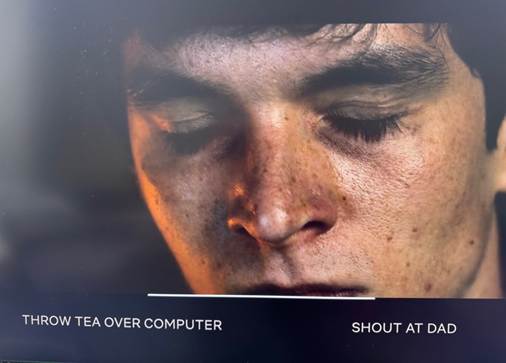
The proposed methodology is quantitative and based on the viewing of interactive content available on Netflix Spain. Under this category, Netflix distinguishes between two types of productions: interactive content, which includes programs or movies where viewers can make decisions that influence the development of the storyline (for example, as shown in Figure 1, where the viewer may choose between «throw tea over computer» or «shout at dad»); and trivia content, consisting of programs or movies that incorporate quiz-like elements or questions but do not significantly affect the narrative outcome (Netflix, 2024). In this study, both categories are considered as forms of interactive content. Accordingly, the productions included in the sample are those officially listed in the Interactive Specials section of the Netflix Spain website as of June 1, 2024 (Netflix, 2024), totaling 24 shows and movies. However, it was also deemed relevant to analyze the individual episodes within these shows, resulting in a total observed sample of N=68 content items.
Figure 1. Screenshot from the movie Black Mirror: BanderSnatch. Interaction number 3
Source: Netflix (2024).
Two data collection phases were established. In the first phase, the following variables were extracted for each piece of content: title, format (show or movie), year of release, total duration, genre, «belongs to» category (Netflix’s own classification), production company (not available on Netflix, therefore obtained from the Filmaffinity database, 2025), target audience and age rating (recommended minimum viewing age), and typology (trivia or interactive).
In the second phase of data collection, the authors watched the 68 selected programs, exploring every possible interaction path until reaching the end of the content. However, only one complete viewing was conducted per program, corresponding to a single choice path, since each title may have multiple possible endings (Rigo, 2021). The total viewing time amounted to 24 hours and 8 minutes of content analysis. During this viewing phase, the following variables were recorded: duration, number of interactions per program, and time interval (in seconds) between each interaction.
Both phases were carried out between June 1, 2024, and October 1, 2024. Methodologically, it was considered useful to update the data from the first phase of the research as of January 1, 2025 (it was observed that all but two programs had been removed, as discussed in the results section). The status of these contents was also verified in the final review of the article before publication (on May 14, all interactive programs were found to have been removed). Finally, access was made via a Virtual Private Network (VPN) connection to the Netflix versions of other countries (United States, Canada, and the United Kingdom) to determine whether the same strategy was followed in their main markets and whether the results could therefore be generalized.
As in other recent quantitative research in the area of communication (Melero et al., 2025), Holsti’s method (1969) was applied to verify the reliability of variable coding across both empirical phases. The viewing and data collection of the 68 programs were divided among the three authors; subsequently, 10 units (15% of the sample) were reanalyzed by researchers who had not previously examined those contents. This process yielded an intercoder reliability coefficient of 0.98 (where 1.00 indicates perfect agreement). To avoid potential interpretive bias and to achieve such a high level of intercoder agreement, a preliminary joint viewing was conducted to define what constitutes an interaction in each analyzed title: any moment in which the viewer is offered a choice among multiple options during playback.
All data was recorded and statistically processed using Microsoft Excel. The data from the second empirical phase (related to interactivity) are presented with the inclusion of Standard Deviation (SD) values, which allow for a deeper analysis beyond simple mean comparisons by revealing whether the observed differences between groups are statistically meaningful or simply reflect the inherent variability of the data. This approach makes it possible to determine whether Netflix follows a uniform strategy in the design of interactive elements across its catalog.
3. Results
3.1. Description of Interactive Content on Netflix Spain
In order to determine the typology of audiovisual interactive productions on Netflix Spain, it is important to describe these contents following the observation and categorization process conducted on the sample (Table 1, N=68).
Table 1. Description of interactive content on Netflix Spain in 2024 (N=68)
|
Name |
Trivia /
|
Show / Movie |
Genre on Netflix (first) |
Age |
Year |
|
Choose Love |
Interactive |
Movie |
Romantic comedy |
7+ |
2023 |
|
We lost our |
Interactive |
Movie |
Kids’ TV |
7+ |
2023 |
|
Trivia Quest (30) |
Trivia |
Show |
TV Comedies |
7+ |
2022 |
|
Triviaverse |
Trivia |
Movie |
Special |
7+ |
2022 |
|
Battle Kitty (9) |
Interactive |
Show |
Kids & |
7+ |
2022 |
|
Cat Burglar |
Interactive |
Movie |
Satires |
12+ |
2022 |
|
Barbie Epic Road Trip |
Interactive |
Movie |
Kids & |
0+ |
2022 |
|
Jurassic World. Camp Cretaceous. Hidden Adventure |
Interactive |
Movie |
Kids & |
7+ |
2022 |
|
Ranveer vs Wild. With Bear Grylls |
Interactive |
Movie |
Indian |
7+ |
2022 |
|
The Last Kids on Earth. Happy apocalypse to you |
Interactive |
Movie |
Kids’ TV |
7+ |
2021 |
|
Animals on the Loose. A You vs Wild movie |
Interactive |
Movie |
Family |
7+ |
2021 |
|
Escape The |
Interactive |
Movie |
Family |
7+ |
2021 |
|
Johnny Test.
Ultimate |
Interactive |
Movie |
Kids & |
0+ |
2021 |
|
You vs Wild. Out Cold |
Interactive |
Movie |
Family |
7+ |
2021 |
|
Headspace. Unwind Your Mind |
Interactive |
Movie |
Documentary Movies |
0+ |
2021 |
|
Carmen |
Interactive |
Movie |
Kids’ TV |
7+ |
2020 |
|
The Boss Baby. Get that Baby! |
Interactive |
Movie |
Kids & |
7+ |
2020 |
|
Spirit, Riding Free. Ride Along Adventure |
Interactive |
Movie |
Kids & |
7+ |
2020 |
|
Unbreakable, Kimmy Schmidt. Kimmy vs The Reverend |
Interactive |
Movie |
Sitcoms |
12+ |
2020 |
|
Captain Underpants. Epic Choice-o-Rama |
Interactive |
Movie |
Kids & |
7+ |
2020 |
|
You vs Wild (8) |
Interactive |
Show |
Kids & |
7+ |
2019 |
|
Black Mirror. Bandersnatch |
Interactive |
Movie |
TV Dramas |
16+ |
2018 |
|
Stretch |
Interactive |
Movie |
Kids’ TV |
7+ |
2018 |
|
Buddy |
Interactive |
Movie |
Kids’ TV |
0+ |
2017 |
|
TOTAL (N=68) |
TRIVIA (31; 45.6%) INTERACTIVE (37; 54.4%) |
MOVIES (21; 30.9%) SHOWS (47; 69,1) |
(see analysis in Figure 1) |
Average age category: +6.8 |
Most frequent year: 2022 |
Source: prepared by the authors.
As we can see in Table 1, 54.4% of the programs with interactions belong to the interactive category (allowing viewers to choose the plot), while 45.6% correspond to trivia content (question-and-answer formats). In this regard, shows have greater representation, accounting for 69,1% of the total sample, with an average minimum recommended viewing age of 6.8 years. However, when focusing exclusively on the programs themselves (N=24), excluding their episodes, the proportion of interactive programs increases to 91.6%, and movies become more prominent, representing 87.5% of the analyzed content.
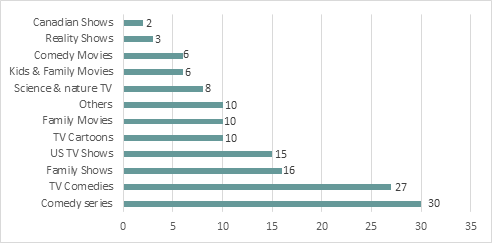
Regarding the genre of the analyzed content, Netflix typically assigns up to three genre classifications per program. Table 1 includes the first categorization listed alongside each analyzed title. Nevertheless, although the sample comprises 68 programs, a total of 143 genre classifications were collected, distributed as shown in Figure 2.
Figure 2. Genre breakdown of interactive content on Netflix Spain (N=143)
Source: prepared by the authors.
The analysis reveals that TV Comedies (30), Kids’ TV (27), Kids & Family (15) and US TV shows (15) are the most common genres. It is important to note that genres with a frequency of only one occurrence were grouped under the Other category, resulting in a total frequency of 10 (including Sci-Fi Movies, Romantic Movies, Romantic Comedy, Special Interests, Adult Animation, British, Documentary Movies, Documentary Series, Indian, and Sports Movies).
Since the same title can belong to multiple genres, the study also conducted a genre concurrency analysis to identify patterns in how genres are combined within Netflix content. This approach helps reveal which genres most frequently co-occur, offering insights for both recommendation strategy design and trend analysis in content production (Table 2).
Table 2. Genres with the highest frequency of coincidence in Netflix Spain content
|
Genre 1 |
Genre 2 |
Frequency
of |
|
TV Comedies |
US TV shows |
30 |
|
Kids’ TV |
Kids & Family TV |
8 |
|
Kids’ TV |
Science & Nature TV |
8 |
|
Kids’ TV |
Kids & Family Movies |
5 |
|
Kids’ TV |
TV Cartoons |
5 |
|
Kids & Family |
Science & Nature TV |
8 |
|
Kids & Family |
TV Cartoons |
8 |
Source: prepared by the authors.
We observed that Comedy and US TV shows coincide in 30 of the 68 analyzed titles. This confirms that a large portion of the comedy content in the sample originates from the United States. Additionally, Kids’ TV and Kids & Family overlap in 8 titles, while Kids’ TV and Science & Nature TV coincide in another 8 cases. Therefore, the genres that are most closely associated with children and family audiences are also those that most frequently overlap with other categories. In other words, the observation of the concurrence of genres determines that most of the content is designed to attract a family audience.
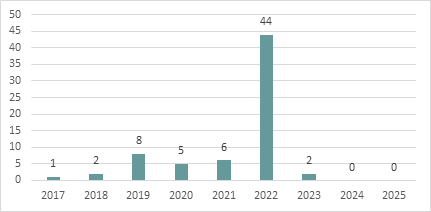
Regarding the year of production, Table 1 shows that 2022 is the most frequent year among the 24 analyzed programs. Considering the total sample (N=68), we found that 44 of the 68 titles were produced in that same year (Figure 3).
Figure 3. Distribution of interactive content on Netflix by year of production (N=68)
Source: prepared by the authors.
Therefore, most of the interactive productions created for Netflix were concentrated in 2022 (64.7%, n=44). This concentration is primarily due to the release of 30 episodes from the Trivia Quest show, 9 episodes from Battle Kitty (Kids’ TV) and 5 movies. No interactive programs produced in 2024 or 2025 were found in the catalog.
Regarding audiovisual production companies, a wide range of entities participated in producing the 24 movies and shows analyzed: a total of 36 different production companies, according to the profile of each title listed in Filmaffinity (2025). The high number of production companies is partly explained by the prevalence of co-productions, which account for approximately half of the content analyzed. It is also important to note that Netflix oversees all productions, as it serves as the sole distributor of this special category of interactive content, which must be compatible with multiple devices (mobile and home television). Such oversight occurs either through delegated production (where Netflix controls the process as a platform) or through direct involvement in production via its own divisions. Specifically, Netflix participates in the production of six titles through Netflix Studios, Netflix Animation and The Netflix Interactive Experiences Team. Table 3 shows the production companies that participate in more than one program in the sample.
Table 3. Production companies involved in multiple interactive programs in the Netflix Spain catalog (N=24)
|
Producer |
Number of titles produced |
|
Netflix Studios |
3 |
|
DreamWorks Animation
|
3 |
|
Netflix Animation |
2 |
|
Atomic Cartoons |
2 |
|
Propagate Content |
2 |
Source: prepared by the authors.
As we can see, there is a great variety and dispersion of interactive content producers, since 31 other companies only participate in one production: Cake Entertainment, The Netflix Interactive Experiences Team, DAE Light Media, Front Row Films, Can & I Will Productions, DHX Media, HMH Productions, WildBrain Studios, Broke and Bones, House of Tomorrow, Mattel Television, Amblin Entertainment, Universal Animation Studios, Universal Pictures, American Greetings Entertainment, Stoopid Buddy Stoodios, Bear Grylls Ventures, Electus, Layzell Bros, WWE Studios, Bevel Gears, Little Stranger, Banijay Asia, Polyphony Digital, Triotech Amusement, Scholastic Entertainment, Titmouse, Treehouse Comix, Hasbro Studios.
3.2. Interactions in Netflix Spain Content
The 68 movies and show episodes were viewed in their entirety from the beginning to the end, accumulating 1,448 minutes watched to detect the number of interactions and how often they are offered to the viewer, as we observe in Table 4.
Table 4. Interaction duration and frequency in Netflix Spain shows and movies (Standard Deviation, SD)
|
Type |
|
|
Mean |
|
Mean
time |
|
|
Shows (Trivia, N=30) |
540 |
0 |
24 |
0 |
7 seconds |
0 |
|
Shows (Interactive, N=17) |
1578 |
662 |
6,2 |
4,7 |
295 |
206 |
|
Movies (N=21) |
2088 |
1213 |
12,1 |
6,7 |
188 |
145 |
|
TOTAL (N=68) |
Mean (N=68) = 1277 |
SD (N=68) = 1008 |
Mean (N=68) = 15.9 |
SD (N=68) = 8.75 |
Mean (N=68) = 135 |
SD (N=68) = 176 seconds |
Source: prepared by the authors.
Table 4 presents the results divided into trivia shows (question-based), interactive shows, and interactive movies (the distinction between interactive and trivia films was not considered meaningful, as only three titles fell into this category). Among all variables, the Standard Deviation (SD) was used not only to compare means but also to assess whether the observed differences were statistically meaningful or simply reflected variability within the sample.
Except for the trivia shows, where identical durations and interaction patterns were recorded across all episodes of Trivia Quiz (see Table 1), no consistent rule or unified strategy was found regarding standard duration, number of interactions, or average interaction interval. For interactive shows, the average duration was 26 minutes, featuring an average of six interactions per program, occurring approximately every 295 seconds. In contrast, interactive movies had a longer average duration (34 minutes), which is shorter than that of traditional non-interactive movies. They also contained more interactions (12 on average), with shorter intervals between them (approximately every 188 seconds).
Furthermore, as outlined in the methodology, a follow-up review was conducted on January 1, 2025, to verify the continued availability of interactive content on Netflix Spain. This review revealed the removal of all such programs from the catalog, with only two remaining titles listed (see Table 5).
Table
5. Interactive programs that remained available on Netflix Spain on
January 1, 2025
|
Content |
Duration (seconds) |
Number of interactions |
Time between interactions (seconds) |
Producer |
|
Black Mirror. Bandersnatch |
4170 (69 minutes) |
32 |
130 |
House of Netflix Studios |
|
Unbreakable, Kimmy Schmidt. Kimmy vs The Reverend |
4800 (80 minutes) |
19 |
216 |
Bevel Gears / Little Stranger / Universal Pictures Television |
Source: prepared by the authors.
Table 5 presents the two titles that remain available in the catalog, both of which are the longest interactive productions in the sample (except for Ranveer vs Wild. With Bear Grylls, which had a similar duration of 70 minutes but has since been removed). In other words, Netflix withdrew all of its interactive content except for Black Mirror: Bandersnatch (2018) and Unbreakable, Kimmy Schmidt. Kimmy vs The Reverend (2020). Although the latter was produced two years after Black Mirror: Bandersnatch, it features fewer interactions and longer intervals between them. This removal strategy appears to be a global decision affecting Netflix’s catalog in all countries, a conclusion supported by our verification through VPN access to the US, Canadian, and UK platforms. Moreover, as of May 14, 2025, Netflix has globally withdrawn all remaining interactive content (including the two titles listed in Table 5) to strengthen its focus on interactivity within the video game division (Kovalova, 2025).
4. Discussion
Based on the previous results, the first specific objective (SO1) of this study was achieved by identifying the main characteristics of existing interactive productions on Netflix. In this regard, it is important to outline the typical features of interactive content on Netflix Spain. The analysis reveals that the most frequent pattern in interactive content corresponds to an interactive (as opposed to trivia) format, delivered as a movie (excluding the disproportionate influence of the Trivia Quest, a 30-episode show that Netflix removed in 2025), which targets children and family audiences, and was generally co-produced in 2022.
Regarding the second objective (SO2), centered on the number of interactions, the findings show that the average duration of interactive content is approximately 21 minutes, featuring an average of 15.9 interactions per program, with viewers prompted to make a decision or respond roughly every 135 seconds.
However, with regards to the third objective (SO3), to assess whether Netflix has maintained a consistent and clear strategy for interactive content, the evidence indicates the opposite. Netflix has not followed a uniform approach to developing or managing this type of production. This inconsistency is apparent across multiple dimensions. For example, no standardized criteria exist for determining when to introduce pauses or interactions, how long each production should last, or how frequently users should be invited to make choices. As shown in Table 4, the Standard Deviation (SD) values are notably wide, reflecting substantial variability among the 68 analyzed titles. One might expect longer productions to contain more interactions, but the data do not support this pattern. There is no coherence in terms of duration, number of interactions, or the interval between them. This diversity is likely linked to the high number of production companies (36) involved. It is concluded that, although these companies worked under Netflix’s supervision, they did not appear to follow a fixed creative or structural model for developing what can only be described as experimental content.
The most evident indicator of this lack of strategy lies in the production dates. The year 2022 stands out with 44 titles (Figure 3), followed by only three in 2023, and by January 1, 2025, all but two interactive productions had been removed from the platform (Table 5). This marks a strategic shift because Netflix temporarily retained two older titles, Black Mirror: Bandersnatch (2018) and Unbreakable Kimmy Schmidt: Kimmy vs. the Reverend (2020), whose durations (69 and 80 minutes) more closely resemble those of non-interactive films on the platform. According to Talker Research (2024), the ideal film length is around 92 minutes, suggesting that these retained titles were better aligned with viewer expectations. Nevertheless, Netflix subsequently removed even these two productions in May 2025 as part of a global strategy to reinforce its investment in the video game sector. Only at this point did Netflix demonstrate a coherent, platform-wide policy regarding interactivity: eliminating interactive content gradually during 2025 to minimize media attention and potential user dissatisfaction.
Interactive movies and shows occupy an ambiguous space between traditional fiction and video games. Netflix’s decision reflects a data-driven understanding of consumption patterns, user preferences, and algorithmic performance. The withdrawal of interactive content supports previous research suggesting that audiences derive pleasure from passive viewing (Owen, 2000), challenging earlier assumptions that interactivity inherently enhances user experience. As a future line of research, focus groups with young viewers could help determine whether audiences actually desire interactive elements when watching movies or shows. Another relevant issue is co-viewing, as viewers increasingly multitask by using additional screens while watching television or streaming content (Barlovento Comunicación, 2022). These multitasking audiences, as defined by Rigo (2021), may engage with secondary activities without necessarily wanting to interact with the narrative itself. Such behavior represents distraction or divided attention rather than genuine narrative participation. Netflix’s decision aligns with Capapé and Oliva (2024), who predicted that, due to limited audience data and unclear metrics, interactive specials were unlikely to have long-term viability.
Therefore, interactive content on Netflix occupies an intermediate position between traditional audiovisual formats (shows and movies) and video games, and this experimental formula has ultimately failed to consolidate. The platform could have retained these productions but instead chose to discontinue them while expanding its video game division. Technological innovation thus evolved into a new business unit: video games, which is distinct from the linear fiction that originally defined Netflix’s model. Interactive content neither fostered user retention nor attracted new subscribers and Netflix clearly recognized greater profit potential in gaming, an industry that in 2024 generated more revenue than the global music and film box offices combined (Alcazar & Braird, 2025). In addition, maintaining interactive titles also posed technical and economic challenges related to compatibility across viewing devices. Netflix’s strategic decision underscores its intent to clarify that «interactivity» no longer means choosing narrative paths but rather engaging with its growing catalog of games. In other words, the company now seeks to reaffirm video consumption as a fully passive experience, encouraging viewers to start one title and seamlessly move to the next without additional input, mirroring the logic of traditional television. In this sense, we agree with Fieiras et al. (2024: 723), who state that on platforms such as Netflix, «it is their operations and user-experience experiments that will define their role in a constantly changing sector lacking long-term stability due to the relentless advance of high technology».
When Netflix first launched its interactive projects, Director Carla Engelbrecht (2017) stated that children’s programming «was the ideal space to begin this project because children love to play with their favorite characters and naturally interact with screens». She also noted that «the key is finding the right stories and storytellers». Yet, eight years later, this content has been discontinued. Economic factors likely played a role: such productions require filming multiple narrative sequences and developing complex scripts with branching endings, which substantially increase costs. However, since these contents had already been produced, their removal suggests a deliberate strategic choice rather than a mere financial adjustment. The absence of a clear trajectory for interactive audiovisual content indicates that its primary promoter has halted all experimentation in this area, instead embracing the 100% interactivity characteristic of video games. In any case, 68 interactive titles represent a negligible proportion of Netflix Spain’s catalog, comprising 5,424 movies and 2,400 shows (Orús, 2025). Netflix was a pioneer in offering interactive streaming content and is now the platform that has chosen to abandon this path. Whether other services will revive this experiment remains uncertain, although current evidence suggests it was merely a temporary phase of audiovisual innovation.
Ethics and transparency
Acknowledgements
We would like to thank Cruz Alberto Martínez Arcos for the English translation of this manuscript.
Conflict of Interest
The authors of this article declare that there is no conflict of interest.
Funding
This research was supported by the project AUDIOPROSUMERS 2.0, funded under the XII Research Call of the Camilo José Cela University.
Author Contributions
|
Contribution |
Author 1 |
Author 2 |
Author 3 |
Author 4 |
|
Conceptualization |
x |
x |
|
|
|
Data curation |
x |
x |
x |
|
|
Formal analysis |
x |
|
|
|
|
Funding acquisition |
x |
|
|
|
|
Investigation |
x |
x |
x |
|
|
Methodology |
x |
x |
x |
|
|
Project administration |
x |
|
|
|
|
Resources |
x |
|
|
|
|
Software |
X |
x |
x |
|
|
Supervision |
X |
x |
|
|
|
Validation |
X |
x |
x |
|
|
Visualization |
X |
x |
x |
|
|
Writing - original draft |
X |
x |
|
|
|
Writing – review & editing |
X |
|
x |
|
Data Availability Statement
For data availability, the authors of the research should be contacted.
References
Alcazar, J. y Baird, S. (2025). Game changer: The evolution of video games’ payments infrastructure. Payment System Research Briefing. Federal Reserve Bank of Kansas City. https://tinyurl.com/4sawm9pa
Ardvin Kester, S. O., Josue, N. L., Urbiztondo, A. M. B., German, J. D. y Espeño, P. R. E. (2024). Evaluation of consumer usage behavior for interactive entertainment: A Netflix case study. Entertainment Computing, 49, 100627. https://doi.org/10.1016/j.entcom.2023.100627
Banfi, R. (2024). Gaming I, II, and III: Arcades, Video Game Systems, and Modern Game Streaming Services. Games and Culture, 19(8), 1000-1037. https://doi.org/10.1177/15554120231186634
Barlovento Comunicación. (2022). Informe: Covisionado. Barómetro TV-OTT. https://tinyurl.com/2hrnjmwd
Benito García, J. M. (2014). El nuevo escenario del mercado audiovisual: un análisis prospectivo de un sector en crecimiento. Revista Mediterránea de Comunicación, 5(1), 123-135.
https://doi.org/10.14198/MEDCOM2014.5.1.09
Bin Mohd Hanapiah, M. L. H. y Binti Md Nasir, S. (2024). A Systematic Review towards Evolution of Interactive Storytelling and Audience Engagement in Films. International Journal of Creative Multimedia, 5(1), 55-73. https://doi.org/10.33093/ijcm.2024.5.1.4
Capapé Poves, E. y Oliva Cantín, H. J. (2024). Caracterización del relato audiovisual interactivo en el catálogo de Netflix España (2024). European Public & Social Innovation Review, 9, 1-17.
https://doi.org/10.31637/epsir-2024-500
Castillo, A., Rosales, G., Tello, R., Valiente, P. y Chambi, M. A. (2021). Articulaciones narrativas: Semejanzas estructurales de la película Bandersnatch de Netflix y el videojuego Become Human de PlayStation Store del año 2018. UCAL. https://tinyurl.com/bdezp4dk
D’Aloia, A. (2020). Against interactivity. Phenomenological notes on Black Mirror: Bandersnatch. Series - International Journal of TV Serial Narratives, 6(2), 21-31. https://doi.org/10.6092/issn.2421-454X/11410
De Zilwa, D. K. (2024). Netflix: rise, fall and recovery. Journal of Business Strategy, 45(6), 405-413. https://doi.org/10.1108/JBS-08-2023-0177
Engelbrecht, C. (2017). Historias interactivas en Netflix: elige qué sucede después. Netflix. https://tinyurl.com/4zbkzt2w
Fieiras Ceide, C., Ufarte Ruiz, M. J. y Murcia Verdú, F. J. (2024). Transformando la experiencia de usuario en televisión en streaming: Prioridades de innovación y tecnología en plataformas OTT. Estudios sobre el Mensaje Periodístico, 30(4), 713-726. https://doi.org/10.5209/emp.96367
Filmaffinity. (2025). Filmaffinity España. https://tinyurl.com/54bzcrkr
Galicia Martínez, A. S. (2024). La expansión de las narrativas transmedia en los videojuegos de las empresas de streaming. Los videojuegos en Netflix: Stranger Things 1984 y Narcos: Cartel Wars Unlimited. Obra Digital, (26), 39-52. https://doi.org/10.25029/od.2024.421.26
Gallardo-Camacho, J. y Jorge-Alonso, A. (2010). La baja interacción del espectador de vídeos en Internet: caso Youtube España. Revista Latina de Comunicación Social, 65, 421-435. https://tinyurl.com/3ryh7r43
Gallardo-Camacho, J., Presol Herrero, Á. y Rubio Jiménez, M. (2024). Las noticias sobre medioambiente en los medios de comunicación españoles verificados por la International Fact-Checking Network. Historia y Comunicación Social, 29(1), 5-16. https://doi.org/10.5209/hics.93310
Gómez-García, S. y Vicent-Ibáñez, M. (2022). ¿A qué juega Netflix? La convergencia de contenidos a través de los videojuegos en su estrategia multietapa. Revista de Comunicación, 21(2), 115-134. https://doi.org/10.26441/RC21.2-2022-A6
Góngora Díaz, G. y Lavilla Muñoz, D. J. (2020). Los nuevos hábitos de consumo audiovisual presentes en la era del usuario interactivo. En J. C. Figuereo Benítez (Ed.), Estudios multidisciplinarios en comunicación audiovisual, interactividad y marca en la red (pp. 79-95). Egregius.
Heredia Ruiz, V. (2018). New business models in broadcast television: the Netflix case. VISUAL REVIEW. International Visual Culture Review. Revista Internacional De Cultura Visual, 5(1), 21-33.
https://doi.org/10.37467/gka-revvisual.v5.1547
Hernández-Pérez, J. F., Albaladejo-Ortega, S. y Raja-Aparicio, D. (2024). Entre la narración y la jugabilidad: explorando la disonancia ludonarrativa en los videojuegos. Comunicación y Medios, 33(49), 80-91. https://doi.org/10.5354/0719-1529.2024.72227
Hidalgo-Marí, T., Segarra-Saavedra, J. y Palomares-Sánchez, P. (2021). Radiografía de los contenidos originales de ficción seriada de Netflix. Communication & Society, 34(3), 1-13. https://tinyurl.com/5x662c5d
Holsti, O. R. (1969). Content Analysis for the Social Sciences and Humanities. Longman Higher Education.
Kiousis, S. (2002). Interactivity: a concept explication. New Media & Society, 4(3), 355-383. https://doi.org/10.1177/146144480200400303
Kovalova, A. (2025). Netflix removed its last two interactive shows from the platform. One is a movie and the other is an episode of Black Mirror. Ain. https://tinyurl.com/4vjbt9fp
Lopera-Mármol, M., Pintor, I. y Jiménez-Morales, M. (2023). Escoge tu aventura: Audiencias inmersivas. El caso de estudio de “Black Mirror: Bandersnatch”. L’Atalante. Revista De Estudios cinematográficos, (35), 63-76. https://tinyurl.com/48kp4e3v
Martín Ramallal, P., Bertola Garbellini, A. y Merchán Murillo, A. (2019). Blackmirror-Bandersnatch, paradigma de diégesis hipermedia para contenidos mainstream VOD. Ámbitos. Revista Internacional de Comunicación, (45), 280-309. https://tinyurl.com/5dfpu4fs
Melero López, I., López Palazón, M. I. y Quiles Bailén, M. (2025). ¿Polarizan los medios? La cobertura mediática en la campaña del 28M en la Región de Murcia. Doxa Comunicación. Revista Interdisciplinar De Estudios De Comunicación Y Ciencias Sociales, (40), 43-66.
https://doi.org/10.31921/doxacom.n40a2188
Mullin, B. (18 de octubre de 2022). Netflix Adds 2.4 Million Subscribers, Reversing a Decline. The New York Times. https://tinyurl.com/36h6u36y
Nee, R. C. (2021). Wild, stressful, or stupid: ¿Qué es Bandersnatch? Exploring user outcomes of Netflix’s interactive Black Mirror episode. Convergence: The International Journal of Research into New Media Technologies, 27(5), 1488-1506. https://doi.org/10.1177/1354856521996557
Neira, E., Clares-Gavilán, J. y Sánchez-Navarro, J. (2024). Keys to streaming success: A Theoretical and Practical Approach to Measuring the Impact of On-Demand Content on SVOD Platforms. VISUAL REVIEW. International Visual Culture Review. Revista Internacional De Cultura Visual, 16(3), 145-165. https://doi.org/10.62161/revvisual.v16.5233
Netflix (9 de noviembre de 2021). Let the Games Begin: A New Way to Experience Entertainment on Mobile. https://tinyurl.com/3s62uwk2
Netflix (2024). Especiales Interactivos en Netflix.
Ong, A. K. S., Josue, N. L., Urbiztondo, A. M. B., German, J. D. y Espeño, P. R. E. (2024). Evaluation of consumer usage behavior for interactive entertainment: A Netflix case study. Entertainment Computing, 40, 100627. https://doi.org/10.1016/j.entcom.2023.100627
Orsal, L. A. (2024). Netflix as a Transverse Transnational Media in Southeast Asia: Exploring the Philippine Context (ProQuest Dissertations & Theses). Northern Illinois University. https://tinyurl.com/yd923ajd
Orús, A. (2024). Número de películas y series de televisión disponibles en Netflix en Europa a fecha de julio de 2024, por país. Statista.
Owen, B. M. (2000). The Internet challenge to television. Harvard University Press.
Powell, A. S. (2020). The musical butterfly effect in Until Dawn. Journal of Sound and Music in Games, 1(4), 22-44. https://doi.org/10.1525/jsmg.2020.1.4.22
Pulukadang, M. T. S., Tumbuan, W. J. F. A. y Tielung, M. V. J. (2024). Distraction or enhancement? Analyzing Netflix user engagement in Black Mirror: Bandersnatch interactive narrative movie. Jurnal EMBA: Jurnal Riset Ekonomi, Manajemen, Bisnis dan Akuntansi, 12(3), 1226-1237.
Rezk, A. M. y Haahr, M. (2022). Beyond free will: Understanding approaches to agency and their suitability for Bandersnatch-like titles. Entertainment Computing, 43, 100500, 1-11.
https://doi.org/10.1016/j.entcom.2022.100500
Rigo, M. N. (2021). Narrativa digital interactiva en un contexto de convergencia. Intersecciones en Comunicación, 1(14). https://tinyurl.com/2rc6cb9u
Rodríguez Fidalgo, M. I., Paino Ambrosio, A. y Ruiz Paz, Y. (2021). La plataforma Dark.Netflix como ejemplo de estrategia de amplificación de la transficcionalidad transmedia. Revista de Comunicación, 20(2), 339-353.
https://doi.org/10.26441/RC20.2-2021-A18
Rodríguez Ortega, V. (2024). Audiovisual streaming, networked memory & Netflix: the spectator-interface. Creative Industries Journal, 17(3), 535-550. https://doi.org/10.1080/17510694.2022.2150814
Saylors, R. G., Klopp, J. A. y Saylors, J. (2025). Bandersnatch and the entrepreneurial imagination: using critical literary methods to illustrate how antenarrative imagination emancipates entrepreneurs from path dependent storytelling. Entrepreneurship & Regional Development, 1-28. https://doi.org/10.1080/08985626.2025.2473106
Scolari, C. (2013). Narrativas transmedia: Cuando todos los medios cuentan. Grupo Planeta. https://tinyurl.com/yzmk9yny
Talker Research. (2024). Research reveals the perfect movie length. https://tinyurl.com/bbmr5zkf
Terrasa-Torres, M. (2022). La estética de la dificultad. Teoría y motivos en el videojuego. Asociación Shangrila Textos Aparte.
Vidal-Mestre, M., Freire-Sánchez, A., Gracia-Mercadé, C. y López-González, J. (2023). Nuevas narrativas audiovisuales mixtas en el sector cinematográfico a través de youtubers. index.Comunicación, 13(2), 271-295. https://doi.org/10.33732/ixc/13/02Nuevas
Villán, M. A. y Ocejo Duce, S. (2019). Elige tu propia aventura: experiencia de usuario, análisis de datos o invasión a la privacidad. XXI° Congreso de la Red de Carreras de Comunicación Social y Periodismo.
Zimmerman, E. (7 de julio de 2004). Narrative, Interactivity, Play, and Games. Electronic Book Review. https://tinyurl.com/yv9pwe2k