index●comunicación
Revista científica de comunicación aplicada
nº16(1) 2026 | Pages 301-325
e-ISSN: 2174-1859 | ISSN: 2444-3239
Climate Activism on Instagram: Classifying Visual and Semantic Narratives
Activismo climático en Instagram: una clasificación de narrativas visuales y semánticas
Received on 31/03/2025 | Accepted on 15/09/2025 | Published on 15/01/2026
https://doi.org/10.62008/ixc/16/01Activi
Ángela Alonso Jurnet | University of the Basque Country (EHU)
angela.alonso@ehu.eus | https://orcid.org/0000-0002-8402-6712
Ainara Larrondo Ureta | University of the Basque Country (EHU)
ainara.larrondo@ehu.eus | https://orcid.org/0000-0003-3303-4330
Jordi Morales i Gras | University of the Basque Country (EHU)
jordi.morales@ehu.eus | https://orcid.org/0000-0003-4173-3609
Abstract: This study examines the visual and semantic dimensions of climate crisis communication on Instagram from the perspective of climate activism, focusing on periods of sustained mobilization beyond peaks of newsworthiness. Based on the analysis of 280,969 posts through big data techniques, this research identified a predominant narrative centered on aesthetics and marked by limited human representation, though nuanced by inspiring and positively framed discourses. On a semantic level, narratives range from aesthetic contemplation to climate protest and the promotion of sustainable consumption. Communication, however, faces challenges such as the influence of commercial dynamics, reliance on media figures and the limited presence of scientific perspectives. This study highlights the need for a more realistic and committed representation of human impact on the climate crisis and proposes a typology of visual and semantic narratives that could be useful as a valuable tool for future research into climate communication in digital environments.
Keywords: Instagram; Digital Activism; Social Media; Climate Crisis; Big Data.
Resumen: Este estudio examina las dimensiones visuales y semánticas de la comunicación de la crisis climática en Instagram desde la perspectiva del activismo climático, centrándose en períodos de movilización sostenida más allá de picos de noticiabilidad. A partir del procesamiento de 280.969 publicaciones mediante técnicas big data, se identifica una narrativa predominante centrada en la estética y con escasa representación humana, aunque matizada por discursos aspiracionales de tono positivo. En el plano semántico, emergen narrativas que oscilan entre el plano estético, la protesta climática y la promoción del consumo sostenible. La comunicación enfrenta retos como la influencia de dinámicas comerciales, la dependencia de figuras mediáticas o la limitada presencia de enfoques científicos. El estudio plantea la necesidad de una representación más realista del impacto humano en la crisis climática y propone una tipología de narrativas visuales y semánticas que constituye una herramienta útil para futuras investigaciones en comunicación climática digital.
Palabras clave: Instagram; activismo digital; redes sociales; crisis climática; big data.
CC BY-NC 4.0
To quote this work: Alonso-Jurnet, A. Larrondo-Ureta, A. & Morales-i-Gras, J. (2026). Climate Activism on Instagram: Classifying Visual and Semantic Narratives. index.comunicación, 16(1), 301-325. https://doi.org/10.62008/ixc/16/01Activi
1. Introduction
The climate crisis has become one of the greatest global challenges of our time, impacting all aspects of life on the planet, and despite international commitments climate action remains insufficient for preventing catastrophic consequences. In the face of this challenge, communication of the climate crisis has been identified as a crucial element for raising awareness and fostering engagement with this issue (Bernstein & Hoffmann, 2019). Communication plays an essential role in increasing awareness and recognizing the challenge posed by sustainability, as well as in sensitizing the public to the anthropogenic origin of the climate crisis, acting as an intermediary between the scientific sphere and the social fabric. Nevertheless, effectively conveying the reality of this crisis represents a complex task for the different actors involved. This difficulty arises, in part, because many people consider it an abstract non-linear phenomenon requiring global collaboration; it has also become a highly politicized issue (Chapman et al., 2016; Boykoff et al., 2022).
One promising aspect for effective communication of the climate crisis is social media, an open space where people express themselves freely and interact with each other. These digital environments play a fundamental role in fostering civic debate and the exchange of ideas related with issues of social relevance (Segado-Boj et al., 2020), among them the climate crisis (Zhang & Skoric, 2018). In a cultural and social context characterized by the supremacy of audiovisuals, Instagram has consolidated its position as a highly relevant platform (Leaver et al., 2020), with two billion active monthly users worldwide, according to Statista.com (June 2025). Its impact is especially notable among younger audiences (Huang & Su, 2018).
Given that visual communication plays a leading role on Instagram, it is crucial to consider how environmental issues are visually represented. In particular, the images used to communicate the climate crisis have a significant impact on public perception of its urgency, as well as on the attitudes and emotions it generates in society (O’Neill et al., 2013; Chapman et al., 2016; Metag, 2020).
Thus, in this study, visual discourse is understood as the set of meanings articulated through images on social media via resources such as composition, framing, color, or the presence of participants, in line with the grammar of visual design proposed by Kress and van Leeuwen (2006). In turn, semantic discourses are conceived as the shared meanings that emerge from hashtags, keywords and texts, structuring narrative frames and conceptual links.
Although research on this topic to date has focused primarily on Western traditional media (Agin & Karlsson, 2021), the exploration of environmental narratives on social media is attracting increasing attention, with its potential for effective communication being particularly highlighted (Anderson & Huntington, 2017; Hautea et al., 2021; Vu et al., 2021; Nieto-Sandoval & Ferré-Pavia, 2024; Vicente-Torrico et al., 2024). More specifically, the phenomenon of digital activism on social media is seen as a new form of environmental communication that facilitates civic engagement and action (San Cornelio et al., 2024). In this regard, recent research has shown how climate activism on platforms such as Instagram articulates new forms of environmental communication and emerging visual narratives, thus establishing these environments as privileged spaces for aesthetic experimentation and the dissemination of sustainable discourses (San Cornelio & Pujol, 2025).
In addition, several recent studies have explored the semantic discourses around climate change on social media by: analyzing the co-occurrence of hashtags and keywords to identify thematic structures (Shi et al., 2020); characterizing narrative frameworks linked to labels such as #Climatechange and #Globalwarming (Graham & Golder, 2024); and examining the way in which non-governmental organizations configure their semantic messages to generate resonance on digital platforms (Kim & Hara, 2024). Taken as a whole, these studies highlight the capacity of hashtags to organize conversations, make narratives visible and articulate shared meanings about the climate crisis in the digital space.
Thus far, the social media platform that has received the greatest academic attention is X (formerly Twitter), partly due to its programmatic interface (API) facilitating access to users’ posts for a number of years (Pearce et al., 2018), thereby enabling the analysis of digital conversations and their interactions. However, since Elon Musk acquired the company in 2022, the access model has changed substantially: in 2023 the API ceased to be free and became available only through paid plans. This modification has significantly reduced academic and journalistic access to the data.
Starting from this premise, the study of climate communication on Instagram is of particular interest from the perspective of digital activism. In addition, the analysis of continuous periods, distanced from peaks of newsworthiness is an area as yet unexplored. Considering the need to construct cohesive visual narratives that complement and reinforce textual messages about the climate crisis (DiFrancesco & Young, 2011), this study adopts a holistic perspective, integrating the interrelation between visual and semantic discourses.
1.1. Instagram: Activism for Climate Action through Visuals
Several studies have analyzed the media coverage of the climate crisis from different perspectives (Chinn et al., 2020; O’Neill et al., 2023), such as risk communication (Painter & Hassol, 2020), audience responses to different framings (Badullovich et al., 2020), or the use of images in representing the phenomenon (Schäfer, 2012; Pearce et al., 2018; Agin & Karlsson, 2021). Traditionally, the news media have represented the climate crisis through images of distant impacts, such as polar landscapes or smoking chimneys, generating concern but limiting the perception of self-efficacy (O’Neill & Smith, 2014). In contrast, more mobilizing images, such as everyday solutions or nearby impacts, are used less frequently (Schäfer & Yan, 2023). Since images can evoke positive or negative emotions and even influence behavioral intentions depending on their content (Metag, 2020), various studies have focused on seeking greater impact for visual climate campaigns. Local personalization (Schroth et al., 2014), data simplification (Calvo et al., 2021), or the use of solution-oriented images (Chapman et al., 2016) are promising developments.
In this context, social media platforms emerge as a strategic space in which to raise awareness and mobilize the audience. For example, they have great potential for fostering bidirectional exchanges that combine information, emotions, and values in an interactive and visually attractive environment (Ettinger & Painter, 2023). Nevertheless, other studies warn about the toxicity of these platforms, whose business models, centered on maximizing engagement, fragment public discourse and hinder the coordination of global actions against the climate crisis (Couldry, 2023). The logic of social media has undeniably transformed communication of the climate crisis by allowing direct public participation, diversifying visual narratives, and fostering greater aesthetic experimentation (Mooseder et al., 2023; Schäfer & Yan, 2023), an aspect that underlines the need for qualitative analyses of visuals on social media (Pearce et al., 2018).
It has been observed that content creators on social media employ visual strategies known as «gateway visuals» to capture audience attention through positive emotions and accessible elements, and then go on to introduce more complex messages about the climate crisis (Harvard & Hyvönen, 2023). Furthermore, it has been concluded that images featuring real people, emotional narratives, local connections, and direct impacts generate greater interaction and reinforce the perception of the climate crisis as a nearby and relevant problem (León et al., 2022). On X, hashtags associated with #climatechange are often accompanied by graphics, landscapes, and scenes of protest. At the same time, images that humanize the issue, such as demonstrations or emotional representations, tend to generate stronger audience connection, although their use remains less frequent (Mooseder et al., 2023).
Instagram has been recognized as a key platform for understanding and mapping the visual cultures of social media (Leaver et al., 2020: 2). On this platform, various actors involved in communicating the climate crisis use images to transform an abstract and complex phenomenon into something tangible (Wozniak, 2020). This is unsurprising when we consider that images foster a more intense and coherent emotional connection with the audience than written text does (Barry, 1997).
These findings align with the Climate Visuals initiative, which proposes seven key principles for effective visual communication of the climate crisis through the use of impactful, evidence-based images (Climate Outreach, n.d.). Its principles emphasize the importance of showing real people, telling new stories, representing the large-scale causes of climate change, and evidencing its impacts in an emotionally powerful way. They also stress the importance of adapting the message to the audience, prioritizing local impacts, and being cautious with the use of protest images. The study of visuals on social media constitutes a field of great interest in light of these guidelines, together with the opportunities that artificial intelligence and automated analyses offer for identifying trends and adjusting communication strategies in real time (Kokoschka et al., 2024).
Communication of the climate crisis often follows the «issue-attention cycle» (Downs, 1972), in which media interest concentrates on specific climate events that capture attention for a time before declining until the next relevant occurrence (Djerf-Pierre, 2012; O’Neill, 2020; Boykoff et al., 2022). Thus, the United Nations Climate Change Conferences (COP) and the IPCC Assessment Reports have been identified as international milestones that drive global media coverage of the phenomenon (Schäfer, 2020).
In this context, sustained digital activism, removed from peaks of newsworthiness, becomes especially relevant for understanding how climate discourses are structured and communicated continuously. Although digital activism is a concept subject to multiple interpretations (Ozkula, 2021), and its impact may be limited in certain contexts or communities (George & Leidner, 2018), integrating a sustained perspective not only broadens its potential influence but also contributes to more effective climate communication. Social media, by combining the dissemination of information with emotional elements, foster citizen engagement in the fight against the climate crisis and strengthen the creation of online communities (Segerberg & Bennett, 2011; Painter et al., 2018). Their versatility and capacity to adapt to the different actors involved in climate communication are two of their key aspects (León & Erviti, 2021). Along these lines, a Pew Research Center survey (2021) in the United States revealed that social media users committed to the climate cause tend to support policies aimed at mitigating its effects to a greater extent.
This study assigns major importance to hashtags, both in sample selection and in semantic analysis. These digital elements allow the thematic organization of images through the use of keywords preceded by the symbol «#», facilitating content search and increasing its visibility. In addition to their practical utility, hashtags play a key role in the construction of collective narratives, drawing attention to certain issues and fostering user participation – users who actively engage in content generation and in the consolidation of digital communities around shared interests (Giannoulakis & Tsapatsoulis, 2016). Hashtags have proven to be an effective tool for expressing personal viewpoints and advocating for diverse social causes. Through them, users can articulate individual discourses in the digital space that become amplified in both reach and resonance when integrated into a collective framework (Mihăeş et al., 2021). In this regard, it has been observed that hashtags can enhance social mobilization and activism, giving rise to the phenomenon known as «hashtivism». This concept has been widely analyzed within the context of emblematic movements such as #BlackLivesMatter (Edrington, 2022) and #MeToo (Hillstrom, 2018), in which the strategic use of hashtags contributed significantly to the dissemination of messages, global awareness, and the articulation of social demands.
The main aim of this study is to explore and characterize the most relevant digital communities that generate environmental content on Instagram, analyzing their visual and semantic dynamics. Based on the research opportunities offered by periods of sustained activism, the study focuses on understanding how these discourses are structured and communicated in a continuous manner.
The research questions that guide the study are the following:
1. How is the configuration of digital communities that generate environmental content on Instagram established during periods of sustained activism? (RQ1).
2. What are the main visual narratives that predominate in these communities? (RQ2).
3. What are the characteristics of the semantic discourses that emerge in these digital communities, both in terms of content and structure? (RQ3).
2. Methodology
To analyze the configuration of digital communities participating in the climate conversation on Instagram during periods of sustained activism (RQ1), a real-time data extraction was carried out through Orange Data Mining (Demsar et al., 2013) —an open-source data analysis and machine learning platform— and also PhantomBuster, an automation tool that allows data extraction from social media and other web platforms. A sample of 280,969 Instagram posts was obtained from February 1, 2022, to November 30, 2022. During this period, several important events related to the climate crisis took place, such as the publication of the report Climate Change 2022: Impacts, Adaptation and Vulnerability (IPCC, 2022), COP27, the United Nations Environment Assembly, and World Environment Day. Although these events may have influenced the dynamics of conversation and activism on social media, the nine-month analysis period of this study is sufficiently extensive to provide a valuable perspective on sustained activism beyond the peaks of attention generated by these prominent events, thus allowing the capture of sustained patterns and trends in climate conversations on Instagram.
Data extraction was carried out through the monitoring of several hashtags related to the climate crisis. The criteria for selecting hashtags were based on the number of posts associated with each hashtag at the time of sample selection and on the representativeness of international climate movements and events (view supplementary material: Appendix 1).
Following data extraction, an image graph was constructed using the OpenAI model openai/clipvit-large-patch14, which enables the identification of complex relationships within structured data, such as images. In this case, the model allowed the vectorization of images by generating embeddings —numerical representations that capture the visual characteristics of images. Thanks to these models, communities or clusters could be identified based on visual features. Similarity between images was measured using cosine distance, considering that images belonged to the same community when similarity was greater than 0.7, thus ensuring that visual communities were mutually exclusive. This metric was selected due to its performance in multidimensional contexts (France et al., 2012), allowing accurate evaluation of similarities in content orientation. The network was partitioned using the Louvain Multilevel community detection algorithm (Blondel et al., 2008).
A filter was applied to avoid duplication —establishing a maximum value of 0.9 cosine distance— since even minimal differences in the pixels of an image could generate new nodes. Within the resulting graph, detailed analysis was carried out on those communities containing at least 2% of the nodes in the total graph, thereby achieving a balance between precision and feasibility of analysis in addition to providing a representative view of the visual and discursive trends and content dynamics of the climate crisis on Instagram.
In order to analyze the predominant visual discourses in these digital communities (RQ2), a qualitative description of them was done. For this purpose, techniques of conventional qualitative content analysis (Hsieh & Shannon, 2005) were applied to the visual content, inductively developing a coding framework in response to emerging categories. However, it should be clarified that the analysis applied is not strictly speaking a classic content analysis, but rather adopts a hybrid approach with semiotic and discursive elements, thus enabling the capture of both thematic dimensions and the narratives and aesthetics of the images. In this way, the coding framework included thematic categories (identification of themes, calls to action, and tone of the message) and visual categories (presence of natural or human elements, use of text in images, and predominant colors).
Finally, to analyze the semantic discourses present in each of these communities (RQ3), semantic networks were generated for each cluster of images, applying a stopword filter in several languages to eliminate common non-informative words and thus more accurately capture the discourses associated with the images.
3. Results
3.1. Leadership and Interaction of Visual Communities
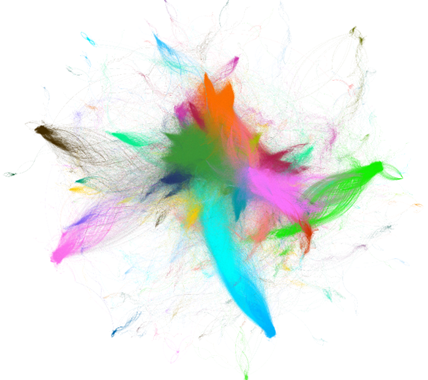
In accordance with the methodological criteria indicated in the previous section, the graph generated through the model openai/clipvit-large-patch14 consisted of 79,550 nodes and 3,643,898 edges. Within it, each image generated a point, and each link between two points represented a cosine similarity relationship greater than 0.7. Consequently, 247 communities were detected based on similar visual characteristics, which represent the different visual narratives (Figure 1).
Figure 1. Graph of Visual Communities
Source: Own elaboration through «openai/clipvit-large-patch14».
From the communities detected, those containing at least 2% of the nodes of the total graph were analyzed in detail, resulting in a total of 14 communities that included 79.33% of the network’s nodes. Table 1 describes these communities (note that the numerical names assigned to the communities are random), including the percentage of nodes contained in each community, the total number of posts, likes and comments, as well as the average number of likes and comments.
Table 1. Characteristics of the main visual communities
|
Name |
Percentage
of |
Posts |
Likes |
Comments |
||
|
Total |
Average |
Total |
Average |
|||
|
3 |
16.86% |
13,451 |
499,525 |
37.14 |
25,131 |
1.87 |
|
10 |
13.71% |
10,979 |
715,039 |
65.13 |
15,591 |
1.42 |
|
12 |
6.91% |
5,510 |
766,669 |
139.14 |
16,540 |
3.00 |
|
1 |
6.10% |
4,878 |
128,179 |
26.28 |
12,564 |
2.57 |
|
8 |
5.30% |
4,226 |
177,781 |
42.07 |
7,221 |
1.71 |
|
6 |
4.79% |
3,818 |
77,317 |
20.25 |
5,407 |
1.42 |
|
21 |
4.01% |
3,189 |
246,935 |
77.43 |
7,403 |
2.32 |
|
28 |
3.88% |
3,112 |
408,481 |
131.26 |
8,244 |
2.65 |
|
7 |
3.86% |
3,092 |
65,591 |
21.21 |
2,920 |
0.94 |
|
14 |
3.66% |
2,919 |
95,571 |
32.74 |
6,827 |
2.34 |
|
5 |
3.04% |
2,420 |
148,437 |
61.34 |
18,220 |
7.53 |
|
26 |
2.69% |
2,140 |
32,813 |
15.33 |
4,230 |
1.98 |
|
0 |
2.36% |
1,882 |
419,937 |
223.13 |
6,311 |
3.35 |
|
4 |
2.16% |
1,719 |
78,716 |
45.79 |
2,565 |
1.49 |
Source: Own elaboration[i].
Although some communities have fewer nodes, they stand out for higher interaction averages. For example, Community 12, with 5,510 posts, achieves an average of 139.14 likes per post and 3 comments, surpassing more active communities such as Community 1. However, these averages are low for Instagram, suggesting that the content —although relevant within these communities— does not achieve high levels of interaction on the platform.
Attention was also paid to the lead users of each visual community, both in terms of the number of posts published and the number of likes received (view supplementary material: Appendix 2). Leadership within these clusters reflects different approaches to environmental activism, sustainability and outreach. Cluster 3 was led by accounts focused on ecology and the environment, although the highest number of interactions was achieved by news media outlets, influencers, and accounts about travel and biodiversity. Similarly, Cluster 10 and Cluster 21 were led in both posts and interactions by activists and environmental NGOs. In Cluster 12, accounts dedicated to nature and wildlife photography predominated in terms of the number of posts, while various accounts associated with National Geographic obtained the highest number of likes. On the other hand, Cluster 1 was marked by the participation of visual artists, dominating both in posts and interactions. Cluster 8 was driven by anonymous climate activists focused on litter collection, while environmental content accounts led in the number of likes. Similarly, Cluster 6 was led by ecological sales and service channels, although influencers with travel and cooking-based content accumulated more interactions in the form of likes. Youth activism and social mobilization were prominent in Cluster 28, highlighting the participation of Fridays for Future. In Cluster 7, posts were led by news media outlets and renewable energy companies, while likes were concentrated on influencers, NGOs, and specialized news media. Cluster 14 was driven by photography and illustration accounts with an environmental focus, with an influencer obtaining the highest number of likes. Regarding Cluster 5, it was led by influencers and anonymous users interested in the environmental sector, while Cluster 26 led in posts by sustainable clothing stores, although interactions were concentrated on travel, fashion, and sustainability influencers. Post leadership in Cluster 0 came from accounts specialized in climate and meteorology, while traditional and independent news media stood out in likes. Finally, in Cluster 4, environmental activists predominated in posts, but likes were mostly obtained by accounts on environmental content, NGOs, and sustainability projects.
Thus, within the communities there is an unequal dynamic in the attention received by each actor. While activists, NGOs, and committed users lead in content creation, news media outlets and influential figures —such as National Geographic and well-known travel and nature influencers— are the ones who actually command greater attention. This phenomenon is particularly evident in clusters such as 3 and 12, where engagement is concentrated on news media accounts and influencers even though activists and nature photographers generate the largest number of posts.
3.2. Exploration of Visual Narratives
The visual narratives observed in the analyzed clusters (view supplementary material: Appendix 3) show, on the one hand, a representation of nature without human intervention. This is the case of Cluster 3, which represents biodiversity with photographs of vegetation in green tones; Cluster 12, which shows oceans and natural environments in blue and cool tones; and Cluster 8, which portrays marine plastic pollution, using impactful images of contaminated oceans.
Clusters with a more social and activistic focus can also be observed, such as Cluster 10, which calls for action against the climate crisis with iconography and messages overlaid onto images of nature; or Cluster 28, which documents climate protests with textual content. Cluster 21, in turn, focuses on the relationship between natural resources and communities in impoverished countries, using images with a strong human presence in green and brown tones.
Art and creativity find their space in Cluster 1, composed of digitized abstract artworks with vibrant colors, and Cluster 14, which highlights floral elements with vivid and striking tones.
On the other hand, Clusters 6 and 26 show a commercial focus, with images of fresh fruits and vegetables, and photographs of clothing items without human presence, respectively. Human presence is more visible in Cluster 5, where portraits of people posing predominate.
In the field of energy and pollution, Cluster 7 contrasts images of chimneys emitting gases with photographs of renewable energies, especially wind turbines. Clusters 0 and 4, in turn, adopt an informative approach with graphics and data on climate and soil conservation, using eye-catching infographics and warm colors.
3.3. Exploration of Semantic Discourses
The semantic networks of the different clusters reflect how the conversation on the climate crisis is articulated across different approaches and communities, encompassing activism and protest, visual aesthetics, sustainability, and scientific outreach (view supplementary material: Appendix 4). In some cases, such as in Clusters 3 and 12, communication revolves around the aesthetics of nature and its preservation, linked to photography and the visual representation of the environment. These clusters present a modularity (Q=0.39 and Q=0.46 respectively) indicating some differentiation between discourses. In contrast, Clusters 10 and 28 reflect a more homogeneous conversation (Q=0.22 and Q=0.18 respectively) focused on climate activism, social mobilization, and climate justice, with key terms such as «protest», «Fridays for Future» and «climate crisis».
Sustainability and responsible consumption also emerge as important narratives in Clusters 6 and 26, where the conversation focuses on food, sustainable design, and waste reduction, with a strong link to social media virality and organized into differentiated thematic communities (Q=0.30 and Q=0.32 respectively). On the other hand, Cluster 1 introduces an artistic perspective on climate change, using art as a means to raising awareness, with an equally segmented structure (Q=0.37). Similarly, Cluster 8, focusing on the ocean crisis and plastic pollution, presents a modularity of Q=0.33, which also indicates some differentiation among its discourses.
In terms of scientific data and extreme climate events, Cluster 0 shows stronger interconnection (Q=0.22) among discourses on climate monitoring and global trends. Cluster 4, in turn, addresses the relationship of climate change with water, carbon, and biodiversity, with a modularity of Q=0.25. Finally, Clusters 7 and 14 present a modularity of Q=0.34 and Q=0.32 respectively, reflecting some segmentation in their discourses: the former focuses on the energy transition and renewable energies with a combination of technological innovation and global policies, while the latter links biodiversity with visual representation and ecological awareness.
3.4. Visual and Discursive Analysis of Environmental Content on Instagram
Table 2 brings together the main characteristics described in the previous sections, along with the detailed analyses that can be found in the supplementary material. Each cluster represents a thematic and discursive space on Instagram, with the interaction dynamics and particular actors that shape environmental communication during a period of sustained activism.
Table 2. Visual and discursive analysis of environmental content on Instagram
|
Cluster |
Description |
Main leaders |
Visual |
Hashtags |
|
3 |
Aesthetic
|
National Geographic and other environmental outreach media |
Photographs of nature and biodiversity, without human presence, predominance of greens and browns |
nature; planet; photography; climatechange; earth |
|
10 |
Protest narrative and direct action against the climate crisis |
Greta Thunberg and Greenpeace |
Photographs
of protests with overlaid text, with human presence, |
fridaysforfuture; actnow; climatejustice; |
|
12 |
Nature,
wildlife, and biodiversity |
National |
Photographs of oceans and wildlife, without human presence, cool colors (blues and greens) |
wildlife; naturephotography; landscape; natgeowild; biodiversity |
|
1 |
Art and visual expression of the climate crisis |
Independent visual artists |
Abstract artworks, bright and varied colors, without human or natural presence |
art; climatechange; artist; environmental; sustainability |
|
8 |
Local activism focused on litter collection |
Anonymous local activists |
Photographs of polluted oceans, without human presence, predominance of blues |
ocean; plastic; zerowaste; pollution; savetheplanet |
|
6 |
Conscious consumption, vegan food, and ecological products, promoting the reduction of environmental impact |
Sustainable lifestyle influencers |
Photographs
of food and ecological |
vegan; bio; zerowaste; organic; greenliving
|
|
21 |
Local organizations for conservation and environmental awareness at the regional level |
Small NGO and independent activists |
Photographs
of people in contact with nature, predominantly green and brown |
gogreen; sustainability; pollution; wildlife; savetheplanet |
|
28 |
Youth activism, protests, and climate actions organized globally |
Fridays for Future and Greta Thunberg |
Photographs of protests with banners and activists, with human presence, predominance of greens |
climatestrike; peoplenotprofit; klimakrise; activism; socialchange |
|
7 |
Energy transition and emissions reduction |
Renewable energy companies |
Photographs of chimneys emitting gases and wind turbines, without human presence |
renewableenergy; emissions; climatechange; cop26; innovation |
|
14 |
Representation of biodiversity |
Photography accounts |
Photographs of flowers and natural elements, bright and vibrant colors |
species;
photography; environment; flowers; |
|
5 |
Engagement
strategies without environmental |
Anonymous users |
Photographs of people |
nature;
|
|
26 |
Sustainable fashion and conscious consumption |
Sustainability influencers and clothing stores |
Photographs of products |
sustainability; slowfashion; ecofriendly; ethicalfashion; lesswaste |
|
0 |
Climate crisis and global meteorology with a focus on extreme weather events and scientific data |
Traditional news media and accounts specialized in meteorology |
Infographics with text, warm colors (reds, oranges) |
climatecrisis; weather; extreme; temperature; warming |
|
4 |
Dissemination of scientific information on the impact of climate change |
WWF (@WWF) and UN Climate Change |
Infographics with eye-catching text |
climate; carbon; biodiversity; food; agriculture |
Source: own elaboration.
4. Discussion and Conclusions
The qualitative analysis carried out from the images and discourses present in digital communities represents one of the first approaches to visual and semantic narratives around the climate crisis on Instagram during periods of low newsworthiness. This study, therefore, expands on the focus of previous research which has concentrated on specific events (Painter et al., 2018), on traditional news media (O’Neill, 2020), or on other social platforms (Mooseder et al., 2023). Furthermore, by addressing the phenomenon from the perspective of digital activism, this research aims to contribute to the development of more effective and mobilizing environmental communication on social media.
The analysis identified visual communities with different levels of interaction, led by diverse profiles reflecting varied approaches to environmental activism, sustainability, and outreach. Although the climate conversation is broad and diverse, most interaction was concentrated into news media outlets and influencers, while activists and NGOs —despite generating a significant volume of posts— did not achieve the same level of engagement. This raises a key question: who defines the agenda of environmental discourse on social media? The high presence of influencers and commercial news media suggests that content popularity does not always translate into a direct impact on social mobilization; the reliance of environmental discourse on media figures and news media outlets may hinder the visibility of critical narratives promoted by activists and independent organizations. The platform’s algorithmic dynamics favor the virality of more visually attractive or superficial content, to the detriment of initiatives focused on political impact or structural change. This presents a challenge for digital activism, as its reach on social media does not always translate into effective impact within the platform’s algorithmic logic. As concluded in previous studies, although social media platforms allow any user to access them and participate, they do not feature as much source diversity as might be expected (Newman, 2017; Veltri & Atanasova, 2017).
This study also identifies various predominant visual narratives. Among them, there is an emphasis on the beauty of nature and biodiversity without human presence, conveying the climate crisis through aesthetically attractive images that reinforce the need for conservation, but with less attention paid to the direct impact of human activity on the environment. Previous studies have also observed a low human presence, despite evidence that users prefer images that humanize the issue and represent it emotionally (Mooseder et al., 2023). This is an aseptic approach that may limit the capacity for raising awareness and for social mobilization, thus diluting the sense of urgency required for climate action.
Moreover, the representation of extreme events or environmental disasters is limited, despite it being highly relevant for climate communication (Painter & Hassol, 2020). This aspect again suggests that the platform prioritizes aesthetics and visual activism over the explicit denunciation of ecological damage. Similarly, informational approaches based on data and graphics have a lower presence and impact compared to other more visual or emotional formats. At the same time, climate discourse is articulated from a perspective of responsible consumption, promoting ecological products and sustainable practices. This growing trend towards environmental communication as a lifestyle is seen as a promising aspect for environmental messaging.
The analysis of semantic networks shows how the climate conversation on Instagram is structured through different approaches, with varying levels of integration among them. While some clusters present higher modularity, reflecting differentiated discourses, others show greater homogeneity, especially those focused on protest and social mobilization. In general, hashtags tend to be related to the images they accompany, although in some cases they are used primarily as virality tools or commercial strategies for product promotion. This phenomenon contrasts with the significant disconnection observed in the traditional news media between images and the texts that accompany them (DiFrancesco & Young, 2011). In this regard, the interconnection between images and text on Instagram represents a key aspect for the construction of cohesive narratives, especially in the context of climate activism, where visual and discursive coherence can enhance the impact of the message.
In this exploratory study, the representation of the climate crisis appears to be based mainly on aesthetically attractive images that emphasize the beauty of nature and biodiversity without human presence. This has the effect of diluting the sense of urgency and pushing to the background the direct impact of the climate crisis on vulnerable populations. Thus, climate justice remains a secondary topic in Instagram’s visual conversation, with narratives focused on a global view of the problem without a clear emphasis on climate inequality. Furthermore, the platform tends to favor the virality of large media actors and easily shareable content, to the detriment of more informational or scientifically grounded approaches.
Climate communication on Instagram is also influenced by commercial dynamics, with a growing link between environmental discourse and responsible consumption, promoting ecological products and sustainable lifestyles. This approach can be attractive and accessible to a wide audience, although at the same time it risks individualizing the problem and diverting attention away from the necessary structural solutions.
In conclusion, while sustained climate activism on Instagram contributes to maintaining a positive and inspiring message, it faces significant challenges. It is necessary to foster a more realistic and committed representation of human impact on the climate crisis, as well as a greater integration of climate justice into the digital conversation to generate more effective and inclusive social mobilization. Likewise, it is pertinent to reflect on the capacity of these visual and semantic dynamics to articulate true shared spaces for collective action. Although the analysis has enabled the identification of shared patterns, the question remains as to whether these go as far as to form spheres of encounter that drive global climate action, or if they are limited to aesthetically grouping similar images. This issue aligns with the arguments of Babo (2021), who emphasizes the importance of questioning the real reach of digital activism in the creation of common spaces.
This research is not without limitations. While the analysis of posts on these platforms makes it possible to identify public beliefs with the potential to influence individuals, news media outlets, and policymakers (Freelon et al., 2016), they cannot be treated as surveys that directly reflect public opinion or general attitudes (Lin et al., 2013). In addition, aggregating thousands of posts may limit the capacity to explore the subtler nuances of conversational exchanges and the evolution of debates among users (Ettinger & Painter, 2023). Nevertheless, given the exploratory nature of the study, Social Network Analysis (SNA) techniques applied within the big data paradigm constitute a valuable tool for deepening the understanding of digital public opinion (Lin et al., 2013). Going forward, it would be pertinent to move towards longitudinal and comparative studies that integrate qualitative and quantitative approaches. Such approaches would allow for a more precise capture of discourse evolution over time, whilst also analyzing how this influence social perceptions and climate mobilization, offering a more robust framework with which to evaluate communicative effectiveness on social media.
Ethics and Transparency
Acknowledgements
The authors of this article thank Angela Jones for her English translation of the article.
Conflict of Interest
The authors of this article declare that there is no conflict of interest.
Funding
This study is part of the academic production of the ‘Gureiker’ Research Group of the Basque University System (IT1496-22).
Author Contributions
|
Contribution |
Author 1 |
Author 2 |
Author 3 |
Author 4 |
|
Conceptualization |
X |
|
|
|
|
Data curation |
X |
|
X |
|
|
Formal Analysis |
X |
X |
|
|
|
Funding acquisition |
|
X |
|
|
|
Investigation |
X |
X |
X |
|
|
Methodology |
X |
|
X |
|
|
Project administration |
|
X |
|
|
|
Resources |
|
X |
X |
|
|
Software |
|
|
X |
|
|
Supervision |
X |
|
X |
|
|
Validation |
|
X |
|
|
|
Visualization |
|
|
X |
|
|
Writing – original draft |
X |
|
|
|
|
Writing – review & editing |
X |
X |
|
|
Data Availability Statement
Supplementary material for the research is available at the following link: https://doi.org/10.5281/zenodo.17227316
References
Agin, S. & Karlsson, M. (2021). Mapping the Field of Climate Change Communication 1993–2018: Geographically Biased, Theoretically Narrow, and Methodologically Limited. Environmental Communication, 15(4), 431-446. https://doi.org/10.1080/17524032.2021.1902363
Anderson, A. A. & Huntington, H. E. (2017). Social Media, Science, and Attack Discourse: How Twitter Discussions of Climate Change Use Sarcasm and Incivility. Science Communication, 39(5), 598-620. https://doi.org/10.1177/1075547017735113
Babo, I. (2021). Ativismo em rede e espaço comum. As mobilizações globais de protesto pelo clima [Network activism and common space: Global climate protest mobilizations]. Revista Crítica de Ciências Sociais, (126), 25-46. https://doi.org/10.4000/rccs.12398
Badullovich, N., Grant, W. J. & Colvin, R. M. (2020). Framing climate change for effective communication: A systematic map. Environmental Research Letters, 15(12), 123002.
https://doi.org/10.1088/1748-9326/aba4c7
Barry, A. M. (1997). Visual Intelligence: Perception, Image, and Manipulation in Visual Communication. State University of New York Press.
Bernstein, S. & Hoffmann, M. (2019). Climate politics, metaphors and the fractal carbon trap. Nature Climate Change, 9(12), 919-925. https://doi.org/10.1038/s41558-019-0618-2
Blondel, V. D., Guillaume, J. L., Lambiotte, R. & Lefebvre, E. (2008). Fast unfolding of communities in large networks. Journal of Statistical Mechanics: Theory and Experiment, 10, 10008-10020.
https://doi.org/10.1088/1742-5468/2008/10/P10008
Boykoff, M., Aoyagi, M., Ballantyne, A., Benham, A., Chandler, P., Daly, M., Doi, K., Fernández-Reyes, R., Hawley, E., Hwang, K., Lee, K., Lyytimäki, J., McAllister, L., McNatt, M., Mervaala, E., Mocatta, G., Nacu-Schmidt, A., Oonk, D., Osborne-Gowey J. & Ytterstad, A. (2022). World newspaper coverage of climate change or global warming, 2004-2022. Media and Climate Change Observatory Data Sets. Cooperative Institute for Research in Environmental Sciences. University of Colorado. https://bit.ly/4bqro3J
Calvo, L., Christel, I., Terrado, M., Cucchietti, F. & Pérez-Montoro, M. (2021). Users cognitive load: A key aspect to successfully communicate visual climate information. Bulletin of the American Meteorological Society, 103(1). https://doi.org/10.1175/bams-d-20-0166.1
Chapman, D. A., Corner, A., Webster, R. & Markowitz, E. M. (2016). Climate visuals: A mixed methods investigation of public perceptions of climate images in three countries. Global Environmental Change, 41, 172-182. https://doi.org/10.1016/j.gloenvcha.2016.10.003
Chinn, S., Hart, P. S. & Soroka, S. (2020.). Politicization and polarization in climate change news content, 1985-2017. Science Communication, 42(1), 112-129. https://doi.org/10.1177/1075547019900290
Climate Outreach. (s.f.). Climate Visuals: Seven principles for visual climate change communication (based on international social research). https://bit.ly/3QGfWan
Couldry, N. (2023). On social media, solidarity, and the catastrophe of climate change. Social Media + Society, 9(2), 1-3. https://doi.org/10.1177/20563051231177907
Demsar, J., Curk, T., Erjavec, A., Gorup, C., Hocevar, T., Milutinovic, M., Mozina, M., Polajnar, M., Toplak, M., Staric, A., Stajdohar, M., Umek, L., Zagar, L., Zbontar, J., Zitnik, M. & Zupan, B. (2013). Orange: data mining toolbox in Python. Journal of Machine Learning Research, 14(1), 2349-2353. https://bit.ly/4i6kpiY
DiFrancesco, D. A. & Young, N. (2011). Seeing climate change: The visual construction of global warming in Canadian national print media. Cultural Geographies, 18(4), 517-536. https://doi.org/10.1177/1474474010382072
Djerf-Pierre, M. (2012). When attention drives attention: Issue dynamics in environmental news reporting over five decades. European Journal of Communication, 27(3), 291-304.
https://doi.org/10.1177/0267323112450820
Downs, A. (1972). Up and down with ecology-The issue-attention cycle. The Public Interest, 28, 38-51.
Edrington, C. L. (2022). Looking back to move forward: a review of literature to identify #BlackLivesMatter as the virtual community that sparked a movement. Hyperrhiz: New Media Cultures, (25). https://doi.org/10.20415/hyp/025.e01
Ettinger, J. & Painter, J. (2023). The science of climate conversations. Social Media + Society, 9(2), 1-5. https://doi.org/10.1177/20563051231177930
France, S. L., Carroll, J. D. & Xiong, H. (2012). Distance metrics for high dimensional nearest neighborhood recovery: compression and normalization. Information Sciences, 184(1), 92-110. https://doi.org/10.1016/j.ins.2011.07.048
Freelon, D., McIlwain, C. & Clark, M. (2016). Quantifying the power and consequences of social media protest. New Media and Society, 20(3), 990-1011. https://doi.org/10.1177/1461444816676646
George, J. & Leidner, D. (2018). Why Marginalized Groups Struggle to Leverage Digital Activism. 24th Americas Conference on Information Systems 2018: Digital Disruption, AMCIS 2018. Association for Information Systems.
Giannoulakis, S. & Tsapatsoulis, N. (2016). Evaluating the descriptive power of Instagram hashtags. Journal of Innovation in Digital Ecosystems, 3(2), 114-129. https://doi.org/10.1016/j.jides.2016.10.001
Graham, H. & Golder, S. (2024). Social media engagement in people and climate change. npj Climate Action, 3(89). https://doi.org/10.1038/s44168-024-00167-5
Harvard, J. & Hyvönen, M. (2023). Gateway Visuals: Strategies of Climate Photographers in the Digital Age. Visual Communication Quarterly, 30(4), 221-233. https://doi.org/10.1080/15551393.2023.2267432
Hautea, S., Parks, P., Takahashi, B. & Zeng, J. (2021). Showing they care (or don’t): Affective publics and ambivalent climate activism on TikTok. Social media & Society, 7(2).
https://doi.org/10.1177/20563051211012344
Hillstrom, L. C. (2018). The #Metoo Movement. Bloomsbury Publishing USA.
Hsieh, H. F. & Shannon, S. E. (2005). Three approaches to qualitative content analysis. Qualitative Health Research, 15(9), 1277-1288. https://doi.org/10.1177/1049732305276687
Huang, Y. T. & Su, S.F. (2018). Motives for Instagram use and topics of interest among young adults. Future Internet, 10(8), 77. https://doi.org/10.3390/fi10080077
Kim, E. & Hara, N. (2024). Identifying Different Semantic Features of Public Engagement with Climate Change NGOs Using Semantic Network Analysis. Sustainability, 16(4), 1438. https://doi.org/10.3390/su16041438
Kokoschka, V., Secco, C. A. & Nazemi, K. (2024, 22-26 de julio). Visual Analytics - Climate Change in Social Media. 28th International Conference Information Visualisation (IV), Coimbra, Portugal. https://doi.org/10.1109/IV64223.2024.00037
Kress, G. & Van Leeuwen, T. (2006). Reading Images. The Grammar of Visual Design. Routledge.
Leaver, T., Highfield, T. & Abidin, C. (2020). Instagram: Visual Social Media Cultures. John Wiley y Sons.
León, B. & Erviti, M. C. (2021). La comunicación del cambio climático en redes sociales: fortalezas y debilidades [Climate Change Communication on Social Media: Strengths and Weaknesses]. In D. Rodrigo-Cano, R. Mancinas-Chávez & R. Fernández-Reyes (Eds.), La comunicación del cambio climático, una herramienta ante el gran desafío [Climate Change Communication: A Tool in the Face of the Great Challenge] (pp. 208-223). Dykinson.
León, B., Negredo, S. & Erviti, M. C. (2022). Social Engagement with climate change: Principles for effective visual representation on social media. Climate Policy, 22(8), 976-992. https://doi.org/10.1080/14693062.2022.2077292
Lin, Y.-R., Margolin, D., Keegan, B. & Lazer, D. (2013). Voices of victory: A computational focus group framework for tracking opinion shift in real time. Proceedings of the 22nd international conference on World Wide Web. Rio de Janeiro, Brasil. https://doi.org/10.1145/2488388.2488453
Metag, J. (2020). Climate change visuals: A review of their effects on cognition, emotion and behaviour. In D. C. Holmes & L. M. Richardson (Eds.), Research handbook on communicating climate change (pp. 153-160). Edward Elgar Publishing.
Mihăeş, L. C., Andreescu, R. & Dimitriu, A. (2021). Handbook of Research on Contemporary Methods across New Media and Disciplines. ISI Global.
Mooseder, A., Brantner, C., Zamith, R. & Pfeffer, J. (2023). (Social) Media logics and visualizing climate change: 10 years of #climatechange images on Twitter. Social Media + Society, 9(1), 1-14. https://doi.org/10.1177/20563051231164310
Newman, T. P. (2017). Tracking the release of IPCC AR5 on Twitter: Users, comments, and sources following the release of the Working Group I Summary for Policymakers. Public understanding of science, 26(7), 815-825. https://doi.org/10.1177/0963662516628477
Nieto-Sandoval, A. & Ferré-Pavia, C. (2024). Communicating Climate Change on TikTok During the Climate Summits: From the Environmental Issues to the Politicization of Discourse. Environmental Communication, 18(5), 569-588. https://doi.org/10.1080/17524032.2023.2299753
O’Neill, S. J. (2020). More than meets the eye: A longitudinal analysis of climate change imagery in the print media. Climatic Change, 163(1), 9-26. https://doi.org/10.1007/s10584-019-02504-8
O’Neill, S. J., Boykoff, M., Niemeyer, S. & Day, S. A. (2013). On the use of imagery for climate change engagement. Global Environmental Change, 23(2), 413-421. https://doi.org/10.1016/j.gloenvcha.2012.11.006
O’Neill, S. J., Hayes, S., Strauβ, N., Doutreix, M. N., Steentjes, K., Ettinger, J., Westwood, N. & Painter, J. (2023). Visual portrayals of fun in the sun in European news outlets misrepresent heatwave risks. The Geographical Journal, 189, 90-103. https://doi.org/10.1111/geoj.12487
O'Neill, S. J. & Smith, N. (2014). Climate change and visual imagery. Wiley Interdisciplinary Reviews: Climate Change, 5(1), 73-87. https://doi.org/10.1002/wcc.249
Ozkula, S. M. (2021). What is digital activism anyway? Social constructions of the “digital” in contemporary activism. Journal of digital social research, 3(3), 60-84. https://doi.org/10.33621/jdsr.v3i3.44
Painter, J. & Hassol, S. J. (2020). Reporting extreme weather events. In D. C. Holmes & L. M. Richardson (Eds.), Research handbook on communicating climate change (pp. 183-195). Edward Elgar Publishing.
Painter, J., Kristiansen, S. & Schäfer, M. S. (2018). How ‘digital-born’ media cover climate change in comparison to legacy media: A case study of the COP 21 summit in Paris. Global environmental change, 48, 1-10. https://doi.org/10.1016/j.gloenvcha.2017.11.003
Pearce, W., Niederer, S., Özkula, S. & Querubín, N. (2018). The social media life of climate change: Platforms, publics, and future imaginaries. Wiley Interdisciplinary Reviews: Climate Change, 10(2), e569. https://doi.org/10.1002/wcc.569
Pew Research Center. (2021). Gen Z, Millennials Stand Out for Climate Change Activism, Social Media Engagement With Issue. https://bit.ly/4h6iwRG
San Cornelio, G., Ardèvol, E. & Martorell, S. (2021). Estilo de vida, activismo y consumo en influencers medioambientales en Instagram [Lifestyle, activism, and consumption in environmental influencers on Instagram]. Obra Digital (Online), 21, 131-148. https://doi.org/10.25029/od.2021.326.21
San Cornelio, G. & Pujol, O. A. (2025). Activismo climático y nuevas formas de comunicación medioambiental en las redes [Climate activism and new forms of environmental communication on social media]. COMeIN: Revista de los Estudios de Ciencias de la Información y de la Comunicación, (150). https://doi.org/10.7238/c.n150.2505
Schäfer, M. S. (2012). Online communication on climate change and climate politics: A literature review. Wiley Interdisciplinary Reviews: Climate Change, 3(6), 527-543. https://doi.org/10.1002/wcc.191
Schäfer, M. S. (2020). News media images of climate change: Reviewing the research. In D. C. Holmes & L. M. Richardson (Eds.), Research handbook on communicating climate change (pp. 143-152). Edward Elgar Publishing.
Schäfer, M. S. & Yan, X. (2023). News and Social Media Imagery of Climate Change: Analyzing the Role and Impact of Visuals in Public Communication. In Z. Baker, T. Law, M. Vardy & S. Zehr (Eds.), Climate, Science and Society, (pp. 66-73). Routledge.
Schroth, O., Angel, J., Sheppard, S. & Dulic, A. (2014). Visual Climate Change Communication: From Iconography to Locally Framed 3D Visualization. Environmental Communication, 8(4), 413-432. https://doi.org/10.1080/17524032.2014.906478
Segado-Boj, F., Díaz-Campo, J. & Navarro-Sierra, N. (2020). Emociones y difusión de noticias sobre el cambio climático en redes sociales. Influencia de hábitos, actitudes previas y usos y gratificaciones en universitarios [Emotions and the Dissemination of Climate Change News on Social Media: Influence of Habits, Prior Attitudes, and Uses and Gratifications among University Students]. Revista Latina de Comunicación Social, (75), 245-269. https://www.doi.org/10.4185/RLCS-2020-1425
Segerberg, A. & Bennett, W. L. (2011). Social media and the organization of collective action: Using Twitter to explore the ecologies of two climate change protests. The Communication Review, 14(3), 197-215. https://doi.org/10.1080/10714421.2011.597250
Shi, W., Fu, H., Wang, P., Chen, C. & Xiong, J. (2020). #Climatechange vs. #Globalwarming: Characterizing Two Competing Climate Discourses on Twitter with Semantic Network and Temporal Analyses. International journal of environmental research and public health, 17(3), 1062. https://doi.org/10.3390/ijerph17031062
Statista (June 2025). Instagram - statistics & facts. http://bit.ly/45YQuWf
Veltri, G. A. & Atanasova, D. (2017). Climate change on Twitter: Content, media ecology and information sharing behaviour. Public Understanding of Science, 26(6), 721-737.
https://doi.org/10.1177/0963662515613702
Vicente-Torrico, D., Hernando-Lera, M. & González-Puente, V. (2024). El obstruccionismo climático en redes sociales: desinformación y ataques contra las voces de la ciencia [Climate Obstructionism on Social Media: Disinformation and Attacks on Scientific Voices]. Zer, 29(56), 173-199. https://doi.org/10.1387/zer.25929
Vu, H. T., Blomberg, M., Seo, H., Liu, Y., Shayesteh, F. & Do, H. V. (2021). Social Media and Environmental Activism: Framing Climate Change on Facebook by Global NGOs. Science Communication, 43(1), 91-115. https://doi.org/10.1177/1075547020971644
Wozniak, A. (2020). Stakeholders' visual representations of climate change. In D. C. Holmes & L. M. Richardson (Eds.), Research handbook on communicating climate change (pp. 131-142). Edward Elgar Publishing.
Zhang, N. & Skoric, M. M. (2018). Media Use and Environmental Engagement: Examining Differential Gains from News Media and Social Media. International Journal of Communication, 12, 380-403. https://bit.ly/4kpTsYK