index●comunicación
Revista científica de comunicación aplicada
nº 16(1) 2026 | Pages 123-146
e-ISSN: 2174-1859 | ISSN: 2444-3239
Advertising Creativity and Artificial Intelligence:
a View from the
Industry Sector
Creatividad publicitaria e inteligencia artificial:
una mirada desde el sector
Received on 08/05/2025 | Accepted on 26/10/2025 | Published on 15/01/2026
https://doi.org/10.62008/ixc/16/01Creati
Juan Pablo Micaletto-Belda | Universidad Loyola Andalucía
jpmicaletto@uloyola.es | https://orcid.org/0000-0002-5424-6968
Pablo Martín-Ramallal | Universidad de Sevilla
pmartin9@us.es | https://orcid.org/0000-0003-3055-7312
Andrea Bertola-Garbellini | Centro Universitario San Isidoro
abertola@centrosanisidoro.es | https://orcid.org/0000-0002-6480-8741
Abstract: This study analyses how advertising professionals perceive the impact of artificial intelligence (AI) on creative processes. Using a questionnaire distributed to experienced agency professionals, quantitative data were collected on the impact of AI within the sector. The results reveal an ambivalent attitude. A total of 54.3% of respondents use AI frequently in their work, particularly graphic designers (85%). It is mainly employed to generate ideas, develop concepts, analyse data, and produce images or texts. Moreover, 73.9% support its ethical integration into university education, fostering critical thinking, creativity, and problem-solving skills. In conclusion, AI is perceived as a useful but not substitute tool, and creatives reaffirm the irreplaceable role of human imagination in an increasingly automated context.
Keywords: Advertising; Artificial Intelligence; Advertising Creativity; Advertising Agencies; Higher Education.
Resumen: Este estudio analiza cómo perciben los publicistas el impacto de la inteligencia artificial (IA) en los procesos creativos. A través de un cuestionario distribuido a profesionales con experiencia en agencias, se recopilaron datos cuantitativos sobre el impacto de la IA en el sector. Los resultados revelan una actitud ambivalente. El 54,3 % de los encuestados utiliza la IA con bastante o mucha frecuencia en su trabajo, especialmente los diseñadores gráficos (85 %). Se está utilizando para generar ideas, desarrollar conceptos, analizar datos o generar imágenes o textos. El 73,9 % se muestra partidario de integrarla en las enseñanzas universitarias de manera ética, potenciando el pensamiento crítico, la creatividad o la resolución de problemas. En conclusión, la IA se percibe como una herramienta útil, pero no sustitutiva, y los creativos reivindican el papel insustituible de la imaginación humana en un contexto cada vez más automatizado.
Palabras clave: publicidad; inteligencia artificial; creatividad publicitaria; agencias de publicidad; formación universitaria.
To quote this work: Micaletto-Belda, J.P., Martín-Ramallal, P. & Bertola-Garbellini, A. (2026). Advertising Creativity and Artificial Intelligence: a View from the Industry Sector. index.comunicación, 16(1), 123-146. https://doi.org/10.62008/ixc/16/01Creati
1. Introduction
Artificial intelligence (hereafter AI) is the most astonishing innovation in today’s knowledge society (Mena-Guacas et al., 2024). In fact, many experts compare its emergence with the impact that the birth of the Internet generated at the time (Trujillo-Chuquihuaccha & Subia-Díaz, 2023). Generative tools, which began to gain widespread popularity in 2022, have rapidly expanded, unchecked, transforming a broad range of knowledge domains and disciplines (Henrik Gruenhagen, 2024).
ChatGPT, Copilot and Gemini are already essential tools for millions of users worldwide (Hochmair et al., 2024). The services offered by these companies have been incorporated into the professional routines of hundreds of people. A significant portion of these individuals would now find it almost unthinkable to work and learn without the assistance of AI (Fraile-Narváez, 2024). Years ago, Castells (2006) announced that the digital revolution would give rise to a new type of society, which would substantially modify the conditions in which work was carried out and knowledge generated. The expansion of the Internet has significantly contributed to the fulfilment of this premise.
With the arrival of AI, a new chapter has begun in the information society, in which automation, large-scale data analysis and algorithm-driven content generation are redefining not only productive processes, but also the way people access, share and validate knowledge (Oliver, 2021).
As various authors point out (Ufarte-Ruiz et al., 2021; Martínez-Martínez et al., 2022; Calvo-Rubio & Rojas-Torrijos, 2024), AI is profoundly transforming the job market in multiple sectors. In fields such as journalism, marketing, and advertising, numerous innovations are emerging, ranging from content automation to message personalisation (Ferruz-González et al., 2023; Gómez-Calderón & Ceballos, 2024; Asenjo-McCabe & del Pino-Romero, 2024).
In the field of advertising, it is essential to reflect on both the positive and negative implications of AI (Asenjo-McCabe & del Pino-Romero, 2024). Creativity has always been considered one of the most important assets in advertising (León-Sáez de Ybarra, 2022). The quality of the work produced by agencies has often been measured by the professionals' ability in this field to develop original ideas with the capacity to solve communication problems (Rosengren et al., 2020). In fact, creative ability has traditionally been one of the most sought-after requirements among professional profiles in the advertising industry (Perlado Lamo de Espinosa & Rubio-Romero, 2017; Sanz-Marcos et al., 2021).
Advertising, in its various forms, is constantly present in our daily lives (Donstrup & García-Estévez, 2025). The saturation of advertising has compelled marketers to devise original strategies that effectively capture audience attention, particularly in the Web 2.0 era, where screens are omnipresent. This is by no means a straightforward task, as there are so many brands constantly vying to hold space in the consumer's mind (Priego-Reyes et al., 2021; Shen et al., 2021).
In a context where AI facilitates not only content creation, but also the adoption of advertising ideas, it is worth asking to what extent this technology limits the creative potential of advertising agencies or whether it is a tool that substantially enhances the creativity of these professionals.
Based on all of the above, the purpose of this research is to analyse the perception held by a group of advertisers with proven industry experience, to investigate the potential impact of AI on this sector. This article, therefore, considers the following research questions, which will be answered during the course of the study: Does AI pose a threat to creativity in advertising? Is AI being implemented in the advertising ecosystem?
The study’s conclusions are considered from a broad, cross-sectional perspective. As mentioned previously, creativity as a skill is closely linked to the advertising industry. However, it is also key in other sectors such as architecture, medicine and economics. Ultimately, it is a capacity inherent to human beings that enables them to seek solutions to various problems, not only from a purely communicative perspective. Therefore, exploring the effects that the emergence of AI is having on creative thinking may be of interest to other professional groups.
Despite the growing scientific interest in AI within the advertising field, most recent studies have focused on its technological application or its influence on campaign effectiveness (Vakratsas & Wang, 2020; Arora, 2024). However, there remains a gap in the literature regarding how agency professionals—those who integrate these tools into their daily creative processes—perceive its impact. This study helps to bridge that gap by providing an empirical approach from the perspective of advertising creatives.
Similarly, the study is also of interest from an educational perspective, as fostering the creativity of younger people has traditionally been one of the global goals pursued by conventional education systems. The practices resulting from the study may possibly have a certain impact on other degrees and study programmes.
For all the above reasons, exploring the transformations taking place in the advertising sector is a relevant objective, as it may enable both advertising professionals and other groups (such as educators and human resources managers) to understand the changes being implemented within these companies.
1.1. AI and creativity: key concepts
AI is a branch of computer science with the ability to perform tasks that involve a certain level of reasoning. Until a few years ago, this way of processing information was an exclusive attribute of the human mind. Currently, this technology enables a machine, through complex algorithms, to reason and create content marked by a strong creative component (Sattele et al., 2023; Rodríguez Gutiérrez, 2024). In the legislative resolution of the European Parliament, dated 13 March 2024, AI is defined as follows:
AI system means a machine-based system that is designed to operate with varying levels of autonomy and that may exhibit adaptiveness after deployment, and that, for explicit or implicit objectives, infers, from the input it receives, how to generate outputs such as predictions, content, recommendations, or decisions that can influence physical or virtual environments.
Creativity in the AI paradigm is conditioned by the available information, mathematical patterns and statistics. Furthermore, the prompts provided by users themselves also come into play, significantly limiting its scope (Fernández-Rincón, 2023).
Human creativity, on the other hand, is based on emotions, imagination, intuition, or the subjective experience of individuals (Lubart, 2001; Catmull, 2024). Creativity is an inherent ability of all individuals that enables them to generate new and original ideas, solutions, or products. This ability can be enhanced through appropriate stimuli. It is expressed through aptitudes such as fluency, flexibility, originality, and divergent thinking, and translates into creative behaviours such as invention, composition, planning, and organisation (Guilford, 1986; Amabile, 1996).
2. Objectives
The main objective of this research is to examine how advertising professionals perceive the impact of AI on the creative processes within agencies, in order to understand how this technology is transforming creative practice and thinking in the sector. This article also pursues the following secondary objectives:
- determining the role of AI in the creative processes of agencies.
- Ascertaining whether generative tools are perceived as a threat or an opportunity for advertising creativity.
- Establishing the practices that advertising faculties and schools should adopt to preserve and strengthen creativity.
3. Methodology
3.1. Nature of the study
The study adopts a descriptive approach (Hernández-Sampieri, 2018), as it seeks to understand and reflect on the potential impact of AI on advertising creativity.
3.2. Research technique
The perspective adopted is quantitative, as the focus is on analysing and quantifying the opinions of different advertisers on the subject in question. Bryman (2016) points out that this research technique is based on the objective measurement of data, using surveys or structured experiments to obtain generalisable results. In this case, the aim is to provide a foundation for assessing the expectations, reflections and concerns of a group of industry professionals.
3.3. Measurement instruments
The research was conducted using a self-designed questionnaire, which is structured into four main sections (see Table 1). The first section focuses on the participants’ profiles. The second explores the use of AI in creative processes. The third comprises various questions aimed at understanding whether AI represents a threat or an opportunity within the sector. Finally, the fourth section examines the role AI should play in advertising faculties and schools. Regarding the questions, there are single-answer, multiple-answer, closed (evaluated with a Likert scale from 1 to 5), and open-ended questions.
Table 1. Questionnaire. Perception of AI in advertising creativity
|
Questions |
Answers |
|
Section 1. Profile of participants |
|
|
What is your age range? |
- 18-24 - 25-34 - 35-44 - 45-54 - 55-64 - 65 or older |
|
Which gender do you identify with? |
- Female - Male - Non-binary |
|
How many years of experience do you have in the advertising industry? |
- Less than 1 year - Less than 3 years - Less than 5 years - 5-10 years - Over 10 years Single response |
|
What is your main role within the advertising agency? |
- Creative director - Art director - Advertising copywriter - Graphic designer - Strategic planning - Accounts - Other (specify) Single response |
|
What type of agency do you work for? |
- Multinational agency - National agency - Freelance - Internal department Single response |
|
Are you currently working? |
- Yes - No Single response |
|
Section 2. Use of AI in creative processes |
|
|
How often do you use AI in your work? |
- Never - Rarely - Sometimes - Often - Very often Single response |
|
Which AI tools have you used in your creative process? |
- Adobe Firefly - ChatGPT - Midjourney - DALL·E - Copilot - Gemini - Stable Diffusion - Runway ML - Leonardo.Ai - Firefly Adobe - Deep Dream Generator - Jasper AI - Other (specify) - None Multiple response options |
|
In what aspects is it most useful? |
- Idea generation - Writing and copywriting - Creation of images and graphics - Editing and optimisation of content - Audiovisual production - Targeted advertising - Trend analysis and data - Creation of music and sound effects - Other (specify) - None Multiple response options |
|
Does AI improve the efficiency of the creative process? |
- Never - Rarely - Sometimes - Often - Very often Single response |
|
Has AI changed the way you work in advertising? |
- Not at all - A little - Somewhat - Quite a bit - A lot Single response |
|
Section 3. Perception of AI as a threat or opportunity |
|
|
Does AI pose a threat to creativity? |
- Not at all - A little - Somewhat - Quite a bit - A lot Single response |
|
Justify your answer |
- Free text |
|
How do you think the relationship between AI and advertising creativity will evolve over the next 5 years? |
- AI will dominate much of the creative process, so human creativity will have a secondary role. - AI will be just another tool within the creative process, so human creativity will continue to be key. Single response |
|
Section 4. Training in creativity and AI in communication faculties |
|
|
Should AI be part of the curriculum in advertising degrees? |
- Not at all - A little - Somewhat - Quite a bit - A lot Single response |
|
Does AI harm students' creative ability? |
- Not at all - A little - Somewhat - Quite a bit - A lot |
|
Which skills should be prioritised in the training of future creatives in the age of AI? |
- Critical thinking - Problem-solving - Storytelling and narrative development. - Creation of original concepts - Preparation of presentations - Communication skills - Ethics and responsibility Multiple response options |
Source: Authors’ own.
3.4. Validation process
The questionnaire was evaluated by four university academics from four different institutions: Centro Universitario San Isidoro, Universidad de Sevilla, Universidad de Valladolid and Universidad Rey Juan Carlos. The reviewers—three of whom are Associate Professors—all hold PhDs in Communication and degrees in Advertising and Public Relations. Furthermore, they have significant professional experience in the advertising industry.
Currently, they teach on official programmes related to digital communication and advertising. Their areas of teaching and research expertise are:
- Strategic Communication, Creative and Art Direction, Advertising Copywriting, and Media Planning.
- Audiovisual Communication and Advertising.
- Strategic Advertising Planning.
- Strategic Communication and Public Relations
Accordingly, they were deemed well-qualified to critically review the questionnaire.
As for their comments, the participants received a validation form divided into three sections: a) participant data, b) instrument evaluation, and c) additional suggestions. 100% of those asked consider, with the combination of options 4 (good) and 5 (excellent), that the questionnaire questions are clear and relevant to measure the impact of AI on advertising creativity. Next, 50% believe that the questionnaire covers all the important aspects of the impact of AI on advertising creativity, while 25% consider it good and 25% acceptable. One of the comments made suggested that the response format for the question ‘In which aspects is it most useful?’ be revised to capture a wider range of nuances. 75% rate the instructions as excellent and 25% as good.
Finally, one of the reviewers suggested the inclusion of the question 'Are you currently working?' (which was not originally included) and rewording the question 'How often do you use AI in your work?'. The rest of the comments made were positive.
3.5. Participant selection and profile
The participants in the study are seasoned, experienced industry professionals in advertising, both men and women. Within advertising agencies, they have held various positions related to advertising activities. These profiles were primarily selected through the professional network LinkedIn, allowing us to ascertain the career paths of specific users. Forms were also sent to different individuals via email, as they are close contacts of the authors of the study.
The need to know the opinions of users with specific experience within a particular sector justifies the adoption of an intentional or theoretical sample. Following Glaser & Strauss (1967), in these studies, researchers select the units of analysis according to the research objectives. As a requirement, the form was shared with individuals who have work experience in the advertising industry. Additionally, the survey was shared in the following LinkedIn communities:
- “Innovation + Content: The Future of Advertising, Media and Entertainment”
- "Creativity and Artificial Intelligence"
- “Corporate Communication, Reputation, Marketing and Branding”
- "Creativity and Branded Content"
3.6. Critical assessment of the sample
A total of 142 people participated voluntarily. As previously noted, the need to contact industry professionals meeting specific criteria—based on education, professional experience, and knowledge of AI and advertising—limits the scope of the sample.
According to Rodríguez-Dorta and Borges (2016), theoretical saturation was achieved, as reflected in the results obtained from the analysis. The findings show that, from the first 30 responses collected, variations were minimal, ranging between 1% and 3%. Therefore, the sample is considered adequate to meet the objectives of the study.
3.7. Data analysis
The data extracted from the questionnaire were exported to a database, making it possible to observe, analyse and represent the observed reality in quantitative terms.
3.8. Timescale
The study began in early March 2025. Sections such as the introduction, objectives and methodology were developed at the beginning of March. The fieldwork, as well as the analysis of results and the subsequent conclusions of the study, were completed during the months of April and May.
4. Results
Data analysis of the information gathered during the research yielded the results presented in the following sections.
4.1. Sociodemographic variables
The percentage of female and male participants in the survey were 54.9% and 44.4%, respectively. The majority (40.1%) were aged between 25 and 34. Just under half (19.7%) were between 18 and 24 years old. A roughly similar figure (19%) was found for those aged 35 to 44. Participation was lowest among the 45–54 (16.2%) and 55–64 (4.9%) age groups.
Regarding experience, 29.1% had worked in the advertising industry for more than 10 years. 21.3% had less than five years’ experience in the industry, 19.9% had between 5 and 10 years, 20.6% less than three years, and 9.2% less than one year. The respondents held different positions related to advertising. 24.9% were graphic designers, 19.3% were creative directors, 17.6% art directors, 16.3% planners, 9.9% copywriters and advertisers, and 7.8% account managers.
To a lesser extent, there were also other advertising-related roles such as community manager (2%), content manager (1%) and marketing manager (1%). 37.9% worked in a national agency, 18.7% were freelance, 17.7% worked in the advertising department of a company, and 23.5% in a multinational corporation. 94.3% were professionally active, compared to 5.7% who were not active at that time.
4.2. Implementation of AI in advertising agencies
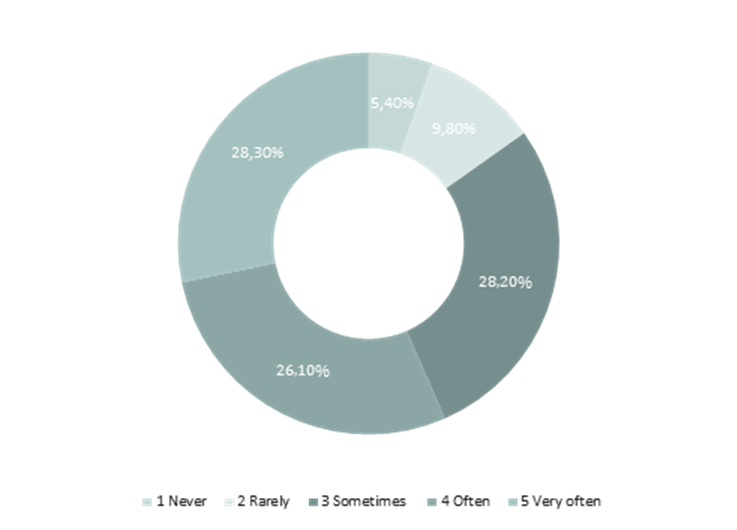
Figure 1 shows different interesting results regarding the frequency of use of AI in advertising activity:
Figure 1. Frequency of use of artificial intelligence in advertising agencies
Source: Authors’ own.
The data obtained suggest that AI is being implemented in the advertising ecosystem. A total of 54.3% respondents use AI in their work (combining the ‘often’ and ‘very often’ categories), with 28.2% using it ‘very often’ and 26.1% ‘often.’ An equal proportion (26.1%) use it ‘sometimes,’ while 9.8% use it ‘rarely’ and only 5.4% ‘never’.
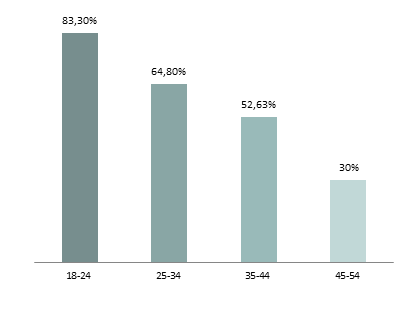
Younger advertisers are those who use AI most frequently, as shown in Figure 2. Higher levels of usage are noted in the following age brackets: 18-24 (83.3%), 25-34 (64.8%), and 35-44 (52.63%). People aged 45-54 use it less (30%), and those over 55 do not use it. These percentages are the result of adding together options 4 'often' and 5 'very often' from the questionnaire.
Figure 2. Use of AI by age among advertising agency professionals
Source: Authors’ own.
In line with this, the agency roles that use AI most regularly are graphic designers (85%), planners (84%) and copywriters (67%). In contrast, art directors (43%) and creative directors (28%) use it less, while account managers almost never use AI.
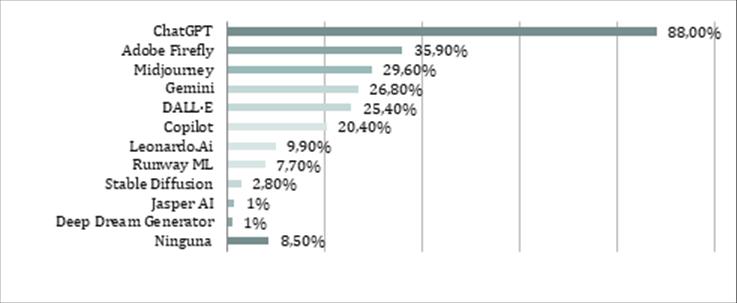
As shown in Figure 3, the most commonly used generative AI tools are: ChatGPT (88%), Adobe Firefly (35.9%), Midjourney (29.6%), DALL·E (25.4%), Gemini (26.8%), Copilot (20.4%) and Leonardo.Ai (9.2%), Runway ML (7.10%). It is worth noting that some participants selected the option ‘None’ (10.2%).
Figure 3. Main artificial intelligence tools used by professionals in the advertising sector
Source: Authors’ own.
Table 2 shows the relative data on the uses that agencies make of artificial intelligence.
Table 2. Functions of artificial intelligence in advertising agencies according to level of use
|
Functions |
Not at all |
A little |
Somewhat |
Quite a bit |
A lot |
|
Generation of initial ideas |
12% |
17% |
24% |
22% |
24% |
|
Writing and copywriting |
10% |
13% |
28% |
26% |
23% |
|
Creation of images and graphics |
19% |
16% |
29% |
27% |
9% |
|
Editing and optimisation of content |
21% |
15% |
34% |
20% |
10% |
|
Audiovisual production |
42% |
20% |
23% |
11% |
4% |
|
Targeted advertising |
41% |
20% |
23% |
10% |
5% |
|
Trend and data analysis |
12% |
13% |
23% |
26% |
25% |
|
Creation of music and sound effects |
40% |
23% |
17% |
16% |
3% |
Source: Authors’ own.
According to the data presented, the use of AI in advertising agencies varies depending on the role performed. It is used frequently in the generation of initial ideas, with 46% using it Quite a bit (22%) and A lot (24%). 24% use it ‘Somewhat,’ while 17% use it ‘A little’ and 12% ‘Not at all’. In advertising copywriting, it is used slightly more frequently (49%), combining the responses for ‘Quite a bit’ and ‘A lot'. 28% use it 'Somewhat', 13% ‘A little’, and 10% 'Not at all'.
AI is also regularly used for data and trend analysis. 25% use it ‘A lot' (25%), 26% ‘Quite a bit’, 23% 'Somewhat', 13% 'A little', and 12% 'Not at all'. It is used less frequently for tasks such as image and graphics creation (36%), content editing (30%), music and sound creation (19%), targeted advertising (15%), and audiovisual production (15%), taking 'Quite a bit' and ‘A lot’ as the reference values.
On the other hand, 62% consider that AI improves the efficiency of the creative process, with the combination of the options 'Quite a bit' (36.6%) and ‘A lot’ (25.4%). 26.8% use it 'Somewhat', 7% 'A little', and 4.2% 'Not at all'. Next, 20.04% believe that AI has changed the way they work 'A lot' and 33.8% 'Quite a bit'. 18.3% use it 'Somewhat', 12.7% 'A little', and 14.8% 'Not at all'. The professional roles that have been most influenced by the emergence of AI are: copywriters (83.3%), followed by planners (71.4%), art directors (71.4%), graphic designers (69.2%), and creative directors (38.8%). Account managers do not appear to be using it at all. As previously, the data presented below combine the options 4 'Quite a bit' and 5 'A lot'.
Additionally, 55.6% of the participants acknowledged that the arrival of AI in their respective agencies has not only changed their way of working but has also transformed the work dynamics of their agencies. 26.8% take a more neutral position, 9.9% indicate that it has changed 'A little,' and 7.7% 'Not at all.'
4.3. Perception of AI as a threat or opportunity
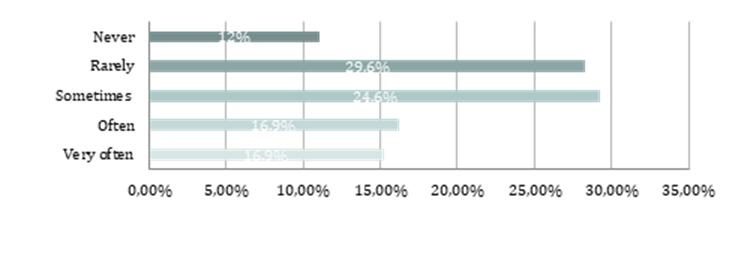
This section of the questionnaire begins with the question 'Does AI pose a threat to creativity?', which yielded the results shown in Figure 2:
Figure 4. Professionals’ perception of the impact of artificial intelligence on advertising creativity
Source: Authors’ own.
This graph shows a certain equality between the different positions detected. Firstly, by adding together the responses 1 'Not at all' and 2 'A little', we see that 41.6% do not believe that AI poses a serious threat to creativity. Secondly, 24.6% of the respondents took a neutral stance. In third and last place, the combination of 'Quite a bit' and 'A lot' concludes that 33.8% see the development of AI as a threat.
Given the complexity of the issue raised, a deeper analysis was required. Therefore, participants were asked to justify their response. Table 3 shows and classifies different opinions:
Table 3. Analysis of AI as threat or opportunity
|
Categories |
Description |
Number of comments |
|
AI is a tool that enhances creativity |
It is considered a useful tool that streamlines processes, inspires ideas and enhances creative performance. |
17 |
|
It depends on the use |
It is not a threat in itself, but it can be if it is used indiscriminately, if it completely replaces professionals or if it is overused. |
15 |
|
Excessive dependence
|
There is a warning about the risk of losing human creative skills due to overuse of AI, which can affect the quality and originality of creative work. |
11 |
|
It does not replace human creativity
|
Despite its capabilities, AI lacks sensitivity, intuition, emotional context and genuine creativity that only human beings can provide. |
13 |
|
Economic and job impact
|
There is a risk identified in the potential reduction in demand for human creative services, especially from clients who do not value creativity. |
9 |
|
Opportunity for professional growth
|
AI is seen as an opportunity for creatives to reinvent themselves, train, and expand their capabilities within the new digital context. |
7 |
Source: Authors’ own.
The perception of these professionals regarding the impact of creativity in the advertising industry varies.
In general, the prevailing view is that AI is a tool that enhances human creativity, capable of streamlining processes, providing inspiration and improving efficiency. However, many agree that its impact depends on the use made of it. It can either enrich or impoverish creative work depending on its application.
In this sense, some professionals warn that this could lead to an excessive dependence that limits the creative process, constricting human capacity to develop their own ideas. However, many believe that AI does not replace creativity, as it lacks emotions and does not understand the cultural and economic context of the advertiser. Other participants understand that there is a partial threat. Some advertisers might opt for more cost-effective AI-generated solutions, thus reducing the demand for advertising services.
Finally, some respondents have a positive view of the emergence of AI, seeing it as an opportunity for professional growth. An interesting finding emerges when comparing the responses between advertisers who use AI frequently and those who perceive it as a threat. In these cases, users who use it 'A little' (43%) and 'Not at all' (29%) are precisely those who identify a potential threat, with responses of 'Quite a bit' (39%) and 'A lot' (38%). On the contrary, those who use it 'Quite a bit' (61%) and 'A lot' (63%) believe that there is no risk (57% None) or consider the impact to be minimal (71% Little).
To conclude this section of the questionnaire, respondents were asked about their beliefs regarding the evolution of the relationship between AI and advertising creativity in the next 5 years. The predominant stance (79.6%) is that AI offers key tools in the creative process, ensuring that human creativity will not be displaced. In contrast, 20.4% believe that AI will go further, taking over most of the creative process and thereby diminishing the role of human creativity in advertising.
4.4.Training in creativity and AI
The final section of the questionnaire consisted of a series of questions designed to gauge participants’ views on how advertising faculties and schools should prepare future professionals for the age of AI.
The majority stated that AI should be integrated into these programmes. Half of the respondents (50%) selected “A lot”, and 23.9% chose “Quite a lot”. A further 15.5% opted for a middle-ground response, while only 2.8% selected “A little” and 7.7% “Not at all”. Age had a slight influence on these responses. Younger respondents were clearly in favour of AI integration, whereas older participants expressed a more moderate stance.
Despite these findings, there remains a widespread concern that AI could potentially diminish students’ creative capacities. In fact, 57.1% agree with this statement. 21.1% chose option 3 'Somewhat'. Only 21.9% believe that this will affect them 'Little' or 'Not at all'.
Respondents emphasised that, in the age of AI, it is essential to foster activities that build the following skills: critical thinking (85.2%), narrative development (69.7%), problem-solving (68.3%), the creation of original concepts (62.2%), communication skills (62%), ethics and responsibility (54%) and presentation development (29.6%).
5. Discussion
The data collected in this research raise certain points for discussion about the impact of AI in advertising, particularly in the creative capacity of agencies. AI is being implemented in the advertising ecosystem. 54.3% of the agency roles use it 'Quite a bit' and 'A lot'. And 24.6% ‘Somewhat’. The study conducted by Forrester (Baar, June 24, 2024) shows that advertising agencies in the United States are following a similar trend. 61% are using generative tools, while 30% are exploring their functions and applications in the sector. Similarly, a study conducted by Adobe (Offerman, 2023), in which 1000 American creatives were interviewed, announced that only 19% claimed not to use AI in their work.
This research also includes the most widely used tools in the sector -ChatGPT (48%), Midjourney (25%), DALL-E (34%) and RunwayML (30%)- coinciding with those used most by the participants in this study: ChatGPT (88%), Midjourney (29.6%), DALL·E (25.4%) and Runway ML (7.10%).
In Spanish society, there is a gap related to the beneficial use that people make of digital technologies based on their age (Instituto Nacional de Estadística, 2024).
In this regard, the data obtained in the study shown younger people are more likely to use AI (18-24, 83.3%; 25-34, 64.8%; and 35-44, 52.63%). In contrast, people aged 45-54 use it somewhat less (30%), and those over 55 do not use it. By definition, the digital divide makes people less competitive (Gesto-Rodríguez, 2024). Some participants share the idea that AI is a source of innovation and new opportunities, improving digital skills. This approach is consistent with the work of Lozano González and Rodríguez García (2024).
Advertising is constantly evolving. This means, among other things, that in terms of professional profiles and roles within advertising, people with advanced knowledge of the latest trends have traditionally been sought after (Sanz-Marcos et al. 2021). Since the data obtained shows that many agencies have implemented AI, it is logical to assume that the use of generative tools will be added to the necessary requirements for working in advertising. Especially considering that 62% of the collaborators understand that AI is improving the efficiency of the creative process, which coincides with the conclusions published by Yongqi (2022) and Arbaiza et al. (2024).
Furthermore, the data show that the most creative profiles have incorporated AI most frequently, including copywriters (83.3%), planners (71.4%), art directors (71.4%) and graphic designers (69.2%). This pattern is consistent, as AI has demonstrated its ability to create images, generate ideas or write texts (Cui, Liu & Yuan, 2025).
There are different perspectives on the impact of AI on advertising creativity. Some respondents believe that it is a tool that enhances creativity. On the other hand, others view it as a threat to human creative capacity. Especially when used excessively. Regarding this situation, the article developed by Doshi & Hauser (2024) offers an interesting perspective, as it considers that AI can enhance individual creative ability. However, collectively, the scope is limited and the content is less innovative.
In a way, we could understand that this conclusion is consistent with this study, since 79.6% of the participants believe that human creativity will continue to play a significant role in creative processes, even if it is as a complement.
Finally, 73.9% believe that AI should be included in the curriculum of degrees and study programmes related to advertising. At the same time, they feel that AI can harm students' creative ability if not implemented properly. According to Gaševic et. al. (2024), this dynamic poses both opportunities and challenges, in which the educational environment must ensure the effective, ethical and professional integration of AI to enhance learning.
6. Conclusions
The study offers an in-depth insight into how advertising professionals perceive AI’s impact on agencies’ creative capacity, addressing the following questions: Is AI being implemented in the advertising ecosystem? Does AI pose a threat to creativity in advertising?
The data obtained show that AI has become integrated into the work dynamics of agencies. Generative tools are frequently used in the professional practices of graphic designers (85%), planners (84%), advertising copywriters (67%), art directors (43%) and creatives (28%). Only account managers claimed not to use it.
The implementation of AI in advertising agencies is regarded as a practice that improves the efficiency of the creative process, according to 62% of the participants. ChatGPT (88%), Adobe Firefly (35.9%), Midjourney (29.6%), DALL·E (25.4%) and Gemini (26.8%) are among the most widely used platforms in the advertising ecosystem. Idea generation, writing, creating images and graphics, as well as data analysis, are the most requested functions. Therefore, there is no doubt that AI is being implemented in advertising agencies, although its level of application depends, broadly speaking, on the position held.
Furthermore, there are two divergent views on the impact of AI on advertising creativity. On one hand, 41.6% believe it does not pose a threat, compared to 33.8% who believe the exact opposite. These participants understand that the deterioration of creative ability occurs primarily when there is excessive dependence and its implementation is not carried out properly.
According to Doshi & Hauser (2024), AI enhances the creative ability of individual users, but worsens outcomes collectively. This means, among other aspects, that in the age of AI, efforts must be made to strengthen advertising creativity. Therefore, the debate surrounding the implementation of AI in university education is relevant and requires a comprehensive analysis. 73.9% argue that it should be integrated into advertising-related education. However, the way to do this is not simple, as there is a risk of harming the students' learning process, according to 56.8% of the respondents.
In the age of AI, enhancing critical thinking, problem-solving, narrative development, creation of original concepts, communication skills, and ethical and responsible work is key to effectively harnessing AI, safeguarding human creativity, and fostering creative thinking that allows both agencies and advertisers to stand out against the fierce competition.
6.1. Limitations and future lines of study
The study itself has two limitations. Firstly, the sample consists of 142 participants. Obtaining these answers has been a somewhat arduous task, as it involves obtaining information from people with whom there is no personal relationship. Furthermore, the fact of selecting and identifying specific profiles, seasoned industry professionals in advertising, made it difficult to cast a wider net when compiling our sample.
Secondly, AI is advancing in leaps and bounds. Therefore, new features or tools may emerge over the coming months, making even further modifications to the creative processes. For this reason, in future studies it would be pertinent to continue examining the opinions of industry professionals in order to understand how the integration of AI in creative processes is evolving and to identify possible changes in perceptions of its ethical, educational, and professional impact.
Similarly, it would also be interesting to investigate how advertising faculties and schools are reacting in the age of AI to protect the creativity of students and adapt to the new technological context.
Ethics and transparency
Acknowledgements
The authors would like to thank Alison O'Connor for translating the article into English.
Conflict of interest
The authors declare that there is no conflict of interest.
Funding
The research underlying this article did not receive any funding.
Author contributions
|
Function |
Author 1 |
Author 2 |
Author 3 |
Author 4 |
|
Conceptualisation |
X |
|
|
|
|
Data curation |
X |
X |
X |
|
|
Formal analysis |
X |
X |
X |
|
|
Funding acquisition |
X |
|
|
|
|
Research |
X |
X |
X |
|
|
Methodology |
X |
X |
X |
|
|
Project management |
X |
|
|
|
|
Resources |
X |
|
|
|
|
Software |
|
|
|
|
|
Supervision |
X |
X |
X |
|
|
Validation |
X |
X |
X |
|
|
Visualisation |
X |
X |
X |
|
|
Writing - original draft |
X |
X |
X |
|
|
Writing - review and editing |
X |
X |
X |
|
Data availability
Access to the data is available upon request from the corresponding author.
Bibliographical references
Amabile, T. M. (1996). Creativity in context: update to the social psychology of creativity. Routledge
Arbaiza, F., Arias, J., & Robledo-Dioses, K. (2024). AI-Driven advertising activity: perspectives from peruvian advertisers. Communication & Society, 37(4), 273-292. https://doi.org/10.15581/003.37.4.273-292
Arora, P. (2024). Creative data justice: a decolonial and indigenous framework to assess creativity and artificial intelligence. Information, Communication & Society, 1–17. https://doi.org/10.1080/1369118X.2024.2420041
Asenjo-McCabe, S., & del Pino-Romero, C. (2024). El uso de la inteligencia artificial en el sector del marketing, la publicidad y los contenidos de marca en España. COMUNICACIÓN. Revista Internacional De Comunicación Audiovisual, Publicidad Y Estudios Culturales, 22(2), 82–102. https://doi.org/10.12795/Comunicacion.2024.v22.i02.06
Baar, A. (24 de junio de 2024). Forrester: 91% of US ad agencies are currently using, exploring generative AI. Marketing dive. https://goo.su/Aa50it
Bryman, A. (2016). Social research methods (5th ed.). Oxford University Press.
Calvo-Rubio, L.-M., y Rojas-Torrijos, J.-L. (2024). Criterios de calidad periodística en el uso de inteligencia artificial. Comunicación y Sociedad, 37(2), 247-259. https://doi.org/10.15581/003.37.2.247-259
Castells, M. (2006). La era de la información Economía, sociedad y cultura. Alianza Editorial.
Catmull, E. (2024). Creativity, Inc. (The expanded edition): Overcoming the unseen forces that stand in the way of true inspiration. Random House
Cui, W., Liu, M. J., & Yuan, R. (2025). Exploring the integration of generative AI in advertising agencies: a co-creative process model for human–ai collaboration. Journal of Advertising Research, 65(2), 167-1891-23. https://doi.org/10.1080/00218499.2024.2445362
Donstrup, M. & García-Estévez, N. (2025). Advertising and children: The viewpoint of mothers. index.comunicación, 15(1), 77-97. https://doi.org/10.62008/ixc/15/01Ymenor
Doshi, A.R. & Hauser, O.P. (2024). La IA generativa potencia la creatividad individual, pero reduce la diversidad colectiva del contenido novedoso. Science Advances, 10 (28). https://doi.org/10.1126/sciadv.adn5290
Fernández-Rincón, A. R. (2023) El creativo invisible: inteligencia artificial y creación publicitaria. Miguel Hernández Communication Journal, 14(2), 391-408. https://doi.org/10.21134/mhjournal.v14i.1983
Ferruz-González, S.-A., Sidorenko-Bautista, P., & Santos-López, C. (2023). Neuromarketing e inteligencia artificial: el caso de la campaña ’con mucho acento’ de Cruzcampo. index.Comunicación, 13(2), 147–169. https://doi.org/10.33732/ixc/13/02Neurom
Fraile-Narváez, M. (2024). Fenomenología e inteligencia artificial: una perspectiva líquida a la arquitectura del siglo XXI. Limaq, (013), 159-180. https://doi.org/10.26439/limaq2024.n013.6950
Gaševic, Jin, Y., Yan, L., Echeverria, V., D., & Martinez-Maldonado, R. (2024). Generative ai in higher education: a global perspective of institutional adoption policies and guidelines. Computers and Education Artificial Intelligence. https://doi.org/10.1016/j.caeai.2024.100348
Glaser B., & Strauss A. (1967). The discovery of grounded theory: strategies for qualitative research. Aldine Publishing.
Gómez-Calderón, B., & Ceballos, Y. (2024). Periodismo e inteligencia artificial. El tratamiento de los chatbots en la prensa española. index.Comunicación, 14(1), 281–300. https://doi.org/10.62008/ixc/14/01Period
Gruenhagen, J. H., Sinclair, P. M., Carroll, J. A., Baker, P. R., Wilson, A., & Demant, D. (2024). The rapid rise of generative ai and its implications for academic integrity: students’ perceptions and use of chatbots for assistance with assessments. Computers and Education: Artificial Intelligence, 7. https://doi.org/10.1016/j.caeai.2024.100273
Guilford, J. P. (1986). Creative talents: their nature uses and development. Bearly Limited.
Hernández-Sampieri, R. (2018). Metodología de la investigación: las rutas cuantitativa, cualitativa y mixta. McGraw Hill
Hochmair, H. H., Juhász, L., & Kemp, T. (2024). Correctness comparison of chatgpt‐4, gemini, claude‐3, and Copilot for spatial tasks. Transactions in GIS, 28(7), 2219-2231. https://doi.org/10.1111/tgis.13233
Instituto Nacional de Estadística (2024). Encuesta sobre equipamiento y uso de tecnologías de información y comunicación en los hogares. https://goo.su/seiCaxD
León-Sáez de Ybarra, J. L. (2022). Creatividad y eficacia publicitaria: Hacia un nuevo copytesting. COMUNICACIÓN. Revista Internacional De Comunicación Audiovisual, Publicidad y Estudios Culturales, 1(14), 1–15. https://doi.org/10.12795/comunicacion.2016.v01i14.01
Lozano González, A. Rodríguez García, F. (2024). Perspectivas cualitativas en la integración de la inteligencia artificial en el ámbito educativo. En Almazán López, Cabanés Cacho, Bunbury Bustillo (coord.), IA, educación y medios de comunicación: modelo TRIC. Dykinson.
Lubart, T. I. (2001). Models of the creative process: past, present and future. Creativity Research Journal, 13(3–4), 295–308. https://doi.org/10.1207/S15326934CRJ1334_07
Martínez-Martínez, I. J., Aguado, J. M., & Sánchez-Cobarro, P. del H. (2022). Smart advertising: Innovación y disrupción tecnológica asociadas a la IA en el ecosistema publicitario. Revista Latina De Comunicación Social, (80), 69–90. https://doi.org/10.4185/10.4185/RLCS-2022-1693
Mena-Guacas, A. F., Vázquez-Cano, E., Fernández-Márquez, E., & López-Meneses, E. (2024). La inteligencia artificial y su producción científica en el campo de la educación. Formación Universitaria, 17(1), 155-164. http://dx.doi.org/10.4067/S0718-50062024000100155
Offerman, S. (2023). Creative pros see generative AI as part of their future. Adobe Blog. https://goo.su/DgnPs
Oliver, N. (2021). Inteligencia artificial, naturalmente: un manual de convivencia entre humanos y máquinas para que la tecnología nos beneficie a todos. Ministerio de Asuntos Económicos y Transformación Digital. https://goo.su/3jO1qr
Parlamento Europeo (13 de marzo de 2024). Resolución legislativa del Parlamento Europeo. https://acortar.link/yiPHPH
Perlado Lamo de Espinosa M. y Rubio-Romero J. (2017). Creatividad publicitaria y formación de los creativos en la cultura digital. Pensar la Publicidad. Revista Internacional de Investigaciones Publicitarias, 11, 121-140. https://doi.org/10.5209/PEPU.56397
Priego-Reyes, R., Martínez-Prats, G., & Rodríguez-Ocaña, M. A. (2021). La publicidad digital y el desafío de la saturación publicitaria para el empresario. FACE: Revista De La Facultad De Ciencias Económicas Y Empresariales, 21(2), 14–21. https://doi.org/10.24054/face.v21i2.1102
Rodríguez Gutiérrez, I. (2024). La inteligencia artificial: una herramienta artística ¿creativa? Revista [sic] (38), 19–26. https://doi.org/10.56719/sic.vi38.671
Rodríguez-Dorta, M., y Borges, A. (2016). Optimización y eficiencia en el análisis de datos en metodología observacional. REMA, 21(1), 1-15. https://doi.org/10.17811/rema.21.1.2016.1-15
Rosengren, S., Eisend, M., Koslow, S. y Dahlen, M. (2020). UA meta-analysis of when and how advertising creativity works. Journal of Marketing, 84(6), 39-56. https://doi.org/10.1177/0022242920929288
Sanz-Marcos, P., González-Oñate, C. & Jiménez-Marín, G. (2021). The creative competition between the students of the degrees in Advertising and Public Relations in Spain and its adaptation to the demands of the professional sector. Icono 14, 19(2). 66-90. https://doi.org/10.7195/ri14.v19i2.1604
Sattele, V., Reyes, M., & Fonseca, A. (2023). La Inteligencia artificial generativa en el proceso creativo y en el desarrollo de conceptos de diseño. UMÁTICA. Revista Sobre Creación Y Análisis De La Imagen, 5(6), 53–73. https://doi.org/10.24310/umatica.2023.v5i6.17153
Shen, W., Wang, S., Yu, J., Liu, Z., Yuan, Y. y Lu, F. (2021). La influencia de la creatividad publicitaria en la efectividad de los anuncios comerciales y de servicio público: Un estudio de doble tarea. Psicología Cognitiva Aplicada, 35(5), 1308–1320. https://doi.org/10.1002/acp.3864
Trujillo Chuquihuaccha, J., & Subia Díaz, F. (2023). Más allá de la ciencia ficción: la irrupción de la inteligencia artificial en la diplomacia. Política Internacional, (134), 177–191. https://doi.org/10.61249/pi.vi134.97
Ufarte-Ruiz M. J., Calvo-Rubio L. M. y Murcia-Verdú F. J. (2021). Los desafíos éticos del periodismo en la era de la inteligencia artificial. Estudios sobre el Mensaje Periodístico, 27(2), 673-684. https://doi.org/10.5209/esmp.69708
Vakratsas, D., & Wang, X. (Shane). (2020). Artificial Intelligence in Advertising Creativity. Journal of Advertising, 50(1), 39–51. https://doi.org/10.1080/00913367.2020.1843090
Yongqi Y. (2022). The role and influence of artificial intelligence on advertising industry. Avances en la investigación en ciencias sociales, educación y humanidades. https://goo.su/CLnsXd4