index●comunicación
Revista científica de comunicación aplicada
nº 16(1) 2026 | Pages 71-97
e-ISSN: 2174-1859 | ISSN: 2444-3239
Artificial Intelligence for Inclusion
in Educommunication: Progress
and Challenges
Inteligencia artificial para la inclusión en educomunicación: avances y retos
Received on 15/06/2025 | Accepted on 26/10/2025 | Published on 15/01/2026
https://doi.org/10.62008/ixc/16/01Inteli
Victoria García-Prieto | Universidad de Sevilla
vgarcia8@us.es | https://orcid.org/0000-0003-4973-7583
Mónica Bonilla-del-Río | Universidad de Cantabria
monica.bonilla@unican.es |https://orcid.org/0000-0003-2476-8922
Juan C. Figuereo-Benítez | Universidad de Sevilla
figuereo@us.es | https://orcid.org/0000-0002-9061-8482
Abstract: This systematic review of 113 research papers (1986-2025) examines the intersection between artificial intelligence (AI), communication, and education for people with disabilities. A notable increase in scientific production has been observed since 2018, with 70.2% of the studies published in the last three years. The educational field dominates the research landscape, with a predominance of empirical and quantitative studies. The most frequently investigated disabilities are learning, visual, and hearing impairments, although 38.1% of the works address disability in general terms. The main aims focus on the evaluation of accessible technologies, the development of intelligent systems, and the educommunicative applications of AI. The findings highlight AI’s potential to remove barriers, personalize learning, and promote digital inclusion, while emphasizing the need to address ableist biases and to involve people with disabilities in the design and development processes to ensure the ethical implementation of AI systems.
Keywords: Artificial Intelligence; Disability; Communication; Education; Systematic Review.
Resumen: Esta revisión sistemática de 113 investigaciones (1986-2025) analiza la intersección entre inteligencia artificial (IA), comunicación y educación para personas con discapacidad. Se evidencia un notable incremento en la producción científica desde 2018, concentrándose el 70,2% de los estudios en los últimos tres años. El ámbito educativo domina las investigaciones, con predominio de estudios empíricos y cuantitativos. Las discapacidades del aprendizaje, visual y auditiva son las más investigadas, aunque el 38,1% de los trabajos abordan la discapacidad en general. Entre los propósitos destacan la evaluación de tecnologías accesibles, el desarrollo de sistemas inteligentes y aplicaciones educomunicativas de la IA. Los hallazgos resaltan su potencial para eliminar barreras, personalizar el aprendizaje y fomentar la inclusión digital. Se subraya la necesidad de abordar sesgos capacitistas e incluir al colectivo en el diseño para una implementación ética y eficaz de la IA.
Palabras clave: inteligencia artificial; discapacidad; comunicación; educación; revisión sistemática.
CC BY-NC 4.0
To cite
this work: García-Prieto, V.; Bonilla-del-Río, M. &
Figuereo-Benítez, J.C. (2026). Artificial Intelligence for Inclusion in
Educommunication: Progress and
Challenges. index.comunicación, 16(1), 71-97.
https://doi.org/10.62008/ixc/16/01Inteli
1. Introduction
In recent years, artificial intelligence (AI) has gained increasing prominence in communication and education, significantly transforming how people interact, learn, and access information (García-Cruz et al., 2023). This technological revolution has created unprecedented opportunities to promote the inclusion of more than one billion people with disabilities worldwide—approximately 15% of the global population (World Health Organization, 2020).
Inclusion has become a core principle for ensuring the universal right to education, fostering the participation and academic success of individuals with disabilities by removing physical, cognitive, social, and communicative barriers (Rosero-Calderón et al., 2021). In this regard, AI provides innovative and adaptable solutions to diverse functional needs and contexts of use (Martínez et al., 2020), making it an essential tool for reducing barriers and promoting the autonomy and sociocultural participation of people with disabilities (Holmes et al., 2021). Conversational and augmentative communication assistants, adaptive learning platforms, and automatic translation systems have demonstrated great potential to facilitate communication and access to information, while also proving effective in supporting expression and comprehension among students with communicative difficulties.
Therefore, AI holds significant potential to transform teaching and learning processes, particularly by personalizing educational support and enhancing accessibility (Morocho-Cevallos et al., 2013). AI-based systems enable both content and methodologies to be tailored to learners' individual needs, facilitating communication and access to information for those with sensory, motor, or learning disabilities (Mera-Castillo, 2023). In light of these technological advances, the convergence of communication, education, AI, and disability constitutes a rapidly expanding field of research, driven by the imperative to ensure inclusive and equitable education for all students, regardless of ability (Valle-Escolano, 2023).
This study presents a systematic review of research published in the Scopus and Web of Science (WoS) databases examining the use of AI in the communicative and educational processes of people with disabilities. The objective is to identify research trends, main aims, and key findings in this area, to synthesize the current state of knowledge, and offer a critical perspective on a field that is becoming increasingly relevant in the context of digital transformation and the promotion of human rights.
1.1. Artificial Intelligence in the Educommunicative Field: Opportunities and Risks for Disability
AI constitutes an interdisciplinary field within computer science, focused on the design, development, and implementation of systems capable of performing functions traditionally attributed to human intelligence, such as natural language processing, decision-making, problem-solving, machine learning, visual and auditory perception, and adaptation to dynamic environments (Morandín-Ahuerma, 2022; Villalobos-López, 2024). These capabilities enable AI to address complex challenges across multiple domains, with a particularly notable application in educommunication—an interdisciplinary theoretical and practical approach that integrates education and communication to promote meaningful and participatory learning through media and information technologies (Barbas-Coslado, 2012).
In the context of inclusive education and support for individuals with disabilities, AI emerges as a strategic tool for eliminating communication, cognitive, and sensory barriers. Its incorporation into educational processes facilitates personalized learning and ensures more equitable access to information, fostering the active participation of all students (Kaplan & Haenlein, 2019). The implementation of AI in assistive technologies—such as speech recognition systems, advanced screen readers, and real-time translation tools—as well as in intelligent learning environments and communication-support systems, promotes the development of accessible, participatory, and learner-centered pedagogical practices (Aparicio-Gómez & Cortés Gallego, 2024). These innovations align with the principles of equity and the universal right to quality education for all.
Nevertheless, the development and integration of AI in accessible communicative and educational contexts face significant challenges. Persistent concerns remain regarding equity, ethics, data quality, the active involvement of people with disabilities in design processes, and the sustainability of implemented solutions—all of which continue to be examined and debated in the specialized literature.
The opacity of algorithms (Flores-Vivar & García-Peñalvo, 2023) and the absence of adequate ethical oversight can perpetuate ableist biases, rendering the experiences of people with disabilities invisible or distorted (Valle-Escolano, 2023). Moreover, the limited participation of these groups in the design and evaluation of technologies reveals a lack of intersectional perspective and cognitive justice (Pallisera-Díaz et al., 2017). Furthermore, the growing dependence on technological solutions may generate new forms of exclusion, particularly in contexts marked by low connectivity, limited resources, or restricted digital literacy (Torres-Acurio, 2023).
For all these reasons, from an epistemological standpoint, the integration of AI into the educommunicative sphere demands critical reflection on the structural inequalities that permeate both educational systems and the media. AI should not be conceived as a neutral or universal solution, but as a tool whose impact is shaped by the normative, pedagogical, and cultural frameworks in which it operates (Pérez-Esteban et al., 2024). This calls for a rethinking of the relationships between technology, subject, and knowledge, to prevent AI from reproducing biases and instead to promote new forms of participation and collective knowledge construction. Likewise, it is crucial to promote an ethical governance of AI grounded in the principles of universal accessibility, active participation by the affected groups, and the protection of human rights (Flores-Vivar & García-Peñalvo, 2023).
2. Methodology
2.1. Purpose and Research Questions
The purpose of this study is to conduct a systematic review of the literature on the use of AI and its relationship with disability in the fields of communication and education. Based on this objective, the following research questions were formulated:
1. What types of studies predominate in publications addressing disability and the use of AI in communicative and educational contexts?
2. What thematic categories emerge from the stated aims of publications concerning AI and disability?
3. What advances and challenges arise from the main findings reported in the scientific literature regarding the use of AI and disability?
2.2. Methodological Approach
To ensure a rigorous process, the PICoS methodological framework, recommended for qualitative and mixed-methods reviews (Methley et al., 2014), was employed. This framework enabled the definition of inclusion and exclusion criteria and the structuring of the search, screening, and thematic coding stages for the selected studies. The inclusion criteria were as follows:
· Population: Studies involving people with disabilities or agents who interact with them (such as communication and education professionals, families, and other specialists in communicative and educational accessibility).
· Phenomenon of interest: Research examining the use, development, analysis, or implementation of AI in communicative and educational settings aimed at improving accessibility, learning, and inclusion for people with disabilities, among other objectives.
· Context: Studies conducted in communicative and educational environments where AI has been applied with people with disabilities. This includes communication spaces, media environments (digital media, interactive platforms, social networks, communication accessibility systems, etc.), and educational institutions (schools, universities, and special education centers) which AI supports inclusion and participation.
· Study design: Research employing quantitative, qualitative, or mixed-method approaches, including experimental, non-experimental, cross-sectional, or longitudinal studies that provide evidence on the use of AI within the target population. Systematic literature reviews were also included.
· Publication scope: Peer-reviewed articles published in English or Spanish, indexed in WoS (Core Collection) and Scopus, and classified in categories relevant to the study due to their focus on communication or education.
Regarding the exclusion criteria, studies unrelated to AI, disability, communication, or education were excluded. Consequently, research focused on medical, biological, or computational applications—as well as studies addressing the technical development of AI without direct application, or its use solely as an analytical tool (e.g., linguistic analyses of interviews)—were excluded. In terms of publication type, non-peer-reviewed documents, books, theses, conference proceedings, and any other materials not classified as scientific journal articles were also excluded. No restrictions were applied regarding the year of publication.
2.3. Procedure
The systematic review process comprised the following stages:
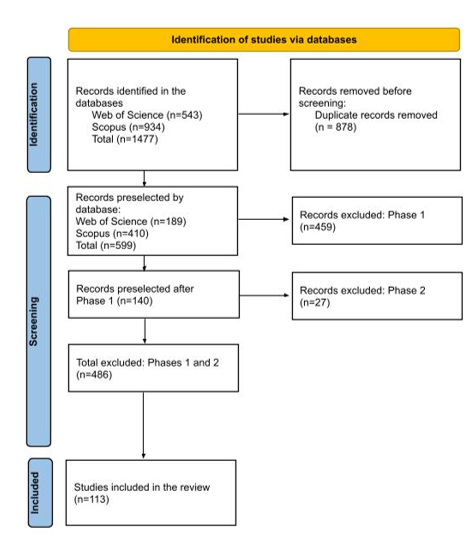
First, a literature search was conducted in WoS and Scopus, given their recognized indexing quality. Combinations of descriptors related to AI and disability were used, together with Boolean operators in both English and Spanish. A total of 1,477 initial records were identified, of which 878 duplicates were removed, resulting in 599 studies (Figure 1).
Figure 1. PRISMA Flow Diagram
Source: Adapted from the statement proposed by Page et al. (2021).
The screening process was then carried out in two phases:
· Phase 1: Title and abstract screening. Two reviewers independently examined the titles and abstracts of the 599 publications, applying the previously defined inclusion and exclusion criteria. Following this process, 459 studies were excluded, leaving a sample of 140 articles for this phase.
· Phase 2: Full-text review. Three coders read the preselected articles to confirm their thematic relevance. Studies that mentioned AI but did not align with the objectives of the review were excluded for reasons such as the use of AI solely for data analysis, AI mentioned only within the theoretical framework (without being the main object of study), or an unsuitable publication type. Discrepancies among reviewers were resolved by consensus. A total of 113 articles met the methodological and thematic requirements, constituting the final sample of the study.
Subsequently, a previously designed rubric was systematically applied to organize the relevant information extracted from each study. The variables collected included the phenomenon of interest (communicative or educational), journal, year of publication, keywords, country where the research was conducted, country of the journal, study sample, educational level, type of study, methodological approach, research technique, type of disability, AI tools, study aims, and main findings reported in each publication. To ensure consistency in the analytical process, the researchers independently applied the coding system to a selected subset of the sample, after which any discrepancies were discussed until consensus was reached. Finally, one researcher conducted a manual review to verify that all criteria had been applied consistently throughout the dataset.
At the quantitative level, the data were analyzed using descriptive statistical techniques to identify trends in scientific production, the predominant methodological approaches, the geographical and temporal distribution of the reviewed studies, and the types of disabilities and AI tools represented in the sample.
Regarding the qualitative analysis—focused on the variables of research aims and findings—a thematic coding approach was employed, structured in three progressive stages. First, an open coding process was conducted, in which the full texts were examined without predefined categories, allowing the inductive identification of recurrent patterns, key concepts, and findings related to the use of AI in disability. Subsequently, automated semantic clustering and textual similarity analyses were conducted using the AI tool ChatGPT (GPT-4.5-turbo, OpenAI), enabling an initial articulation of the emerging themes and their organization into broader categories, thereby revealing meaningful conceptual relationships and areas of convergence among the phenomena studied. The research team critically supervised the use of this tool to ensure interpretative rigor and adherence to ethical standards in data management. Finally, the categories were manually refined, with specific examples from the analyzed literature synthesized and cited for each category based on the information gathered through the rubric.
3. Results
3.1. Categorization of Studies
3.1.1. Areas of Knowledge and Types of Disability
This study presents a systematic review of 113 articles on the application of AI to disability, published between 1986 and 2025. Of these, 78 studies (69%) corresponded to the field of education, and 35 (31%) to the field of communication. Beyond the smaller number of studies in the communication domain, only six addressed media-related topics, representing 17.1% of all communication studies and 5.3% of the total sample. Moreover, in communication studies, individuals with disabilities were consistently positioned as receivers or users, rather than as producers—such as journalists, designers, or other professionals. The sole exception was the study by McNally et al. (2024), which examined the use of ChatGPT by autistic content creators on TikTok.
In the educational field, individuals with disabilities were consistently positioned as participants or users, rather than as teachers, professionals, family members, or caregivers. Within this field, one study (1.3%) focused on early childhood education (ages 0–6), twelve (15.4%) on primary education (ages 6–12), five (6.4%) on adolescents aged 13–18 (secondary or pre-university education), fourteen (17.9%) on university students and adults, and nine (8%) on special education. In addition, 15 educational studies (19.2%) encompassed multiple age groups, while 22 (19.5%) did not specify an age range—this latter group comprising a larger number of theoretical or review papers.
Conversely, information was also gathered regarding the types of disabilities addressed in the reviewed articles. A total of 43 studies (38.1%) referred to disability in general, without specifying a particular type, while 10 studies (8.8%) examined multiple disabilities. Visual disability was addressed in 16 studies (14.2%), and another 14 (12.4%) focused on hearing disability. Among these, Nganji and Brayshaw (2017) examined both and proposed the design of virtual learning environments tailored to the needs of students with multiple disabilities, specifically those with visual, auditory, and reading difficulties, such as dyslexia. Similarly, Coughlan and Iniesto (2025) investigated these two types of disability, along with physical or motor impairments, autism spectrum disorder (ASD), and non-visible disabilities, in the implementation of an AI-based virtual assistant for university students. Pierrès et al. (2024) also included visual and hearing disabilities, as well as neurodiversity, chronic illnesses, and mental health conditions.
Other studies explored AI in relation to intellectual disabilities (n=10; 8.8%), physical disabilities (n=3; 2.7%), or speech impairments (n=3; 2.7%). In addition, two studies (1.8%) examined neurological disorders, and one study focused on cognitive disability associated with dementia (Curumsing et al., 2024).
A total of 21 studies (18.6%) addressed learning disabilities, either in general or in relation to specific difficulties such as dyslexia, dysgraphia, dyspraxia, and language or mathematical learning disorders. Several investigations also examined AI applications for specific conditions such ASD (n=14; 12.4%) or attention-deficit/hyperactivity disorder (ADHD) (n=3; 2.7%), analyzed either independently or in combination with other disabilities. The study by Faria et al. (2020) encompassed intellectual disability, ASD, and ADHD, as well as oppositional defiant disorder, hydrocephalus, and cerebral palsy. Conversely, El Naggar et al. (2024) focused on giftedness, analyzing how students perceive AI as a facilitative tool in debates that foster active and personalized learning, while also cautioning against risks such as confirmation bias and information overload.
3.1.2. Applications and Types of AI Investigated
Of the 113 articles reviewed, 29 (25.7%) examined AI in general terms or did not specify particular tools. In addition, 22 studies (19.5%) focused on generative AI, of which 14 specifically addressed ChatGPT. Other tools in this category included Dream.ai, an AI-based art generator (Bober et al., 2024; Wilson et al., 2025), and writing-support applications such as WeGotIT!, Corgi, and Grammarly (Marino et al., 2023).
Further studies explored other AI subfields applied to disability, including computer speech (9 articles, 8%), artificial neural networks (6, 5.3%), computer vision (3, 2.7%), and robotics (2, 1.8%). The latter investigated the use of educational robots—one with students with hearing impairments (Khasawneh, 2024) and another with students on the autism spectrum (Athbah, 2024).
Regarding the specific uses of AI in relation to disability, 17 articles (15%) emphasized its application to enhance accessibility. Meanwhile, seven studies (6.2%) addressed emotional or affective domains, and three (2.7%) explored algorithmic bias related to disability. Other identified applications included AI-powered virtual assistants (n=6), conversational AI systems (n=4), chatbots (n=4), and big data analysis (n=3), examined either independently or in combination. Additionally, two studies (1.8%) focused on AI-based machine translation for sign languages, specifically addressing official South African sign languages (Madahana et al., 2022) and the translation of American Sign Language into three low-resource spoken languages in Nigeria (Dere et al., 2023).
Finally, several isolated studies examined other aspects related to AI, such as deepfakes (Yadlin-Segal & Oppenheim, 2020), GeoAI (Martínez-Santiago & Navas-Berbel, 2024), and specific applications, including an intelligent audiovisual classroom (Meng & Wong, 2024), smart glasses (Sahin et al., 2018), and adaptive games (Faria et al., 2020). Conversely, other works—mainly literature or systematic reviews—compiled broader inventories of AI applications. For example, Shivani et al. (2024) listed tools such as Annie (for Braille learning), Notebook, Readable, Augmentally, and Tactopus, among others, designed to support students with disabilities.
3.1.3. Publication Dates and Countries
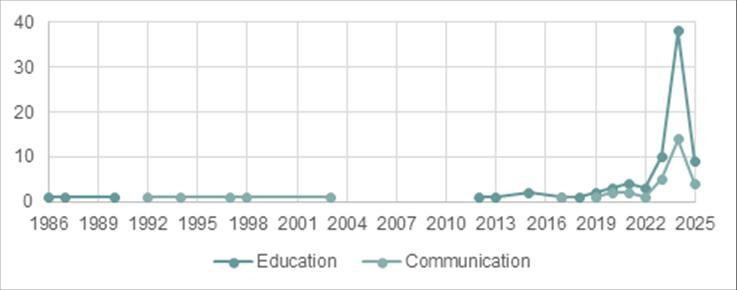
Regarding publication dates, studies in the analyzed fields were identified as early as the 1980s. Specifically, the first research in the educational domain was published in 1986, while the earliest study in communication dates to 1992. However, until 2018, research on AI and disability within communication and education remained limited, with only one or two studies published per year. Interest in this topic increased notably from that point onward, with the number of publications rising to 15 in 2023 and 52 in 2024. These figures indicate that, although studies were identified over a 40-year period, 45.6% were published in 2024 and 70.2% within the last three years—bearing in mind that data for 2025 extend only to March (Figure 2).
Figure 2. Evolution of research by year of publication and field
Source: Prepared by the authors.
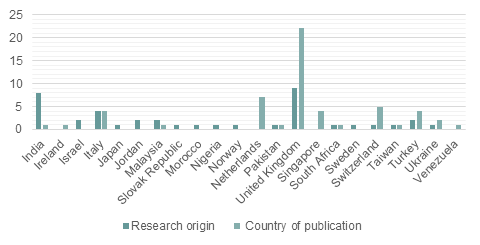
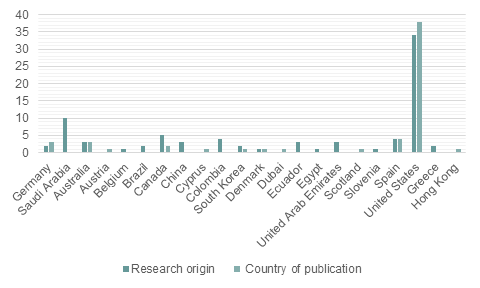
The geographical distribution of the studies was analyzed by distinguishing between the country where the research was conducted and the country of publication (Figure 3). A total of 35 countries were represented among the studies reviewed, with the United States emerging as the leading country of origin (n=34; 30.1%), followed by Saudi Arabia (n=10; 8.8%) and the United Kingdom (n=9; 8%). When considering the countries of publication, the diversity decreased to 26 nations, with the United States again in first place (n=38; 33.6%). Although the United Kingdom ranked third as a country of origin, it occupied second place as a country of publication, hosting 22 articles (19.5%). In contrast, countries such as Brazil, Colombia, and Ecuador were represented as research sites but not as the countries of publication for the studies.
Figure 3. Comparison between the countries where the research was conducted and the countries of publication
Source: Prepared by the authors.
3.1.4. Methodological Approach
The results revealed that 75 studies (66.4%) were empirical, 16 (14.2%) were theoretical works, 14 (12.4%) were systematic reviews, and 8 (7%) were case studies. Empirical research represented the largest share, encompassing a wide range of methods and research techniques. Of the 75 studies classified as empirical, 42 (56%) were quantitative, 22 (29.3%) qualitative, and 11 (14.7%) employed mixed methods. A variety of research techniques was identified among these empirical studies, including experimental or quasi-experimental designs (n=34; 45.3%), surveys (n=14; 18.6%), content analyses (n=9; 12%), interviews (n=9; 12%), design, evaluation, or testing of initiatives (n = 6; 8%), focus groups (n=3; 4%), observational techniques (n=3; 4%), and exploratory studies (n=2; 2.7%). The predominance of experimental and quasi-experimental research reflects the large number of studies conducted in the educational domain, where interventions are typically implemented and accompanied by outcome measurement instruments such as standardized tests or surveys.
The case studies employed techniques such as content or data analysis, surveys and interviews, experimental methods, or focus groups (Cheung et al., 2020; Curumsing et al., 2024; among others). The theoretical work mainly consisted of the description and development of proposed interventions or AI-based tools, without experimental testing. This category also included interpretative or critical reflections on the proposed initiatives. Meanwhile, the systematic reviews encompassed samples ranging from 13 to 85 publications.
3.1.5. Keywords
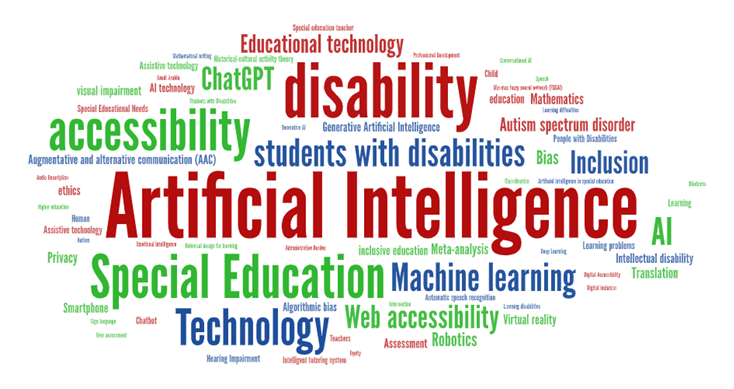
The analysis of keywords in the reviewed studies yielded 454 distinct terms. Of these, 72 appeared at least twice, while 382 were mentioned only once, highlighting the heterogeneity of the research examined. The most frequently occurring keyword was «artificial intelligence» (x51), followed by «disability» (x11), «special education» (x10), «accessibility» (x8), «technology» (x7), «machine learning» (x6), «students with disabilities» (x6), and the abbreviation «AI» (x6). Figure 4 provides a visual representation of the keywords that appeared at least twice across the reviewed articles.
Figure 4. Visual representation of the most frequent keywords
3.2. Purpose of the Studies
Regarding the research aims, an inductive categorization was conducted based on conceptual, methodological, and analytical similarities to identify recurring patterns in the objectives of the reviewed studies. From this analysis, eight thematic categories emerged (Table 1):
Table 1. Emerging thematic categories
|
Category |
Description |
|
1 |
Evaluation of accessible and adaptive technologies |
|
2 |
Development of intelligent systems and inclusive interfaces |
|
3 |
Educational applications of AI |
|
4 |
Structural and digital barriers |
|
5 |
Automation and assistance in educational and administrative processes |
|
6 |
Teacher training and professional development in relation to AI |
|
7 |
Integration of emerging technologies in inclusive educational contexts |
|
8 |
Critical and conceptual review of AI in relation to disability |
Source: prepared by the authors.
The first category, «Evaluation of accessible and adaptive technologies», encompasses studies that employ AI to promote the inclusion of people with disabilities. The main objectives include examining the accessibility of generative AI tools in web design contexts—particularly for users with disabilities (Acosta-Vargas et al., 2024)—and developing or evaluating AI-based intelligent virtual keyboards (Prete et al., 2025).
The second category, «Development of intelligent systems and inclusive interfaces», brings together studies primarily aimed at designing or implementing technological solutions that enhance interaction, mobility, and communication for people with disabilities. These works often integrate AI with Internet of Things (IoT) devices or automatic translation systems. Notable examples include the development of an IoT-based personal assistant system named IRON, designed to enable people with disabilities to control customizable devices via voice commands (Ali et al., 2023), and the creation of a text-to-speech system for the Slovenian language intended to improve the quality of life of people with disabilities (Šef & Gams, 2003).
The third category, «Educational applications of AI», includes studies exploring how AI can enhance teaching and learning processes among students with special educational needs. For example, some research examines how an AI-based vocational training program influences self-efficacy and learning outcomes in students with intellectual disabilities (Hong & Kim, 2024), while other studies investigate the effects of AI-driven playful learning activities on the quality of life of children with ADHD (Aldakhil, 2024).
The fourth category, «Structural and digital barriers», encompasses studies that analyze the challenges faced by people with disabilities in digital environments, as well as proposals to mitigate these barriers. This approach is exemplified by research examining how individuals with speech impairments navigate the web and encounter technological obstacles (Pucci et al., 2024), as well as by critical reflections on the exclusionary logics embedded in access barriers within the context of generative AI (Jenks et al., 2024).
The fifth category, «Automation and assistance in educational and administrative processes», brings together studies that leverage AI to support educational and administrative tasks in special education. Examples include research exploring how AI can assist special education teachers in drafting Individualized Education Program (IEP) objectives (Waterfield et al., 2025), and the development and evaluation of an automated system based on neural networks and semantic analysis models designed to streamline short-answer grading within a national assessment program (Ormerod et al., 2023).
The sixth category, «Teacher training in relation to AI», includes studies focused on the preparation and professional development of current or future teachers, as well as on curriculum redesign. For instance, some investigations aim to guide educators in the use of AI chatbots to model mathematical writing and support instruction for students with learning difficulties (Smith et al., 2024), while others analyze how special education teacher preparation programs have addressed the challenges of integrating AI into their training processes (Howorth et al., 2024).
The seventh category, «Integration of emerging technologies in inclusive educational contexts», comprises studies that examine the use of technologies such as AI, robotics, and augmented reality (AR) in educational settings. These include research exploring the role of educational robots in developing programming skills among primary school students with hearing impairments (Khasawneh, 2024), as well as studies analyzing the implementation of an Intelligent Tutoring System (ITS) that combines AI and AR to enhance the learning experiences of students with disabilities (Ahuja et al., 2022).
Finally, the eighth category, «Critical and conceptual review of AI in relation to disability», encompasses studies that reflect on the role of AI from ethical, reflexive, and conceptual perspectives. This category includes research that critically examines how technological infrastructures—particularly those mediated by AI—affect the lives of people with disabilities through the lens of social justice and critical disability studies (Goggin et al., 2019), as well as studies that identify recent research trends on AI in relation to disability or special education through systematic or literature reviews (Madahana et al., 2022).
3.3. Main Findings of the Studies: Advances and Challenges
Regarding the main findings of the reviewed studies, clear similarities were identified in the use of AI across contexts related to media literacy and inclusion. The results were organized inductively into two overarching domains — communicative and educational — from which thematic categories were developed to capture the recurrent conceptual trends emerging from the analyzed literature.
3.3.1. Contributions to the Field of Communication
Within the communicative domain, one of the central thematic areas identified was the «elimination of communicative barriers and technological accessibility». This category encompasses findings that illustrate how AI facilitates new forms of interaction for people with disabilities (Dere et al., 2023; Pucci et al., 2024; Acosta-Vargas et al., 2024).
A second thematic area, «digital inclusion and the development of emerging communicative environments», highlights studies that propose using AI to create accessible platforms, automated services, and digital mediation strategies that enhance the user experience for people with disabilities. Examples include the implementation of AI-based chatbots (Cheung et al., 2020) and intelligent virtual keyboards or systems (Prete et al., 2025).
A third category, focused on «design and ableism», offers a critical perspective on the ableist biases embedded in current technologies. These studies emphasize the need to actively incorporate the voices and lived experiences of people with disabilities into the design and governance of AI-based communicative systems. Goggin et al. (2019) argue that AI infrastructures often reproduce ableism by systematically excluding people with disabilities, instead advocating for a technological justice framework that centers their perspectives. Similarly, Palmer and Oswal (2024) stress the importance of involving users with disabilities in the web development process to ensure inclusivity and usability.
3.3.2. Contributions to the Field of Education
Within the educational domain, one major category identified was «personalization of learning and its impact on teaching–learning processes». This group includes findings that highlight the role of AI in tailoring educational pathways to meet the specific needs of students, particularly those with disabilities. As noted by Shivani et al. (2024), AI holds significant potential to foster the autonomy of students with disabilities and enhance their quality of life by providing access to customized learning materials, personalized educational experiences, increased participation, and more inclusive and effective communication. Similarly, the use of generative AI tools such as ChatGPT has been shown to improve learning outcomes and reduce students’ workload, saving time while promoting greater independence (Pierrès et al., 2024).
Closely related to this, a second theme emerging from the findings centers on «educational inclusion and the reduction of barriers». These studies examine how AI can help remove physical, sensory, and cognitive obstacles that have historically restricted the full participation of students with disabilities, while acknowledging the persistence of certain barriers. For instance, Martínez-Santiago and Navas-Berbel (2024) report that the use of GeoAI enables students with disabilities to experience urban heritage without requiring physical mobility. However, they caution that the lack of adaptation in some heritage elements still results in discriminatory situations. Along similar lines, other studies underscore the ongoing technical and physical challenges that must be addressed to ensure the successful implementation of these technologies in the education of students with disabilities (Athbah, 2024; Martínez-Santiago & Navas-Berbel, 2024).
A third category addresses the «challenges of implementation and teacher training». Despite the transformative potential of AI for inclusive education, several studies emphasize the need to strengthen teacher preparation and professional development, addressing training gaps that hinder the effective implementation of AI in the classroom (Khasawneh, 2024; Howorth et al., 2024; Wilson et al., 2025).
Finally, a fourth category of findings concerns the «creative and socio-emotional potential of AI in the classroom», underscoring the positive impact of these technologies in fostering creativity, identity development, and emotional expression. Wilson et al. (2025) found that AI-driven art generation promotes creativity, identity exploration, and engagement, although they caution that such systems must be designed with emotional sensitivity. Similarly, Standen et al. (2020) reported that emotion-based content adaptation can enhance engagement and reduce boredom among students, even if it does not immediately improve academic performance.
4. Discussion and Conclusions
Although AI has gained increasing prominence in recent years (García-Cruz et al., 2023), the systematic review conducted reveals that studies addressing AI and disability in the fields of communication and education date back to the 1980s. Nevertheless, a marked growth in research has been observed since 2018, with 70.2% of the studies published in the past three years.
Educational studies clearly predominate, along with empirical investigations employing quantitative approaches. The most frequently examined forms of disability are learning, visual, and hearing impairments, although 38.1% of the studies address disability in general terms. Moreover, the educational research reviewed spans all levels of the educational system—from early childhood to higher and adult education—thereby updating and extending the findings reported in previous reviews, such as that of Hopcan et al. (2022).
The results indicate that AI provides multiple adaptable solutions for diverse needs and contexts (Martínez et al., 2020), with applications designed to reduce barriers and foster the autonomy and participation of people with disabilities (Holmes et al., 2021). Both the empirical studies and systematic reviews analyzed reveal a growing interest in harnessing the potential of AI to enhance accessibility (Morocho-Cevallos et al., 2013), promote active student engagement, and personalize learning according to individual needs (Kaplan & Haenlein, 2019; Aparicio-Gómez & Cortés Gallego, 2024).
Regarding the challenges, the specialized literature increasingly addresses ethical issues related to access and the active participation of people with disabilities. One of the most debated concerns is the persistence of ableist biases, which can render the experiences of people with disabilities invisible or distorted (Valle-Escolano, 2023; Pallisera-Díaz et al., 2017). Several studies included in this review warn of the risk that such biases may be reproduced in AI developments, emphasizing the importance of involving users with disabilities in design and technological development processes (Goggin et al., 2019; Palmer & Oswal, 2024). Additionally, El Naggar et al. (2024) highlight other risks associated with AI use, such as a tendency toward confirmation bias and the potential for information overload in technology-mediated environments.
Consequently, this systematic review contributes to the field of inclusive educommunication by providing both a theoretical and empirical foundation for understanding the role of AI as a mediating tool in the educational and communicative processes of people with disabilities. The study systematizes the main trends and gaps in current scientific production and proposes an interpretive framework that integrates the principles of accessibility, participation, and communicative justice as the basis for the development of inclusive technologies. In doing so, it reaffirms the importance of conceiving AI not merely as a technical instrument, but as a transformative agent that—within the perspective of educommunication—can help shape more equitable, participatory, and diversity-sensitive educational environments.
While this systematic review applied rigorous selection criteria, it also presents certain limitations. Books, book chapters, studies published in non-indexed journals, works written in languages other than English or Spanish, and grey literature—such as conference papers, proceedings, and academic theses—were excluded from the analysis.
As a future line of research, it is recommended to broaden the scope of the study to include additional types of publications, databases, and contexts, as well as to incorporate empirical approaches that enable the assessment of AI’s impact through experimental studies, surveys, interviews, or focus groups that directly integrate the perspectives and lived experiences of people with disabilities.
Ethics and Transparency
Acknowledgments
We would like to thank Michelle Symonds (Your English Lab) for providing the translation services used in preparing the English version of this manuscript.
Conflict of Interest
The authors declare that there are no conflicts of interest related to this article.
Funding
Author Juan C. Figuereo-Benítez is the recipient of a predoctoral fellowship (PIF) funded by the VI PPIT-US (Own Research and Transfer Plan of the University of Seville), within the research group SEJ-675: Communication, Power and Critical Thinking in the Face of Global Change (Compoder) at the University of Seville.
Author Contributions
|
Function |
Author 1 |
Author 2 |
Author 3 |
Author 4 |
|
Conceptualization |
|
|
X |
|
|
Data curation |
X |
X |
X |
|
|
Formal analysis |
X |
X |
X |
|
|
Funding acquisition |
|
|
|
|
|
Research |
X |
X |
X |
|
|
Methodology |
|
X |
|
|
|
Project administration |
X |
|
|
|
|
Resources |
X |
X |
X |
|
|
Software |
X |
X |
X |
|
|
Supervision |
X |
X |
X |
|
|
Validation |
X |
X |
X |
|
|
Visualization |
X |
X |
X |
|
|
Writing – original draft |
X |
X |
X |
|
|
Writing – review and editing |
X |
X |
X |
|
Data Availability Statement
The full dataset, comprising the complete list of scientific publications included in this systematic review, is openly available in the institutional repository of the University of Seville (idUS) and can be accessed via the following DOI: https://doi.org/10.12795/11441/178618
References
Acosta-Vargas,
P., Salvador-Acosta, B., Novillo-Villegas, S., Sarantis, D. & Salvador-Ullauri, L. (2024). Generative Artificial Intelligence and Web Accessibility: Towards an
Inclusive and Sustainable Future. Emerging Science Journal, 8(4),
1602-1621.
https://doi.org/10.28991/ESJ-2024-08-04-021
Ahuja, N.J., Dutt, S., Choudhary, S. Lohmor & Kumar, M. (2022). Intelligent Tutoring System in Education for Disabled Learners Using Human–Computer Interaction and Augmented Reality. International Journal of Human–Computer Interaction, 41(3), 1804-1816. https://doi.org/10.1080/10447318.2022.2124359
Aldakhil, A.F. (2024). Investigating the impact of an AI-based play activities intervention on the quality of life of school-aged children with ADHD. Research in Developmental Disabilities, 154, 104858. https://doi.org/10.1016/j.ridd.2024.104858
Ali, A.-E.A., Mashhour, M., Salama, A.S., Shoitan, R. & Shaban, H. (2023). Development of an Intelligent Personal Assistant System Based on IoT for People with Disabilities. Sustainability, 15(6), 5166. https://doi.org/10.3390/su15065166
Aparicio-Gómez, O.Y. & Cortés Gallego, M.A. (2024). Desafíos éticos de la Inteligencia Artificial en la personalización del aprendizaje. RIIEP, 17(2), 377-392. https://doi.org/10.15332/25005421.10000
Athbah, S.Y. (2024). The challenges of employing robotics in improving social skills among students with autism spectrum disorder from their teachers’ perspectives. Arts Educa, 39, 41-49. http://bit.ly/3Jhnroe
Barbas-Coslado, Á. (2012). Educomunicación: desarrollo, enfoques y desafíos en un mundo interconectado. Foro de Educación, 14, 157-175. https://bit.ly/4kIs08H
Bober, A., Kosenko, Y. & Korol, O. (2024). Development of an interactive website with didactic games to enhance vocabulary in young students with intellectual disabilities. Information Technologies and Learning Tools, 102(4), 39-50. https://doi.org/10.33407/itlt.v102i4.5711
Cheung, T.Y., Ye, Z. & Chiu, D.K. (2020). Value chain analysis of information services for visually impaired people: a case study of contemporary technological solutions. Library Hi Tech, 39(2), 625-642. https://doi.org/10.1108/LHT-08-2020-0185
Coughlan, T. & Iniesto, F. (2025). What should I know? Analysing behaviour and feedback from student use of a virtual assistant to share information about disabilities. The Internet and Higher Education, 66, 101002. https://doi.org/10.1016/j.iheduc.2025.101002
Curumsing, M.K., Rivera-Villicana, J., Vouliotis, A., Burns, K., Babaei, M., Petrovich, T., Mouzakis, K. & Vasa, R. (2024). Talk with Ted: An embodied conversational agent for caregivers. Gerontology & Geriatrics Education, 46(2), 186-203. https://doi.org/10.1080/02701960.2024.2302584
Dere, M.D., Dere, R.O., Adesina, A. & Yauri, A.R. (2023). An end-to-end framework for translation of American sign language to low-resource languages in Nigeria. Scientific African, 21, e01809. https://doi.org/10.1016/j.sciaf.2023.e01809
El Naggar, A., Gaad, E. & Inocencio, S.A.M. (2024). Enhancing inclusive education in the UAE: Integrating AI for diverse learning needs. Research in Developmental Disabilities, 147, 104685. https://doi.org/10.1016/j.ridd.2024.104685
Faria, D.R., Bird, J.J., Daquana, C., Kobylarz, J. & Ayrosa, P.P.S. (2020). Towards AI-based interactive game intervention to monitor concentration levels in children with attention deficit. International Journal of Information and Education Technology, 10(9), 641-648. https://doi.org/10.18178/ijiet.2020.10.9.1437
Flores-Vivar, J. M. & García-Peñalvo, F.J. (2023). La vida algorítmica de la educación: Herramientas y sistemas de inteligencia artificial para el aprendizaje en línea. In G. Bonales-Daimiel & J. Sierra-Sánchez (Eds.), Desafíos y retos de las redes sociales en el ecosistema de la comunicación (pp. 109-121). McGraw-Hill. https://bit.ly/4kIs48r
García-Cruz, J.A., García-Díaz, B.L., Guevara-Valdiviezo, Y., Ortega-Rojas, Y.K., Pernalete-Lugo, J., Sakibaru-Mauricio, L.A. & Vargas Cárdenas, C. (2023). Inteligencia artificial en la praxis docente: vínculo entre la tecnología y el proceso de aprendizaje. Editorial Mar Caribe. https://doi.org/10.17613/vqt1-cp64
Goggin, G., Ellis, K. & Hawkins, W. (2019). Disability at the centre of digital inclusion: assessing a new moment in technology and rights. Communication Research and Practice, 5(3), 290-303. https://doi.org/10.1080/22041451.2019.1641061
Holmes, W., Hui, Z., Miao, F. & Ronghuai, H. (2021). Inteligencia artificial y educación: Guía para las personas a cargo de formular políticas. UNESCO Publishing. https://bit.ly/43ZGtWr
Hong, H. & Kim, Y. (2024) Applying artificial intelligence in career education for students with intellectual disabilities: The effects on career self-efficacy and learning flow. Education and Information Technology, 29, 25237-25256. https://doi.org/10.1007/s10639-024-12809-6
Hopcan, S., Polat, E., Ozturk, M.E. & Ozturk, L. (2022). Artificial intelligence in special education: a systematic review. Interactive Learning Environments, 31(10), 7335-7353. https://doi.org/10.1080/10494820.2022.2067186
Howorth, S.K., Marino, M.T., Flanagan, S., Cuba, M.J. & Lemke, C. (2024). Integrating emerging technologies to enhance special education teacher preparation. Journal of Research in Innovative Teaching & Learning. https://doi.org/10.1108/JRIT-08-2024-0208
Jenks, A., Onufer, L. & Guberman, D. (2024). Emergent questions of access: disability and the integration of generative AI in teaching and learning. Higher Education Research & Development, 44(4), 932-945. https://doi.org/10.1080/07294360.2024.2442611
Kaplan, A. & Haenlein, M. (2019). Siri, Siri, in my hand: Who’s the fairest in the land? On the interpretations, illustrations, and implications of artificial intelligence. Business Horizons, 62(1), 15-25. https://doi.org/10.1016/j.bushor.2018.08.004
Khasawneh, M.A.S. (2024). Teacher Opinions on the Role of Educational Robots in Enhancing Programming Skills among Hearing-Impaired Students. International Journal of Learning, Teaching and Educational Research, 23(5), 309-322. https://doi.org/10.26803/ijlter.23.5.16
Madahana, M., Khoza-Shangase, K., Moroe, N., Mayombo, D., Nyandoro, O. & Ekoru, J. (2022). A proposed artificial intelligence-based real-time speech-to-text to sign language translator for South African official languages for the COVID-19 era and beyond: In pursuit of solutions for the hearing impaired. South African Journal of Communication Disorders, 69(2), 915. https://doi.org/10.4102/sajcd.v69i2.915
Marino, M.T., Vasquez, E., Dieker, L., Basham, J. & Blackorby, J. (2023). The Future of Artificial Intelligence in Special Education Technology. Journal of Special Education Technology, 38(3), 404-416. https://doi.org/10.1177/01626434231165977
Martínez, R., Palma, A. & Velásquez, A.M. (2020). Revolución tecnológica e inclusión social: Reflexiones sobre desafíos y oportunidades para la política social en América Latina. CEPAL. https://bit.ly/442aPaG
Martínez-Santiago, C.J. & Navas-Berbel, A. (2024). La Geo Inteligencia Artificial (GeoAI) como una herramienta de participación e innovación en el aula: el Alcázar Real, un estudio de caso en el espacio urbano de Ciudad Real. ENSAYOS, 39(2), 97-112. http://doi.org/10.18239/ensayos.v39i2.3523
Mcnally, K., Wright, K., Goldkind, L., Kattari, S.K. & Victor, B.G. (2024). Disability Expertise and Large Language Models: A Qualitative Study of Autistic TikTok Creators’ Use of ChatGPT. Social Media+Society, 10(3). https://doi.org/10.1177/20563051241279549
Meng, X. & Wong, B.E. (2024). Anxiety sentiment evaluation and coping strategies in English audio-visual smart classroom based on artificial intelligence. Pakistan Journal of Life and Social Sciences, 22(2), 9917-9927. https://doi.org/10.57239/PJLSS-2024-22.2.00749
Mera-Castillo, D.E. (2023). La influencia de la inteligencia artificial en la personalización del aprendizaje: Perspectivas y desafíos en la educación. Revista Ingenio Global, 2(2), 28-39. https://doi.org/10.62943/rig.v2n2.2023.64
Methley, A.M., Campbell, S., Chew-Graham, C., Mcnally, R. & Cheraghi-Sohi, S. (2014). PICO, PICOS and SPIDER: a comparison study of specificity and sensitivity in three search tools for qualitative systematic reviews. BMC Health Services Research, 14(1). https://doi.org/10.1186/s12913-014-0579-0
Morandín-Ahuerma, F. (2022). What is Artificial Intelligence? International Journal of Research Publication and Reviews, 3(12), 1947-1951. https://doi.org/10.55248/gengpi.2022.31261
Morocho-Cevallos, R.A., Cartuche-Gualán, A.P., Tipan-Llanos, A.M., Guevara-Guevara, A.M. & Ríos-Quiñónez, M.B. (2023). Integración de la Inteligencia Artificial en la Educación. Ciencia Latina Revista Científica Multidisciplinar, 7(6), 2032-2053. https://doi.org/10.37811/cl_rcm.v7i6.8832
Nganji, J.T. & Brayshaw, M. (2017). Disability-aware adaptive and personalised learning for students with multiple disabilities. International Journal of Information and Learning Technology, 34(4), 307-321. https://doi.org/10.1108/IJILT-08-2016-0027
Ormerod, C., Lottridge, S., Harris, A. E., Patel, M., Van-Wamelen, P., Kodeswaran, B. & Young, M. (2023). Automated Short Answer Scoring Using an Ensemble of Neural Networks and Latent Semantic Analysis Classifiers. International Journal of Artificial Intelligence in Education, 33, 467-496. https://doi.org/10.1007/s40593-022-00294-2
Page, M.J., Mckenzie, J.E., Bossuyt, P.M., Boutron, I., Hoffmann, T.C., Mulrow, C.D., Shamseer, L., Tetzlaff, J.M., Akl, E.A., Brennan, S.E., Chou, R., Glanville, J., Grimshaw, J.M., Hróbjartsson, A., Lalu, M.M., Li, T., Loder, E.W., Mayo-Wilson, E., Mcdonald, S., … Welch, V.A. (2021). The PRISMA 2020 statement: An updated guideline for reporting systematic reviews. BMJ, 372(71). https://doi.org/10.1136/bmj.n71
Pallisera-Díaz, M., Fullana-Noell, J., Rovira, C.P., Vilà-Suñé, M. & Díaz-Garolera, G. (2017). Apoyando la participación real de las personas con discapacidad intelectual: una experiencia de investigación inclusiva sobre vida independiente. Spanish Journal of Disability Studies, 5(1), 7-24. https://bit.ly/4n1XN5R
Palmer, Z.B. & Oswal, S.K. (2024). Constructing Websites with Generative AI Tools: The Accessibility of Their Workflows and Products for Users with Disabilities. Journal of Business and Technical Communication, 39(1), 93-114. https://doi.org/10.1177/10506519241280644
Pérez-Esteban, M.D., Gutiérrez-Ángel, N. & Mercader-Rubio, I. (2024). Los docentes universitarios ante el avance de la Inteligencia Artificial. Nuevos enfoques curriculares. In P. Arranz-Martínez, M.A. Soláns-García, R. Feltrero-Oreja & L.M. Fernández-Martínez (Eds.), Educomunicación y transformación social (pp. 135-148). Dykinson. https://bit.ly/45qkquq
Pierrès, O., Darvishy, A. & Christen, M. (2025). Exploring the role of generative AI in higher education: Semi-structured interviews with students with disabilities. Education and Information Technologies, 30, 8923-8952. https://doi.org/10.1007/s10639-024-13134-8
Prete, A.L., Andreini, P., Bonechi, S. & Bianchini, M. (2025). A smart virtual keyboard to improve communication of locked-in patients. Computer Standards & Interfaces, 93, 103963. https://doi.org/10.1016/j.csi.2024.103963
Pucci, E., Piro, L., Possaghi, I., Mulfari, D. & Matera, M. (2024). Co-designing the integration of voice-based conversational AI and web augmentation to amplify web inclusivity. Scientific Reports, 14, 16162. https://doi.org/10.1038/s41598-024-66725-3
Rosero-Calderón, M., Delgado, D.M., Ruano, M.A. & Criollo-Castro, C.H. (2021). Actitud docente frente a la educación inclusiva de estudiantes con discapacidad intelectual. Revista UNIMAR, 39(1), 96-106. https://doi.org/10.31948/Rev.unimar/unimar39-1-art7
Sahin, N.T, Abdus-Sabur, R., Keshav, N.U., Liu, R., Salisbury, J.P. & Vahabzadeh, A. (2018). Case Study of a Digital Augmented Reality Intervention for Autism in School Classrooms: Associated With Improved Social Communication, Cognition, and Motivation via Educator and Parent Assessment. Frontiers in Education, 3(57). https://doi.org/10.3389/feduc.2018.00057
Šef, T. & Gams, M. (2003). Speaker (GOVOREC): a complete Slovenian text-to speech system. International Journal of Speech Technology, 6, 277-287. https://doi.org/10.1023/A:1023470304749
Shivani, G., Gupta, M. & Bal-Gupta, S. (2024). A systematic analysis of AI-empowered educational tools developed in India for disabled people. Information Technologies and Learning Tools, 100(2), 199-216. https://doi.org/10.33407/itlt.v100i2.5501
Smith, R.A., Smith, E. & Price, M.D. (2024). Utilizing Emergent AI Chatbot Technology to Generate Mathematical Writing Models for Elementary Students with Learning Disabilities. Intervention in School and Clinic, 59(5), 339-346. https://doi.org/10.1177/10534512241233512
Standen, P.J., Brown, D.J., Taheri, M., Galvez-Trigo, M.J., Boulton, H., Burton, A. & Hortal, E. (2020). An evaluation of an adaptive learning system based on multimodal affect recognition for learners with intellectual disabilities. British Journal of Educational Technology, 51(5), 1748-1765. https://doi.org/10.1111/bjet.13010
Torres-Acurio, J. (2023). Acceso a material didáctico digital e integración de las Tecnologías de la Información y la Comunicación durante el confinamiento por Covid 19 en estudiantes con discapacidad visual del departamento peruano de Puno. ESPACIOS EN BLANCO. Revista de Educación, 1(34), 243-258. https://doi.org/10.37177/UNICEN/EB34-386
Valle-Escolano, R. (2023). Inteligencia artificial y derechos de las personas con discapacidad. Revista Española de Discapacidad, 11(1), 7-28. https://bit.ly/4kHvx6Z
Villalobos-López, J.A. (2024). Marco teórico de realidad aumentada, realidad virtual e inteligencia artificial: Usos en educación y otras actividades. Emerging trends in education, 6(12), 1-17. https://doi.org/10.19136/etie.a6n12.5695
Waterfield, D.A., Coleman, O.F., Welker, N.P., Kennedy, M.J., Mcdonald, S.D. & Cook, B.G. (2025). IEPs in the Age of AI: Examining IEP Goals Written with and Without ChatGPT. Journal of Special Education Technology, 0(0). http://doi.org/10.1177/01626434251324592
Wilson, S. E., Wiggins, J. B., Wong, L. N., Ulrich, T. G., Causey, B., Parra, J. & Blackorby, J. (2025). Leveraging Design-Based Research in the Development of a Technology-Based Intervention for Students with Disabilities. Journal of Special Education Technology, 40(2), 195-207. https://doi.org/10.1177/01626434251317989
World Health Organization (2020). Disability and health. https://bit.ly/2Xa2AL6
Yadlin-Segal, A. & Oppenheim, Y. (2020). Whose dystopia is it anyway? Deepfakes and social media regulation. Convergence, 27(1), 36-51. https://doi.org/10.1177/1354856520923963