Index●comunicación
Revista científica de comunicación aplicada
nº 16(1) 2026 | Pages 277-300
e-ISSN: 2174-1859 | ISSN: 2444-3239
Largely Unknown yet Highly Regarded: the Perception of Playz (RTVE) by Young Audiences
Desconocida y bien valorada: Percepción del público joven sobre Playz (RTVE)
Received on 03/07/2025 | Accepted on 25/11/2025 | Published on 15/01/2026
https://doi.org/10.62008/ixc/16/01Descon
Josep Àngel Guimerà i Orts | Universidat Autònoma de Barcelona (UAB)
JosepAngel.Guimera@uab.cat | https://orcid.org/0000-0003-4281-3571
Gaizka Eguzkitza Mestraitua | Universidad del País Vasco (UPV/EHU)
gaizka.eguzkitza@ehu.eus | https://orcid.org/0000-0003-1315-8248
Miguel Ángel Casado del Río | Universidad del País Vasco (UPV/EHU)
miguelangel.casado@ehu.eus | https://orcid.org/0000-0003-1264-9336
Abstract: This article analyses the perception of young audiences regarding Playz, an online platform for audiovisual content from Spanish public television station RTVE, which directs its attention to the youth audience. The aim is to identify the extent of familiarity with this platform among its target audience, their level of use, and the opinions they hold regarding the quality, innovation, and diversity of its content. For this purpose, the authors conducted a survey and several focus groups, revealing scarce knowledge and use of Playz, which contrasts with the positive opinions stated regarding its content after viewing. One of the main findings is that traditional television operators struggle to reach young audiences, in spite of offering products specifically tailored to the consumption patterns of this age group, an example of which is Playz, and despite the fact that Spanish youth generally give a positive rating to the content offered on its programming schedule. Finally, regarding the study of audiovisual viewing and the public media, this work puts the spotlight on the viewer, which is uncommon in academic research in this area.
Keywords: Public Broadcasting Service; Young Audiences; Audiovisual Platforms; RTVE; Playz.
Resumen: Este artículo analiza la percepción del público joven sobre Playz, la plataforma online de contenido audiovisual destinada a este grupo etario de la televisión pública española (RTVE). Se identifica el nivel de conocimiento y de uso de su público objetivo, así como sus opiniones en relación con su contenido respecto a su calidad, innovación y diversidad. Para ello, se ha realizado una encuesta y unos grupos de discusión, que arrojan un escaso conocimiento y uso de Playz, lo cual contrasta con las buenas valoraciones que se vierten sobre su contenido, una vez visionado. Como conclusión, puede apuntarse las dificultades de los operadores tradicionales de televisión por alcanzar a las audiencias jóvenes, incluso a pesar de poner a su disposición productos específicos adaptados al consumo juvenil, como Playz. Además, la juventud española aprecia positivamente el contenido de su parrilla. Este trabajo pone la lupa sobre la persona espectadora en el estudio del consumo audiovisual y los medios públicos, algo poco habitual en la academia.
Palabras clave: servicio público audiovisual; audiencias jóvenes; plataformas audiovisuales; RTVE; Playz.
CC BY-NC 4.0
To quote this work: Guimerà-i-Orts, J.P. Eguzkitza-Mestraitua, G. & Casado-del-Río, M.A. (2026). Largely Unknown yet Highly Regarded: the Perception of Playz (RTVE) by Young Audiences. index.comunicación, 16(1), 277-300. https://doi.org/10.62008/ixc/16/01Descon
1. Introduction
In October of 2017, the public broadcaster Radio Televisión Española (RTVE) launched Playz, an over-the-top (OTT) media service aimed at young audiences. Its offering combines entertainment, news and educational content distributed through the internet sites YouTube and RTVE Play (formerly RTVE a la carta), social media, and a dedicated mobile app (Casado et al., 2023; Fieiras et al., 2023). This digital native medium is an attempt by RTVE to overcome its difficulties in connecting with younger audiences since the beginning of the 21st century, which is a problem being experienced by all traditional television operators. However, this problem is exacerbated for public companies due to their nearly endemic dual crisis of funding shortages (aggravated by the 2008 financial crisis and the pandemic), together with the problem of credibility among their audiences (Bonini & Pais, 2017; Hagedoorn et al., 2021; Dragomir & Túñez, 2024; Bruun et al., 2025a).
The launch of Playz addressed a need identified in RTVE’s 2007 framework mandate, which the Congress of Deputies and Senate approved at the end of that same year based on Law 17/2006, of 5 June, on State-owned Radio and Television. In the law, Article 30 states the following: «Measures shall be implemented to ensure a presence in TV-IP technology, and in mobile systems and devices, taking into account the need to produce specific content in line with the consumption habits of young people».
However, in spite of this declaration, as the following years were marred by the 2008 crisis and the Spanish government's austerity policies, this idea was not pursued further. In fact, it was not until 10 years later that the concept took shape in an organised way on the Internet, highlighting the organisation's problems in developing long-term strategies (Casado et al., 2023; Eguzkitza et al., 2023a).
Added to the mix is the fact that Playz's launch was hampered by strategic problems and a lack of clarification. On the one hand, shortly after its launch RTVE acknowledged that the move was a reaction to the ventures carried out by the two major, private Spanish television operators, which had previously created native digital offerings for young people: firstly, Flooxer and MTMAD, started by Atresmedia in 2015; and Mediaset, which began operations in 2016. Furthermore, RTVE acknowledged internal resistance to the launch of Playz (Casado et al., 2023; Fieiras et al., 2023). In short, the organisation was aware of its problems, as demonstrated by its participation in the European macro-survey on the tastes of young audiences entitled Generación What (Maroto & Rodríguez, 2018), yet it still had not decided on a specific strategy to address the issue.
On the other hand, problems were also observed in the public media’s inability to define its target audience for this service (Casado et al., 2023). Some research recommends a broader scope, «ranging from 18 to 35 years of age» (Pardo-Larrosa & Martínez-Cano, 2020: 62), while others point to a more delimited spectrum of 18-24 (Fieiras et al., 2023).
In any case, we are currently witnessing the «youthification» of RTVE, referring to the strategic interest of the audiovisual sector in producing content for young people. This is especially pertinent for traditional operators, who must adapt to the new consumption patterns in order to reach this elusive audience (Hagedoorn et al., 2021; Krauss & Stock, 2021).
2. What Does Playz Offer to Young People?
Nearly a decade after its inception, and despite its problems with defining the platform, Playz is now a consolidated offering within RTVE. Over the years, it has established itself as a generalist channel featuring fictional series and debates, as well as factual programmes and documentaries that address topics of interest for young audiences. Moreover, the platform embraces the point of view of young people themselves, offering insights in order to help them navigate through a complex world. It also places emphasis on people of their own age, as well as mobile devices and social media (Casado et al., 2023; Eguzkitza et al., 2023a; Fieiras et al., 2023; Pardo-Larrosa & Martínez-Cano, 2020).
In its early days, Playz stood out for its commitment to original fiction, for which it garnered awards and media visibility, yet the consumption figures were not impressive. Its plots featured humour, urban culture such as rap, freestyle, and skateboarding, and other cultural content as well. There was a clear intention to address the concerns of young audiences and to do so with topics and approaches in line with its public service mandate (Casado et al., 2023; Eguzkitza et al., 2023; Fieiras et al., 2023; García-Guardia et al., 2021). In this regard, the debate programme Gen Playz is iconic, along with its magazine spin-off Gen Playz XL, renamed Play Zeta in 2025. Consistent with its problems in defining the audience, some programmes are clearly aimed at teenagers, while others target the older age group of young adults, which from the beginning has raised questions about Playz's true target audience (Casado et al., 2023).
The topics are addressed in an innovative way, which aims to present Playz as a «laboratory of ideas» that champions native digital content (Casado et al., 2023: 263). Short products for rapid consumption are developed based on YouTube-style videos, yet longer formats are not neglected. Interactivity and transmedia ventures are pursued, especially in series where episodes are converted into films, and there is interactivity with the audience, original music videos, promotional events, and more (Eguzkitza et al., 2023b).
«New talent» is combined with young content creators, who find Playz to be a space that is less concerned with audience share, where there is room for creativity and experimentation. As these creative people would almost certainly not find a place on the linear programming schedule, on this platform they intermingle with influencers in order to bring their followers closer to RTVE. They offer high-quality, technically well-executed products that offer original content and aesthetics, which appear to have no connection with the broadcaster's usual offerings (Casado et al., 2023; Fieiras et al., 2023).
There are also vertical-format productions designed for social media, especially Instagram (283,000 followers), as well as TikTok, where it had accumulated 1.3 million supporters by April of 2025. As highlighted by Fieiras et al., (2023), Playz stands out for its continuous experimentation with formats, spaces and channels, as well as audiovisual language and aesthetics. Moreover, from the very beginning its goal has been to develop innovative products (Eguzkitza et al., 2023b).
Consequently, Playz does not dismiss any channel that is able to connect with young audiences, showing remarkable agility in migrating where necessary and paying attention to new trends (Fieiras et al., 2023). Initially, the platform was outside the RTVE website, perhaps to disassociate the new brand from TVE’s more traditional image. However, since 2023, Playz has been part of the digital platform RTVE Play, which aims to bring young people closer to the entire online offering of Spanish public television. It has given up its separate website, yet it continues to have its own app and YouTube channel, where the outlet broadcasts its productions. In this regard, Playz is geared toward smartphones and social media, which are indispensable for young people, in order to interact with them and increase engagement, and to learn more about the audience as well (Fieiras et al., 2023).
Although various studies have examined Playz, not much has been written about the audience’s reception of this platform. According to Azurmendi (2018) and Goyanes et al., (2021), a clear disconnection occurred some time ago between young people and public media in Spain. This age group perceived RTVE content as outdated and designed for older people, which made Playz unnoticeable to young people due to their strong, pre-conceived notions about public television (Goyanes et al., 2021).
3. Public Service, Innovation and Youth
The current audiovisual system is defined by platformisation and new consumption patterns (Mayorga-Escalada, 2019). This has led to reconsidering the mission of public media, which must prioritise innovation in order to regain the young audience (Cañedo et al., 2022; Donders, 2021; Donders & Van-den-Bulck, 2016). As such, these media are no longer mere content providers but have become an «essential part of the media infrastructure» (Barr, 2025: 15).
Regarding standards, the European Broadcasting Union (EBU) established the fundamental values that public media are expected to uphold, which are the following: universality, independence, excellence, diversity, responsibility, and innovation (EBU, 2016). More recently, a guided focus group of experts (Cañedo et al., 2022) defined 12 aspects related to the value of public media, which could be valid for the long term in the current multi-platform era, and are as follows: social commitment, diversity, innovation, independence, excellence, universality, citizen participation, media education, accountability, territorial cohesion, social justice, and cooperation.
As mentioned above, in the present context of platformisation and changes in consumption patterns, which have led young people to turn away from public media, some of the aforementioned 12 features take on special relevance (Bardoel & Lowe, 2007; Cañedo et al., 2022; Doñate-Ventura et al., 2025; EBU, 2016; Hagedoorn et al., 2021). On the one hand, there are doubts about the universality of public service media due to market fragmentation and disengagement, especially among young people. It is impossible for a media outlet to be universal if there are difficulties in connecting with a significant part of the audience. According to Martin & Johnson (2023), universality is a recurring topic of debate related to the future of public service broadcasting, and young people are the main players.
Regarding another of the 12 aspects, innovation is essential for connecting with this lost audience, whether in form, referring to channels and platforms, or substance, as it relates to content and narratives. The aspect of diversity means offering a wide variety of content capable of fulfilling different territorial, cultural and social needs. Excellence refers to the offer of quality content produced with professionalism and leadership (Cañedo et al., 2022; EBU, 2016). Moreover, Bruun et al., (2025b) and Rivero (2022) believe that public service media should differentiate themselves from large, streaming platforms by offering a larger variety of genres.
Thus, the foregoing are key factors in evaluating public media strategies for reaching younger segments of the population. In fact, this is reflected in Law 17/2006, which regulates RTVE’s operations. Article 3.2p of this law states that the objective of the organisation is «to serve the widest possible audience, ensuring maximum continuity, as well as the utmost geographical and social coverage, with a commitment to offering quality, diversity, innovation and ethical standards». As a result, Playz is part of RTVE's attempt to offer these values to citizens.
In Europe, public television stations have established two models to recapture young audiences: isolated products, and ad hoc platforms. Scandinavia championed the former by launching native online products aimed at the youth segment (Krüger & Rustad, 2019; Lindtner & Dahl, 2018), an example of which is the series Skam from NRK, which is Norway’s public television station. Similarly, Denmark's DR produced one-season dramas that were considered quite original by viewers (Andersen & Sundet, 2019).
As for the second paradigm, ad hoc platforms, the British transformed their BBCThree channel into an online platform for young people, with content produced by the young creators themselves (Ramsey, 2018). The British example spread to Germany, where ARD and ZDF launched the Funk platform, with content that propagated extensive interaction with the audience through social networks (Stollfuß, 2019).
Undoubtedly, there are costs and difficulties in developing innovative offerings, and there is no guarantee of connecting with the youth audience (Casado et al., 2023; Eguzkitza et al., 2023b; Eguzkitza et al., 2023c; Fieiras et al., 2023; Hagedoorn et al., 2021; López-Golán et al., 2019; Zaragoza-Fuster & García-Avilés, 2020). However, failing to address this challenge might lead to stagnation, which could pose a risk to the very survival of public media.
4. Objectives and Methodology
The objective of this study is two-fold. Firstly, it aims to determine the scope of Playz, which is RTVE's youth-focused venture, by identifying the extent of awareness and use among its audience. Secondly, it will attempt to gain insight into the target audience's perception of the «value» of what this platform has to offer. Based on certain aspects of public service value mentioned above (Cañedo et al., 2022; EBU, 2016), and on the objectives set forth by RTVE in its programming contract, the concepts of quality, diversity and innovation will be used as indicators of this perception. Therefore, this study is based on the following research questions:
1. How much does Playz's target audience know about its offering compared to the content of other platforms?
2. How much does Playz's target audience use the platform in comparison to other platforms?
3. How does the young audience rate the quality, diversity, and innovation of the content on Playz?
To answer these questions, a hybrid research study was developed that combines a survey with focus groups. The survey provides a comprehensive and representative view of the relationship between Spanish youth and content distribution platforms, while the focus groups enable a deeper exploration of this relationship and, specifically, young people’s opinions regarding this technology.
The sample was designed by CPS and consists of 1,000 surveys distributed throughout the country, with quotas for gender, age (three ranges), and the Autonomous Region where the respondent lives.
The survey comprises a sample of 1,016 subjects located in all parts of the country, with quotas for gender, age (three ranges), and the Autonomous Region of residence. The confidence level is 95%, assuming maximum variability of the population at p=q=0.5. The fieldwork took place between 8 and 27 April of 2022, and the sampling error for the total sample is ±3.07%. Age was divided into three ranges: 18 to 23 years; 24 to 29 years; and 30 to 35 years. These ranges were chosen based on the definition of the audience formulated by the director of interactive content at Playz, Alberto Fernández, in 2018 (Eguzkitza et al., 2023a). Before conducting the survey, a pretest was carried out with a total of 50 people in order to ensure that all the items on the form were well-organised and understood.
The survey was designed to provide answers to the three research questions. In all three questions, a descriptive analysis of frequencies is presented which, in the case of the questions included in Q3, includes an examination based on the socio-demographic variables considered. Q3 assesses the indicators of quality, diversity and innovation addressed in this research. These questions were open-ended in order to avoid a closed definition of the concepts, and to prevent the definition from being linked to consumption on the platform. To examine these responses, the authors performed an ANOVA analysis of variance (p< .005) to assess the significance of the differences discovered based on the gender and age variables.
The focus groups were conducted between December 2022 and May 2023 in Bilbao. Eight groups of five participants were carried out using non-probability quota sampling, stratified by gender (four male and four female), age (18-25 and 26-35), and level of education, which is a standard procedure in focus group design (Soriano, 2007; Treadwell, 2024). The dynamics of the groups diverged from the usual pattern since they were not limited to conversation. Participants were introduced to the MTMAD, Flooxer and Playz platforms and allowed to browse their content for a few minutes before the sessions. This helped to increase the awareness of these OTT services among those who were not familiar with them, which helped fuel the debate. In the case of Playz, along with the presentation of the website and its main sections, trailers and short videos were shown, including some of its most typical content. Excerpts were shown from the series Ser o no ser[i] [to be or not to be], Yrreal[ii] [unreal], Grasa[iii] [fat], and El verano de después[iv] [the following summer].
The conversation revolved around two main topics. The first involved open-ended questions regarding their perception of the content of each platform. The second topic focused on the research objectives, including conversations regarding the quality, diversity, and innovation of each platform. From the outset, the focus groups were designed to complement the surveys, the latter of which were conducted first, so that the qualitative material could be obtained in order to gain a deeper understanding of its relationship with the object of study.
In selecting the sample for both the survey and the focus groups, the informed consent of the participants was obtained. Likewise, anonymous techniques were used in obtaining the results from both methods.
5. Awareness and Consumption of Playz
The quantitative data obtained from the survey show that among those who are aware that Playz exists, their knowledge of the platform is very limited, and their use is minuscule. Among the 14 offerings analysed, only Flooxer, Atresmedia's youth platform, is less popular than Playz. The level of awareness of Playz is similar to other platforms with a similar audience, such as Flooxer and MTMAD, but it is well below international platforms like HBO Max, Disney+, and Netflix, and lower than national generalist platforms such as Atresplayer and Mitele. In terms of gender, there are no significant differences regarding the awareness of Playz, although there are differences in relation to age, as the platform is more well-known within the 18-23 age group (29.04%) compared to the 30-35 age category (22.45%).
Table 1. Percentage of the sample who are familiar with audiovisual platforms, by gender and age
|
Platform |
Total |
Gender |
Age |
|||
|
Male |
Female |
18 to 23 |
24 to 29 |
30 to 35 |
||
|
YouTube |
92.81% |
93.68% |
91.90% |
91.62% |
93.22% |
93.59% |
|
Twitch |
69.39% |
72.53% |
66.21% |
78.44% |
72.27% |
57.73% |
|
Netflix |
92.32% |
90.12% |
94.47% |
89.52% |
93.51% |
93.88% |
|
HBO |
84.84% |
82.41% |
87.15% |
84.73% |
87.02% |
82.80% |
|
Disney+ |
82.58% |
78.26% |
86.76% |
86.23% |
80.83% |
80.76% |
|
Playz |
25.20% |
23.72% |
26.68% |
29.04% |
24.19% |
22.45% |
|
Flooxer |
19.00% |
21.34% |
16.60% |
23.95% |
21.24% |
11.95% |
|
MTMAD |
37.01% |
25.10% |
49.01% |
43.41% |
36.58% |
31.20% |
|
Atresplayer |
71.65% |
66.80% |
76.68% |
72.75% |
72.57% |
69.68% |
|
Mitele |
65.85% |
61.26% |
70.75% |
69.46% |
66.96% |
61.22% |
|
RTVE a la carta |
52.66% |
49.60% |
55.93% |
50.00% |
57.82% |
50.15% |
|
Filmin |
33.17% |
32.21% |
34.19% |
25.45% |
36.87% |
37.03% |
|
Prime |
83.27% |
81.23% |
85.18% |
82.63% |
84.66% |
82.51% |
|
None |
0.39% |
0.40% |
0.40% |
0.30% |
0.29% |
0.58% |
Source: created by the authors. N=1.016.
In terms of platform use, the data indicate low usage of Playz. Among the mere 25% of the respondents who are aware that the platform exists, less than 1% use it daily. However, these figures are comparable to those of its direct competitors, which are Flooxer and MTMAD. By contrast, both awareness and use are much higher among generalist national and international platforms, and on those fuelled by user-generated content such as Twitch and YouTube.
Table 2. Platform consumption
|
N = |
Never use it |
<2 hours |
2-4 hours |
>4 hours |
|
|
YouTube |
943 |
1.59% |
59.17% |
29.69% |
9.54% |
|
Twitch |
705 |
39.57% |
43.26% |
13.19% |
3.97% |
|
Netflix |
938 |
10.23% |
47.44% |
34.01% |
8.32% |
|
HBO |
862 |
40.49% |
42.81% |
13.57% |
3.13% |
|
Disney+ |
839 |
44.82% |
39.57% |
12.99% |
2.62% |
|
Playz |
256 |
73.05% |
21.09% |
5.08% |
0.78% |
|
Flooxer |
193 |
79.79% |
16.06% |
3.63% |
0.52% |
|
MTMAD |
376 |
67.29% |
25.00% |
5.05% |
2.66% |
|
Atresplayer |
788 |
55.63% |
35.03% |
7.14% |
2.20% |
|
Mitele |
669 |
59.19% |
32.29% |
7.03% |
1.49% |
|
RTVE a la carta |
535 |
59.81% |
33.27% |
5.79% |
1.12% |
|
Filmin |
337 |
78.34% |
16.32% |
4.45% |
0.89% |
|
Prime |
846 |
23.17% |
54.73% |
18.91% |
3.19% |
Source: created by the authors. N=1,016.
Data from the discussion groups is consistent with the findings of the survey regarding the low level of awareness and consumption of Playz. Most young people are not even aware that the platform exists, nor that it is free of charge: «If people knew about all the variety it offers, and that it's free, they would be more inclined to watch it» (M18). Some are surprised by its lack of popularity, «considering it's part of RTVE». Nevertheless, Playz’ offering arouses curiosity. «I found it quite interesting, and I didn't even know about it. The trailers are also intriguing, and they make you want to watch the series» (M24).
A small minority say they know about Playz, mainly through influencers such as Inés Hernand, presenter of Gen Playz, and Angy Fernández, star of Yrreal. They also learn about the platform through social media such as Instagram. «I see clips from Gen Playz in my reels. I didn't even know this platform existed» (F27). Others acknowledge knowing about it, yet they prefer to consume its content on other platforms. «Yeah, I knew about it, but I've consumed more of its content on YouTube and other networks. I didn't think it offered so much content, or that there was so much variety» (M18).
As for consuming the content on Playz, if you use a small screen very infrequently, it is difficult to watch content on this platform. «I don't watch television. And if I did, it would be Netflix, HBO, Amazon Prime, or Disney+» (F21). Another member of the sample made this comment: «TV? Never. I don't watch it. I prefer Mitele or something similar. But I watch YouTube all the time. And about Twitch, although I don't have it downloaded, I watch streamers» (F20).
The audience is aware that RTVE is struggling to connect with young people. «They offer a lot of content related to young people, mainly boys, but I would say they’re not able to reach them, despite the fact that the topics might be interesting for them. I think they look for that content elsewhere» (M23). Nevertheless, the respondents say that they are in favour of the organisation working in this direction. «If all the audiovisual media are moving toward digital platforms, I can understand why RTVE is also going in that direction» (M31).
Along the same lines, they suggest improvements in order to attract young people to Playz, such as increasing its activity on social media. «They should upload the content to YouTube, because more people consume it there» (M30). «What do I want? For you to watch this series? Well, I'll show you the best moments, and after watching 5,000 reels, that's when I'll give it a chance and watch it, but that doesn't happen. All the series put certain scenes on Instagram. For example, in Yrreal, they could show the bit where he's cutting off the guy's balls. Also, at the end they should say that it's an original Playz series, like Netflix and the others do» (M28).
6. Young Audiences' Perception of Playz
To assess the opinion of young audiences regarding Playz, three ideas were considered: quality, innovation, and diversity. In each case, the results of the quantitative analysis are shown first, and then compared with the ideas drawn from the focus groups.
6.1. Perception of Quality
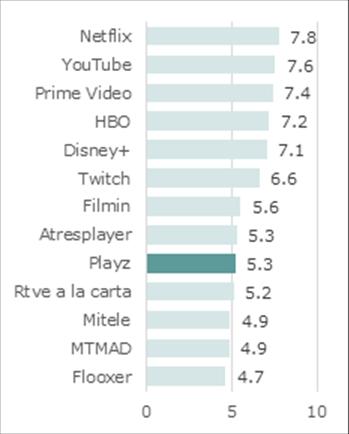
In terms of quality, the platform's content ranks in the middle. The most highly rated are YouTube and the major international platforms like Netflix, Prime, and the like. Compared to other Spanish platforms, Playz is only surpassed by Atresplayer, and it ranks ahead of MTMAD and Flooxer. In terms of gender differences, women rate it nearly one point higher than men, while in terms of age, there are no significant differences according to the ANOVA analysis.
Table 3. Perception of Playz' quality by gender and age, and compared to other platforms
|
Analysis of the perception of quality by gender |
Perception of quality by platform |
|||||
|
Gender |
Media |
N |
Stan. Dev. |
ANOVA |
|
|
|
f |
Sig. |
|||||
|
M |
4.8 |
93 |
2.9 |
4.843 |
.029 |
|
|
F |
5.7 |
98 |
2.8 |
|||
|
Analysis of the perception of quality by age |
||||||
|
18-23 |
5.2 |
64 |
3.1 |
2.052 |
0.131 |
|
|
24-29 |
5.8 |
62 |
2.6 |
|||
|
30-35 |
4.8 |
66 |
2.8 |
|||
Source: created by the authors.
The focus groups offered an even more positive opinion of Playz, with a level comparable to that of any international platform. «I see almost no difference. Any content on this website could easily be on Netflix, and there would be no noticeable difference in quality» (M24). Although they mention a wider range of content on other platforms, mainly Netflix, which is a benchmark for this type of consumption, the respondents have a high regard for the content on Playz. «It’s not bad. Take Grasa, for example. It really grabbed my attention, and I could definitely watch it on this platform» (M18).
Playz' offering is described as being «very Spanish», as if it were a badge of honour, yet for some people this is not a positive comment. Rather than being «low brow», it is often associated with «low quality». As one respondent comments, «The offering is fairly good. And in terms of quality, well, the programmes are Spanish... For that reason, I don't really like them too much, so I don't watch them very often. Also, I don't find that kind of humour funny» (F29). Consequently, expectations regarding Playz' content are lower, so the respondents assume that this platform «can't compete with series like Game of Thrones» (HBO). Nevertheless, these technical limitations do not necessarily mean that the ideas are less creative, which could be developed with a larger budget on other platforms. As one respondent put it, «Compared to what Netflix can do, Playz will always have limitations. But if a cool idea starts here, and a big production company does something based on the idea, that's a good thing, because in the end, it's RTVE, isn't it? » (M26).
On the other hand, some users like the «Spanish» label and claim to be «fans» of these products. They are aware of certain production limitations, as there are no «special effects on a daily basis», but they find the content «more direct» and are willing to give Playz a try.
Regarding the website itself, the opinions were more varied. Some describe its design as «cool, easy to use, and modern» (M28), while others consider it “less confusing than Netflix” and better organised into categories, which saves time when searching for content. However, other members of the sample disagree, believing that the Playz site is neither user-friendly nor accessible. «The content may be attractive, but not the website itself» (M20).
6.2. Perception of Innovation
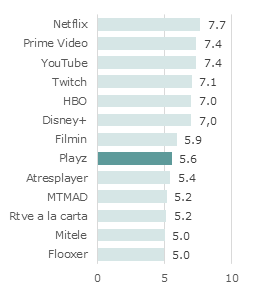
Similar to the aspect of quality, Playz is also in the middle of the pack in terms of innovation, as it lags behind international platforms and only surpasses Filmin among Spanish platforms. Moreover, gender and age show similar results in this regard.
Table 4. Perception of Playz’ innovation by gender and age, and compared to other platforms
|
Analysis of the perception of innovation by gender |
Perception of innovation by platform |
|||||
|
Gender |
Media |
N |
Stan. Dev. |
ANOVA |
|
|
|
f |
Sig. |
|||||
|
M |
5.4 |
97 |
2.86 |
0.946 |
0.332 |
|
|
F |
5.8 |
97 |
2.6 |
|||
|
Analysis of the perception of innovation by age |
||||||
|
18-23 |
5.5 |
68 |
2.7 |
0.284 |
0.753 |
|
|
24-29 |
5.8 |
60 |
2.8 |
|||
|
30- 35 |
5.5 |
66 |
2.7 |
|||
Source: created by the authors.
Although the focus groups offered a wide variety of opinions about Playz, positive comments were dominant. On the one hand, some respondents believe that the content on this platform is «more modern», not «the same old thing, » and «can't be seen anywhere else». In fact, they see the «debates» as especially innovative, mainly «because of the way current issues are addressed», and «how they appeal to young people». Unlike other television channels, young people play a key role due to the fact that the panellists on Playz are between 18 and 35 years of age, and no one is older than that range. Likewise, the intermix of topics such as rap and feminism is emphasised, which is something that «cannot be seen in many places».
It is also appealing to link animation with reality, as occurs in Yrreal. This show has received several comments about its innovative approach. As one respondent comments, «I find its production impressive and uncommon (...). It’s interesting. It reminds me of an Akira Toriyama film (...) which is also innovative, because that style has only been used in a tiny number of films» (M24).
In a similar vein, the series Si fueras tú has garnered good reviews for its interactive approach with the audience. At the end of each episode, the main character is given two options to be voted on by the audience, and depending on the opinion of viewers, one of the options is carried over into the next episode. «I really liked being able to choose what is going to happen, and then see it happen, because that’s never been done in Spain» (M28). Other respondents are surprised to find this on RTVE, which they perceive as «a channel far removed» from the young crowd. Due to this perception, there are doubts as to whether the Playz programming can attract viewers under the age of 18.
By contrast, some people feel that Playz' content is «just more of the same», «repetitive» «nothing special», or «not much different than the rest». Once again, comparisons with other platforms emerge. «I don't think it's innovative, to be honest, because Amazon Prime, Netflix, and all the others are identical. There's nothing new. I haven't seen anything that's different» (M28).
Others go even further by beckoning RTVE to embark on a bolder plan, so that audiences will consume Playz rather than other media. «I think they need to take a few more risks, be more innovative, and offer something special, and to increase the variety, because if you have YouTube, Amazon and Netflix, who’s going to choose Playz over YouTube to watch cockfighting?» (M27).
It should be clarified that the participants highlight the need for innovation and accessibility to content. «If I can't watch it just any place, it's innovative, but the rest is just the same as other series I can watch on other channels. The only one that's somewhat different is the one with animation» [referring again to Yrreal] (F25).
6.3. Perception of Diversity
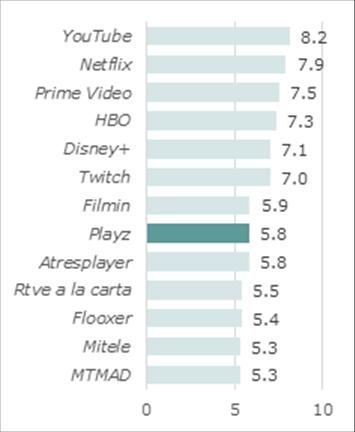
In this category, Playz's position is similar to that of the other two categories, quality and innovation. However, there are significant differences in terms of gender and age: women give it nearly one point more than men, and the younger group also rate it one point higher than the older group.
Table 5. Perception of Playz' diversity by gender and age, and compared to other platforms
|
Analysis of the perception of diversity by gender |
Perception of diversity by platform |
|||||
|
Gender |
Media |
N |
Stan. Dev. |
ANOVA |
|
|
|
f |
Sig. |
|||||
|
M |
5.4 |
92 |
2.8 |
5.758 |
0.017 |
|
|
F |
6.3 |
92 |
2.4 |
|||
|
Analysis of the perception of diversity by age |
||||||
|
18-23 |
6.1 |
65 |
2.6 |
3.127 |
0.046 |
|
|
24-29 |
6.2 |
57 |
2.5 |
|||
|
30-35 |
5.2 |
62 |
2.7 |
|||
Source: created by the authors
The focus groups offer two different concepts of diversity: firstly, in terms of who the main character of the content is; and secondly, in reference to the variety of topics covered, such as sexual diversity, mental health, urban issues like graffiti, trap music, skateboarding, etc., and issues specific to young people, such as sex, job insecurity, drug use, and others.
Some highlight diversity as an essential feature of Playz. «To me, the variety of content seems to be the biggest difference between Playz and other platforms» (H25). Another person believes that some of the topics should be less mainstream: «Netflix takes it seriously [referring to the fictional series El Ministerio del Tiempo[v]], because this platform gives a voice to many stories from Spanish culture and history, which would not be given a voice elsewhere. I don't know, I really like it» (F19).
In the focus groups, the participants appreciate the fact that minorities, who do not generally appear on screen, are given a voice. These include women in the music industry, people from disadvantaged social strata, and others. «It's a way to show another lifestyle, and it gives visibility to people who are a little further down the social ladder» (F18). Along the same lines, another respondent made the following comment: «In every series or film, you get content that defends an underrepresented group. For example, in the first series mentioned, it’s the trans community; in another series, Grasa, it’s fat people. Also, these are issues that you don't see much on television. I like the fact that the actors and topics are diverse» (F20).
In this regard, programmes such as Gen Playz are especially noteworthy, as they provide a forum for debate that gives «visibility to a lot of people from different communities» which, in the words of one respondent, is something that «was needed, because the programmes we had were becoming a bit old-fashioned» (M19).
The fact that the trans community is regularly featured on Playz is also seen as positive; again, in contrast to more international platforms: «It’s true that Netflix has LGTBIQ+ content, but it's always fiction. I don't think there are any debates or interviews. On the other hand, Playz has series on these topics, but also interviews with activists and drag queens, and debates that go beyond fiction, and they end up having a stronger impact on society» (M18).
Even people outside these minority groups agree that Playz should give these people space on its programming schedule. «I'm not part of those communities, so to speak, but I think I can also learn and see other points of view, and how they live. I think it's good» (F20). However, some comments give greater importance to the content «than to what is being shown».
To a lesser extent, we also identified discourse that expressed distrust of displaying minorities on the screen, which «seems to be a fad» and can «end up being used as a product itself». Some explicitly expressed their lack of interest in these characters: «I don't have any interest in knowing what these people are like» (F32). Others are even bothered by the importance given to the personal attributes of the protagonists in the series: «It seems like they’re trying to say, ‘I'm just my circumstances, nothing else. I'm the gay guy, or the trans guy’. I have a trans friend who doesn't even think about it. He's trans, period. For example, in Grasa, ‘I'm fat, so what?’ I don't like when they make it the focus of the plot. I just skip those series» (F28).
7. Conclusions
The platform known as Playz is a clear response to RTVE’s need to connect with young audiences in the increasingly complex and fragmented scenario of audiovisual consumption. This need is shared by other public operators in Europe, who are also losing touch with youth, and by traditional private operators such as Mediaset and Atresmedia. In fact, the two latter outlets have developed specific offerings for young people, and they are Playz's most direct competition.
Previous studies on Playz have placed their offering within the framework of public service, along with RTVE's compliance with its obligation to reach the entire population, and to make an effort in terms of audiovisual innovation (Fieiras et al., 2023). However, the results of the present study reveal a very limited response to this offering by the target audience. In fact, the mere existence of the platform is not well known, and even among those who are aware of it, the consumption is low.
From a quantitative point of view, assessment of the offering in terms of quality, innovation and diversity is also quite limited compared to other platforms. In nearly all the cases, the averages for these criteria range from 5-6, which is well below those of platforms such as Netflix, Prime, and YouTube.
However, this low level of use and marginal evaluation clash with the largely positive opinion that emerged from the focus groups. In fact, after viewing Playz’ content, participants responded favourably when asked to give their opinion about the quality, innovation and diversity of the platform's productions.
Although a clear difference exists between Playz' Spanish origins and local themes, compared to those of international platforms, this aspect is also highly valued and related to its public service mission, and some respondents even said they are similar in terms of quality. Likewise, innovation also received positive responses regarding Playz’ commitment to transmedia narratives in some of the programmes, as pointed out by Eguzkitza et al., (2023b). In addition, the incorporation of content that gives a direct voice to young people is also valued and is seen as innovative as well. This concurs with Casado et al. (2023), among others, who contrast this approach with the exclusively adult discourse of other channels and platforms.
Regarding diversity, assessment of both the variety of content, as well as the presence of minorities and LGTBIQ+ groups in these spaces, is well regarded. Therefore, though not explicitly stated, what is clear is RTVE’s obligation as a public service media to create social debate and promote awareness of sensitive issues by focusing on current affairs. This approach concurs with Bruun et al., (2025b), who call on public media to incorporate a larger diversity of genres. However, some discourse points to an excessive presence of these groups, which are considered «fads» by certain people.
Despite the limited approach of using a qualitative sample, such as the one used for this research, the comparison of these data with those collected in the quantitative part of the study is considered a relevant contribution. And the reason is, it shows a notable contrast between the lack of knowledge and limited use of the Playz platform and the favourable opinions it elicits when young audiences actually use it.
Based on this finding, two major conclusions can be drawn. Firstly, beyond the classification of genres that comprise the public service content of Playz, it is highly regarded and appreciated by the target audience. Secondly, this contrast reveals RTVE's difficulty in reaching this age group. Moreover, this second point highlights the significant limitations that the organisation has in terms of marketing and promotion, as well as its own internal difficulties in developing ambitious projects, which also results from the lack of a clear definition of the platform itself. However, it bears mentioning the fierce competition and promotional efforts that are an essential part of a large, international platform. In this regard, it has been noted that the performance of its direct competitors, MTMAD and Flooxer, is similar to that of Playz, which in some ways highlights the difficulty encountered by the latter in positioning itself with this target audience.
To achieve the goal of gaining audience share among young people, RTVE might consider following the recommendations of the focus groups in undertaking a much more ambitious dissemination of content through social media, using Netflix as an example. One option would be to launch short promotions of its content on TikTok or Instagram, and display the Playz logo at the end in order to gain visibility among its target audience.
Finally, from a methodological perspective, the authors suggest future lines of research focused on qualitative techniques. It is important to draw attention to the need for this type of investigation, as it is closer to the public and creates a link between the audience and the content, the purpose of which is to go beyond a quantitative approach. In the currently weakened state of the public realm, this study clearly shows that by limiting oneself to audience analysis to determine the value of the public domain, this approach ends up being biased and self-serving. Not only does it limit the voice of viewers, but it also detracts from the complexity of the debate.
Ethics and transparency
Acknowledgements
The authors would like to thank the participants of the various focus groups for their willingness to participate and their enthusiastic involvement. We would also like to thank Charles Arthur for his attention to detail in the translation of this article.
Conflict of interest
The authors declare that there is no conflict of interest in any part of this study.
Funding
This work is part of the R&D project entitled, Audiovisual Platforms and Youth: Content, Business Strategies, and Audience Perception, funded by the Ministry of Science and Innovation as part of the call for R&D challenge projects (RTI2018-095213-B-I00), and the UPV/GIU Research Group 22/028. EHU GIU22/028.
Contributions from the authors
|
Task |
Author 1 |
Author 2 |
Author 3 |
Author 4 |
|
Conceptualisation |
X |
X |
X |
|
|
Data curation |
X |
|
|
|
|
Formal analysis |
X |
|
|
|
|
Funding acquisition |
|
X |
X |
|
|
Investigation |
X |
X |
X |
|
|
Methodology |
|
X |
|
|
|
Project administration |
|
|
|
|
|
Resources |
|
|
|
|
|
Software |
|
|
|
|
|
Supervision |
|
|
|
|
|
Validation |
|
X |
|
|
|
Visualisation |
|
|
X |
|
|
Writing – original draft |
X |
X |
X |
|
|
Writing – review & editing |
X |
X |
X |
|
Data availability
For data availability, please contact the authors of this research.
References
Andersen, M. M. T. & Sundet, V. S. (2019). Producing online youth fiction in a nordic public service context. VIEW. Journal of European Television History and Culture, 8(16), 1-16. https://tinyurl.com/4khb4kzb
Azurmendi, A. (2018). Reconectar con la audiencia joven. Narrativa transmedia para la transformación de la televisión de servicio público en España, Francia, Alemania y Reino Unido. Revista Latina De Comunicación Social, (73), 927–944. https://doi.org/10.4185/RLCS-2018-1289
Bardoel, J. L. & Lowe, G. F. (2007). From public service broadcasting to public service media: The core challenge (pp. 7-26). Nordicom.
Barr, K. (2025). ‘Are you being served?’ Public service media: audience conceptions of value in UK critical media infrastructure. International Journal of Cultural Policy, 1-17. https://doi.org/10.1080/10286632.2025.2478230
Bonini, T. & Pais, I. (2017). Hacking public service media funding: A scenario for rethinking the license fee as a form of civic crowdfunding. International journal on media management, 19(2), 123-143. https://doi.org/10.1080/14241277.2017.1298109
Bruun, H., Lassen, J. M. M. & Johnson, C. (2025a). Streaming Public Service Television in the Age of Platforms: Lessons from a comparative analysis of VoD publishing and personalisation in seven markets. https://tinyurl.com/bdcu78v6
Bruun, H., Johnson, C., Lassen, J. M., Nucci, A., Raats, T. & Świtkowski, F. (2025b). Publishing public service media on demand: A comparative study of public service media companies’ editorial practices on their VoD services in the age of platformization. Journal of Digital Media & Policy. https://doi.org/10.1386/jdmp_00167_1
Cañedo, A., Rodríguez-Castro, M. & López-Cepeda, A. M. (2022). Distilling the value of public service media: Towards a tenable conceptualisation in the European framework. European Journal of Communication, 37(6), 586-605. https://doi.org/10.1177/02673231221090777
Casado, M. Á., Guimerà, J. À., Bonet, M. & Llavador, J. P. (2023). Adapt or die? How traditional Spanish TV broadcasters deal with the youth target in the new audio-visual ecosystem. Critical Studies in Television, 18(3), 256-273. https://doi.org/10.1177/17496020221076983
Doñate-Ventura, J., Galán-Cubillo, E. & Marzal-Felici, J. (2025). All you can view: Análisis de la transformación del consumo audiovisual a través de Netflix. ZER. Revista de Estudios de Comunicación, 30(58), 129-140. https://doi.org/10.1387/zer.27286
Donders, K. (2021) Public Service Media in Europe. Law, Theory and Practice. Routledge.
Donders, K. & Van den Bulck, H. (2016). Decline and fall of public service media values in the international content acquisition market: An analysis of small public broadcasters acquiring BBC Worldwide content. European journal of communication, 31(3), 299-316. https://doi.org/10.1177/0267323116635833
Dragomir, M. & Túñez López, M. (2024). How public service media are changing in the platform era: A comparative study across four European countries. European Journal of Communication, 39(6), 608-624. https://doi.org/10.1177/02673231241290062
EBU (2014). PSM Values Review: The Tool. The European Broadcasting Union. https://tinyurl.com/4cj7n867
Eguzkitza-Mestraitua, G., Guimerà, J. À. & Casado, M. Á. (2023a). Are there any young people out there? Spanish public broadcaster in search of new audiences. Catalan Journal of Communication & Cultural Studies, 15(1), 123-142. https://doi.org/10.1386/cjcs_00081_1
Eguzkitza-Mestraitua, G., Casado-del-Río, M. Á. & Guimerá-i-Orts, J. À. (2023b). RTVE’s transmedia strategy aimed at young audiences: the case of Playz (2017-2020). Communication & Society, 36(3), 1-17. https://doi.org/10.15581/003.36.3.1-17
Eguzkitza-Mestraitua, G., Casado-del-Río, M. Á. & Guimerá-i-Orts, J. À. (2023c). Percepción del público joven sobre las plataformas online de la televisión pública española: RTVE Play y Playz. Revista Latina De Comunicación Social, 81, 40–62. https://doi.org/10.4185/rlcs-2023-1970
Fieiras-Ceide, C., Túñez-López, M. & Sousa, J. P. (2023). Radiografía de innovación de los medios públicos de escala nacional de la península Ibérica: visión estratégica, tecnológica, y de captación de audiencias jóvenes en RTVE y RTP. Revista Latina de Comunicación Social, 81, 353-374. https://www.doi.org/10.4185/RLCS-2023-1957
García-Guardia, M. L., Clemente-Mediavilla, J. & Calvo-Triviño, L. M. (2021). La ficción como herramienta de retención de la audiencia más joven. El caso de Playz en YouTube. Creatividad y sociedad: revista de la Asociación para la Creatividad 34: 159-178. https://tinyurl.com/5n8bvn2f
Goyanes, M., Costa-Sánchez, C. & Démeter, M. (2021). The social construction of Spanish public television: The role and function of TVE in a multiplatform environment. International Journal of Communication, 15, 20. https://tinyurl.com/3devj2b4
Hagedoorn, B., Eichner, S. & Gutiérrez Lozano, J. F. (2021). The ‘youthification’ of television. Critical studies in television, 16(2), 83-90. https://doi.org/10.1177/174960202110118
Krauss, F. & Stock, M. (2021). Youthification of television through online media: Production strategies and narrative choices in DRUCK/SKAM Germany. Critical Studies in Television, 16(4), 412-432. https://doi.org/10.1177/17496020211044821
Krüger, S. & Rustad, G. C. (2019). Coping with Shame in a Media-saturated Society: Norwegian Web-series Skam as Transitional Object. Television and New Media, 20(1), 72–95. https://doi.org/10.1177/1527476417741379
Ley 17/2006, de 5 de junio, de la radio y la televisión de titularidad estatal. Boletín oficial del Estado 134, de 06/06/2006. https://tinyurl.com/4fj6n4v2
Lindtner, S. S. & Dahl, J. M. (2018). Aligning Adolescent to the Public Sphere: The Teen Serial Skam and Democratic Aesthetic. Javnost – the Public 26 (1), 54-69. https://doi.org/10.1080/13183222.2018.1529471
López-Golán, M., Rodríguez-Castro, M. & Campos-Freire, F. (2019). La innovación de las radiotelevisiones públicas europeas en la comunicación digital y las comunidades de usuarios. Cuadernos.Info, 45, 241-255. https://doi.org/10.7764/cdi.45.1350
Maroto, I. & Rodríguez, T. (2018). Estrategias de desarrollo de la televisión pública española: El caso de la plataforma Playz, in V. A. Martínez-Fernández, Ó. Juanatey-Boga, I. Puentes-Rivera, and M. M. Rodríguez-Fernández. (eds), Proceedings of III Simposio Internacional sobre Gestión de la Comunicación, A Coruña, 22–23 March, A Coruña: Rede Internacional de Investigación da Xestión da Comunicación; pp. 662–76. https://tinyurl.com/4db7huma
Martin, D. & Johnson, C. (2024). Universality: A battleground for UK public service media in the platform age. The Political Quarterly, 95(1), 25-34.
https://doi.org/10.1111/1467-923X.13342
Mayorga-Escalada, S. (2019). Netflix, estrategia y gestión de marca en torno a la relevancia de los contenidos. AdComunica, 18, 219–244. https://doi.org/10.6035/2174-0992.2019.18.11
Pardo-Larrosa, I. & Martínez-Cano, F. J. (2020). Creación de contenidos audiovisuales y distribución en el siglo XXI. Estudio de caso de Playz y la webserie Neverfilms. Narrativas transmedia a la deriva: del storytelling a las nuevas ficciones audiovisuales, 55-80.
Ramsey, P. (2018). ‘It could redefine public service broadcasting in the digital age’: Assessing the rationale for moving BBC Three online. Convergence, 24(2), 152-167. https://doi.org/10.1177/1354856516659001
Rivero, E. A. (2022). Debates teóricos para el estudio de la televisión pública estatal ante la convergencia digital en América Latina. ZER: Revista de Estudios de Comunicación, 27(53), 81-99. https://doi.org/10.1387/zer.23816
Soriano, J. (2007). Ofici de comunicòleg. Eumo.
Stollfuß, S. (2019). German public television, social media and audience engagement. VIEW Journal of European Television History and Culture, 8(16), 98. https://doi.org/10.18146/2213-0969.2019.jethc178
Treadwell, D. (2024). Introducing communication research. Paths of inquery. Sage.
Zaragoza-Fuster, M. T. & García-Avilés, J. A. (2020). The role of innovation labs in advancing the relevance of public service media: The cases of BBC news labs and RTVE LAB. Communication and Society, 33(1), 45-61. https://doi.org/10.15581/003.33.1.45-61