index●comunicación
Revista científica de comunicación aplicada
nº 16(2) 2026 | Pages 325-352
e-ISSN: 2174-1859 | ISSN: 2444-3239
Chronic Stress among Journalists: Prevalence, Risk and Protective Factors
Estrés crónico en periodistas: prevalencia, factores de riesgo y de protección
Received on 08/12/2025 | Accepted on 28/04/2026 | Published on 15/07/2026
https://doi.org/10.33732/ixc/16/02Estres
Susana Herrera-Damas | Universidad Carlos III de Madrid
dherrera@hum.uc3m.es | https://orcid.org/0000-0002-1755-1621
Abstract: This systematic review synthesizes empirical evidence (2000–2025) on the prevalence of chronic stress among journalists and the main associated risk and protective factors. Articles were searched for in WoS and Scopus, applying PICOS criteria and selection in Rayyan. Data were synthesized using inductive-deductive thematic analysis. Twenty studies were included, examining the situation faced by 7,394 journalists from a total of 16 countries. Quantitative designs (n=12) predominated over qualitative (n=6) or mixed (n=2) designs. The results show a high prevalence, with higher levels among women, young people, freelancers, and professionals exposed to precariousness, overload, and harassment. Internal locus of control, positive reappraisal, and social support emerge as robust protective factors. These findings underscore the need for multiscale interventions and improved standardization and physiological measurement of chronic stress.
Keywords: Chronic Stress; Journalists; Systematic Review; Risk Factors; Protective Factors.
Resumen: Esta revisión sistemática sintetiza la evidencia empírica (2000–2025) sobre la prevalencia del estrés crónico en periodistas y los principales factores de riesgo y protección asociados. Se buscaron artículos en WoS y Scopus, aplicando criterios PICOS y selección en Rayyan. Los datos se sintetizaron mediante análisis temático inductivo-deductivo. Se incluyeron 20 estudios que examinan la situación a la que se enfrentan 7.394 periodistas de un total de 16 países. Predominan los diseños cuantitativos (n=12) frente a los cualitativos (n=6) o mixtos (n=2). Los resultados muestran una prevalencia elevada, con mayores niveles entre mujeres, jóvenes, autónomos y profesionales expuestos a precariedad, sobrecarga y acoso. El locus de control interno, la reevaluación positiva y el apoyo social emergen como factores protectores robustos. Estos hallazgos subrayan la necesidad de intervenciones multiescalares y de mejorar la estandarización y medición del estrés crónico.
Palabras clave: estrés crónico; periodistas; revisión sistemática; factores de riesgo; factores de protección.
CC BY-NC 4.0
To quote this work: Herrera-Damas, S. (2026). Chronic Stress among Journalists: Prevalence, Risk and Protective Factors. index.comunicación, 16(2), 325-352. https://doi.org/10.33732/ixc/16/02Estres
1. Introduction
Contemporary journalism operates in a workplace ecosystem undergoing profound transformations and unprecedented structural pressure. Digital acceleration, job instability, intensifying workloads, and constant exposure to emotionally disturbing content have created a professional environment that is highly demanding and psychologically hazardous (Hayes & O'Sullivan, 2023). Within this framework, chronic stress has become a major occupational health issue, with direct implications not only for the individual well-being of journalists, but also for the quality of news coverage, the long-term viability of career paths, and the democratic capability of journalism to provide rigorous, truthful, contextualised, and socially-relevant information.
From the viewpoint of occupational psychology, chronic stress is defined as a sustained psychophysiological response that surfaces when work demands persistently exceed available coping resources (Monteiro et al., 2016). Unlike acute reactions, it keeps the body in a state of continuous alertness, with cumulative effects on physical health, psychological well-being, and professional performance (Najder et al., 2015; Monteiro et al., 2016). Two theoretical frameworks are especially relevant for understanding this phenomenon. The Job Demands-Resources (JD-R) model posits that chronic stress arises from a sustained imbalance between job demands and the resources available to cope with them (Demerouti et al., 2001; Schaufeli & Bakker, 2004). By contrast, the Conservation of Resources (COR) model explains how the threat of losing cherished resources such as stability, autonomy, and social support produces spirals of progressive attrition (Hobfoll, 1989; 2001). Both frameworks serve as the interpretive lens of the present review.
The available literature conceptually distinguishes between acute stress, chronic stress, burnout, and post-traumatic stress disorder. Acute stress occurs following critical incidents and typically subsides over time (Backholm, 2012). Chronic stress, on the other hand, stems from persistent work demands and sustained psychosocial risks that undermine health and job satisfaction (Najder & Merecz-Kot, 2014; Hoak, 2021; Shah et al., 2024). Burnout is a distinct syndrome of emotional exhaustion, depersonalisation, and reduced personal fulfilment arising from a maladaptive response to unmanaged, chronic stress (Maslach, 2003; Maslach & Leiter, 2016). Therefore, while chronic stress does not necessarily lead to burnout, as it depends on the coping resources available, burnout implies the existence of prior chronic stress. This asymmetrical relationship underpins the decision to focus the present review on chronic stress as a differentiated construct and to exclude studies focused exclusively on burnout. As for post-traumatic stress disorder, or PTSD, this syndrome arises following intense or repeated exposure to trauma, which is characterised by re-experiencing, avoidance, and hyperarousal (Backholm, 2012; MacDonald et al., 2022). Though conceptually distinct, these phenomena sometimes coexist: For example, war journalists often experience a combination of acute symptoms of trauma with high levels of chronic stress stemming from precarious work conditions and a lack of institutional support (Obermaier et al., 2023).
The consequences of chronic stress on journalists’ quality of life are multifaceted and associated with poorer perceived health, increased absenteeism, and impaired psychological well-being, including difficulties concentrating, irritability, rumination, and emotional numbness (Najder & Merecz-Kot, 2014; Najder et al., 2015). Nevertheless, there is still a notable lack of research that incorporates objective physiological measurements, which limits the somatic understanding of the phenomenon.
Chronic stress also compromises the quality of journalistic work. It reduces job satisfaction, affects performance, and leads to a decline in essential practices such as fact-checking, contextualisation, and analytical depth (Reinardy, 2013; Najder & Merecz-Kot, 2014; James-Garrod, 2023). Likewise, it erodes the organisational climate and internal cohesion of newsrooms (Hoak, 2021). From an industry viewpoint, symptoms of stress have been linked to the intention to leave the profession, resulting in significant losses of expertise and organisational memory (Talabi et al., 2024).
Despite the proliferation of empirical studies, the available systematic reviews do not approach chronic stress as a distinct construct. Monteiro et al. (2016) synthesised the evidence related to occupational stress among journalists, including demands, coping strategies, and impact, yet their research timeframe ended in the mid-2010s before the determining factors of stress in this profession were reshaped by the advent of intense digitisation, the COVID crisis, and increased job insecurity. Other reviews have focused on related constructs: For example, MacDonald et al. (2016) reviewed burnout. Moreover, the same group, MacDonald et al. (2022), also addressed PTSD symptoms, yet they failed to grapple with chronic stress or employ frameworks such as JD-R or COR. More recently, Herrera-Damas (2025) has provided the most up-to-date synthesis on burnout and coping strategies among journalists, with an ample range of review from the year 2000 to 2025, integrating the JD-R and COR frameworks for the first time. However, the focus in that study was on burnout, which does not systematically examine protective factors beyond individual coping strategies. Consequently, two gaps remain: firstly, there is no synthesis for the purpose of estimating the prevalence of chronic stress among journalists; secondly, there is a lack of systemisation regarding risks and protective factors which, supported by the JD-R and COR frameworks, are intended to integrate the organisational, occupational, contextual, and psychosocial levels.
Given the context, the aim of this exploratory review is to synthesise, analyse, and compare the empirical evidence produced between 2000 and 2025 on the prevalence of chronic stress among journalists, as well as the factors that lead to both risk and protection. The purpose is to provide a comprehensive understanding of this phenomenon within the framework of digital transformation, job insecurity, and the new emotional dynamics of newsroom work. Technically, risk factors refer to the interaction between the work environment, job tasks, organisational conditions, and the capabilities, needs, and culture of workers. This also includes personal considerations unrelated to work which, through perceptions and experience, can influence health, work performance, and job satisfaction. Conversely, protective factors are the conditions and attributes, including skills, strengths, resources, support, and coping mechanisms, which are present in individuals, families, communities, and society, generally speaking, that help people cope more effectively with stressful events and mitigate or eliminate risk (Leka et al., 2010).
In particular, this review is structured around two specific objectives:
The first (SO1) aims to estimate and describe the prevalence of chronic stress among journalists. Thus, two research questions correspond to this objective: RQ1. What is the prevalence of chronic stress among journalists according to the scientific literature from 2000-2025, and how does it vary by gender, type of media outlet, job category, geographic region, and professional experience? RQ2. What instruments for measuring chronic stress have been employed in studies on journalists?
In line with the gaps mentioned above, the second specific objective (SO2) is to identify the main determining factors of chronic stress among journalists. In this case, we aim to answer the following two research questions: RQ3. What are the main risk factors associated with chronic stress in journalists, and how are they distributed among the organisational, occupational, contextual, and psychosocial levels according to the JD-R and COR frameworks? RQ4. What personal, interpersonal, and organisational factors of protection have been shown to mitigate the intensity of chronic stress effects?
2. Material and Methods
A systematic review is a rigorous, transparent, and reproducible methodology that allows for the structured identification, evaluation, and synthesis of the available scientific literature on one or more research questions, which have been explicitly defined in advance. This enables a coherent mapping of existing empirical contributions, trends, recurring methodological approaches, and opportunities for future research (Petticrew & Roberts, 2006).
To ensure methodological rigour, this review follows the guidelines established by the PRISMA 2020 statement (Page et al., 2021), which is considered an international standard. Moreover, the complete protocol has been registered in the Open Science Framework (see Appendix 1)[i] . In the following sub-sections, we detail the most important phases of the review.
2.1. Literature Search Strategy
The search was conducted in the Web of Science (WoS) and Scopus databases. These multidisciplinary databases have the widest range of indexed journals among the social sciences (Norris & Oppenheim, 2007). Their combined use is a well-established methodological strategy: Although they share a common body of records, each contains unique content. Therefore, in line with Echchakoui (2020), by consulting both repositories together, coverage is maximised without compromising the quality of the records retrieved.
The search strategy in Web of Science was designed to optimise the balance between topic coverage and conceptual precision. To adequately define the phenomenon of interest, we constructed a Boolean search query that combined the professional descriptor «journalists» with the term «stress», yet we excluded entries with the terms «burnout», «post-traumatic» and «acute».
We also applied the following filters: time period, 2000–2025; document type, «Article»; language, English; and open access availability within the core collection. Overall, this strategy complied with the methodological principles recommended by PRISMA 2020 (Page et al., 2021) and was designed according to the criteria proposed by Methley et al. (2014). The search in WoS yielded a total of 108 results.
In Scopus, the search strategy was also designed to ensure broad yet conceptually precise coverage. To this end, we used Boolean operators that combined terms specific to this profession (journalist*) with conceptual descriptors relevant to occupational stress («stress», «job stress», «work stress», «occupational stress»). We simultaneously applied exclusion operators aimed at eliminating studies focused on related phenomena such as burnout, MBI, PTSD, «vicarious trauma», etc.). We also restricted the search by document type, stage of publication, source type, and language, and we prioritised open-access availability. Specifically, the search in Scopus yielded a total of 27 results.
2.2. Criteria of Inclusion and Exclusion
To ensure a rigorous selection of empirical evidence, we defined the inclusion and exclusion criteria according to the PICOS framework as follows: firstly, we limited the study population to adult journalists working in reporting roles in all types of media. We only included studies that explicitly measured chronic stress using valid psychometric instruments or robust qualitative approaches, while excluding studies that focused exclusively on associated yet distinct phenomena, such as burnout, acute stress, and secondary trauma.
Secondly, the criteria regarding results aimed to ensure that the evidence gathered was empirically sound. We only included studies that provided verifiable data on the prevalence or determinants of chronic stress, while excluding studies that did not offer empirical findings, as well as non-peer-reviewed grey literature and documents with inaccessible, full-text versions. We accepted quantitative, qualitative, and mixed-method designs, as long as they presented rigorous analyses and an explicit approach.
We set the starting point at the year 2000, given that from that moment on the journalistic ecosystem started to undergo a radical transformation due to intensive digitisation, a 24/7 news cycle, progressive structural precariousness, and new demands associated with hyperconnectivity. All these factors have decisively reshaped the determinants of chronic stress. The period includes milestones that intensified sustained exposure to stress, as well as emerging phenomena that directly impact the mental health of journalists. By ending the study in 2025, the authors were able to incorporate the most recent evidence.
Furthermore, the use of exclusively open-access sources reduces barriers to replication and validation, and it promotes the global inclusion of researchers in resource-limited settings, which fosters equality and cost-effectiveness in accessing knowledge (Haddaway et al., 2021; Martinou & Angelidi, 2022; Page et al., 2022). The complete list of inclusion and exclusion criteria can be found in Appendix 2[ii] .
2.3. Study Selection
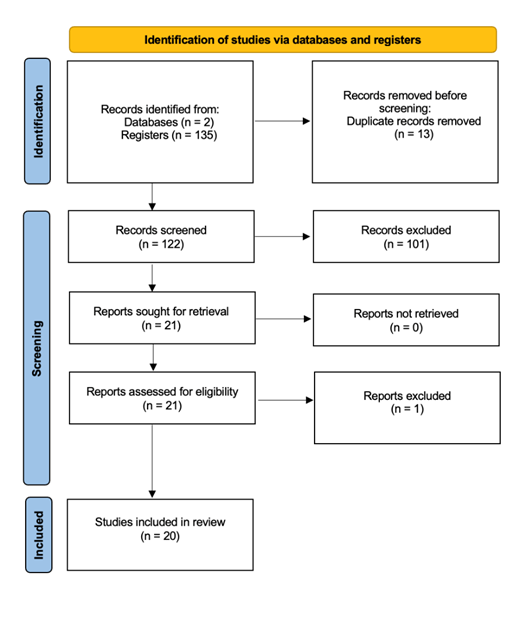
For the selection task we used Rayyan, due to its capability for choosing and screening the studies that we ultimately included in the review. In the initial phase, we retrieved a total of 135 records from the two selected databases: specifically, 108 from Web of Science (WoS), and 27 from Scopus.
After removing 13 duplicates, 122 unique records remained, which underwent a preliminary selection phase (phase 1) based on a review of the title and abstract. At this stage, we applied the defined criteria and excluded 101 studies for failing to meet the thematic or population requirements.
Next, we evaluated the remaining 21 studies by reading the full text, and we verified that all but one met the eligibility criteria. Thus, the final corpus consisted of a total of 20 studies. Figure 1 details the complete process:
Figure 1. PRISMA 2020 diagram showing the text screening process
Source: Page et al. (2021)
Details of the 20 texts analysed can be found in Appendix 3[iii].
2.4. Data Extraction and Validation
From each of the 20 studies, we extracted a total of 16 variables using a structured Excel template, designed in advance, which was in line with the research questions. Before proceeding with the full data extraction, we tested the template on two articles to improve the operational clarity of each variable.
To facilitate information retrieval, we used the NotebookLM tool, although we manually verified all information against the original texts. This ensured accuracy and consistency between the original texts and the data entry fields.
We applied strategies for internal control, traceability, and intra-rater consistency verification. Firstly, we tested and adjusted the template to reduce ambiguities. Secondly, we maintained a decision log to document the interpretive criteria and the resolutions adopted (Nowell et al., 2017). Additionally, we conducted a validation self-audit, which consisted of independently reviewing 25% of the items after two weeks (Thomas & Harden, 2008). We also double-checked all numerical values against the full text until we achieved complete correspondence between the source and the recorded data, in accordance with recommendations for single-evaluator reviews (Lincoln & Guba, 1985).
2.5. Analysis of Bias in the Publications Examined
To analyse the methodological quality of the studies, we used MMAT. Designed and developed by Pluye and colleagues (2009), this tool enables the evaluation of studies by analysing their strengths and limitations.
The evaluation of the twelve quantitative studies reveals uneven methodological quality. While all the studies pose clear research questions, collect adequate data, and present appropriate statistical analyses, weaknesses in the design compromise the external validity of some of the studies. Specifically, the criterion regarding sample representativeness has shortcomings: this aspect is not fulfilled in four studies and is only partially met in two others. The criterion regarding the risk of bias due to non-response is also problematic: seven studies do not fulfil this standard, and one paper only partially complies. These findings underscore the need to strengthen the methodological rigour of future quantitative research.
Evaluation of the six qualitative studies reveals a high level of methodological quality. All of them fully meet the seven criteria established for this type of design, as they formulate clear, well-designed research questions and confirm that the data collected are relevant to the questions posed. The qualitative approach was considered pertinent, and the data collection methods were appropriate. Likewise, the findings were adequately supported by the data obtained.
The two mixed-method studies fulfil most of the criteria. They both clearly state their research questions, adequately justify the use of a mixed-method design, and effectively integrate the different approaches. However, both studies show only partial compliance with the criterion of data integration. This limitation does not invalidate the overall quality of the design, but it does suggest areas for improvement. The results of the bias analysis for all 20 studies examined can be found in Appendix 4[iv] .
2.6. Data Analysis
After completing the data extraction, we conducted an inductive-deductive, thematic analysis following the guidelines of Fereday and Muir-Cochrane (2006), and Braun and Clarke (2006). We carried out the task in two iterative stages. In the first phase, we created preliminary categories through the systematic listing of ideas, patterns, and recurring keywords in all the studies. In the second stage, we refined these categories through axial and selective coding. To enhance validity, we verified our decisions through iterative comparisons of the sources, and we also assessed thematic saturation (Nowell et al., 2017). Finally, we aggregated the synthesised information into higher-order analytical themes, which is in line with best practice for qualitative, systematic reviews (Thomas & Harden, 2008).
3. Results
3.1. Descriptive and Methodological Features of the Sample
Recent academic literature on chronic stress among journalists reflects a strong focus on structural crises and triggering factors. Such studies appear in specialised publications in psychology and communication, such as Digital Journalism, European Journal of Psychotraumatology, Journalism & Mass Communication Quarterly, and Anàlisi, with a high concentration of works published between 2023 and 2025.
The literature we analysed also reveals significant geographical diversity, covering the experiences of professionals in at least 16 countries. In Europe, research has focused on job instability and the aftermath of trauma. Some findings are from Norway, where the work-life balance among freelance journalists has been examined (Flatøy, 2025), in addition to stress reactions related to the tenth anniversary of the Oslo/Utøya terrorist attacks (Idås & Backholm, 2023). In Finland, the focus is on emotional strain related to managing audience metrics (Ahva & Ovaska, 2023), while in Germany, Springer & Rick (2025) have tried to pinpoint the coping strategies used to confront job insecurity. In the United Kingdom, Wahl-Jorgensen (2024) analysed stress among entrepreneurs, while in Lithuania, Jastramskis et al. (2023) investigated threats and self-censorship, and in Poland, Najder et al. (2015) examined occupational stress among radio journalists.
In Southern Europe, several studies have been linked to current crises. Spain is the most frequently cited country, which includes an analysis of the psychological impact of COVID on media professionals (Rodríguez-Rey et al., 2020), identification of stress predictors (Herrero-Jiménez et al., 2024), and a study on the strain associated with journalists’ transition to institutional communication offices (Aguar Torres, 2025). In Portugal, Monteiro & Marques-Pinto (2017) compare daily, work-related stress with that arising from the coverage of major events. Another qualitative, comparative analysis between Greece and Cyprus addresses the impact of COVID coverage (Vatikiotis et al., 2023). In Italy, Buoncompagni (2024) explores the prevalence of stress and anxiety related to local disasters, while in Ukraine, Balaklytskyi & Kuryliak (2020) analyse the work of war correspondents.
In the Americas, Hoak (2021) investigated organisational support in the United States during COVID-19, and Nicoletti & Figaro (2024) analysed job insecurity within the platform economy in Brazil. In Asia, studies focus mainly on India, where the impact of AI on journalists’ mental health is analysed (Upadhyay et al., 2024), as well as in Pakistan, where Malik & Malik (2023) associate stress with the locus of control. Finally, in Oceania, an Australian study explores time poverty linked to smartphones (James-Garrod, 2025).
From a methodological perspective, there are more quantitative studies (n=12) than either qualitative (n=6) or mixed-method (n=2) analyses.
Most of the quantitative studies are based on cross-sectional surveys (Hoak, 2021; Nicoletti & Figaro, 2024; Herrero-Jiménez et al., 2024). These investigations often use standardised psychometric tools, such as DASS-21 (Malik & Malik, 2023; Upadhyay et al., 2024), or the Psychosocial Risk Scale (Najder et al., 2015). Qualitative studies mostly employ in-depth interviews with small, purposive samples and theoretical saturation procedures (Monteiro & Marques-Pinto, 2017; Aguar Torres, 2025; Springer & Rick, 2025).
Regarding sample size, notable quantitative studies include a national survey in Brazil involving 3,100 participants (Nicoletti & Figaro, 2024), as well as an analysis of work-life balance in Norway based on a sample of 1,166 journalists (Flatøy, 2025). Representative samples are also included, such as one that appeared in the study conducted in Spain (n=391) (Herrero-Jiménez et al., 2024), and the one in Lithuania (n=302) (Jastramskis et al., 2023). The qualitative samples are much smaller, with case sizes ranging from n=14 (institutional journalists in Spain) (Aguar Torres, 2025), to n=57 (entrepreneurs in the United Kingdom) (Wahl-Jorgensen, 2024). Methodological details of the 20 studies comprising this review can be found in Appendix 5[v] .
3.2. Prevalence and Variation in Chronic Stress among Journalists
3.2.1. Frequency and Differences
The prevalence of chronic stress among journalists is high, although its intensity and manifestation vary considerably depending on geographical setting, demographic features, and employment status (Rodríguez-Rey et al., 2020; Buoncompagni, 2024; Herrero-Jiménez et al., 2024).
Firstly, quantitative studies show a high overall prevalence of chronic stress. In Spain, a representative sample from 2023 was found to have an average rate of self-reported stress at 3.71 out of 5, and 59.1% of the journalists experienced stress frequently or very frequently (Herrero-Jiménez et al., 2024). Moreover, this pattern is even more intense during crisis situations. During the COVID-19 pandemic, the psychological impact on media professionals was significantly higher than that of the general population (M=36.20 vs. M=27.95). Nearly half (48.6%) exhibited severe levels of stress according to the IES-R scale (Rodríguez-Rey et al., 2020). In Lithuania, 43.4% of the professionals reported feeling stress «often» or «very often» (Jastramskis et al., 2023). In Italy, the data were even more startling: According to one survey (2020), in highly precarious environments 87% of the journalists reported suffering stress, and 73% were afflicted with anxiety (Buoncompagni, 2024).
Finally, conditions involving work contracts affect the perception of stress in different ways. In places like Italy and Germany, freelance journalists attribute their unease to financial uncertainty, while those with permanent work contracts link their strain to work overload (Buoncompagni, 2024; Springer & Rick, 2025). Digitisation and remote work have also intensified the pressure in Spain and Brazil. In the former, content production for platforms such as WhatsApp or Instagram was a significant predictor of stress (Herrero-Jiménez et al., 2024), while in Brazil more than half the journalists who engage in teleworking reported high levels of stress due to excessive workloads and long hours (Nicoletti & Figaro, 2024).
3.2.2. Instruments for Measuring Chronic Stress
Measuring chronic stress in the journalistic field required the use of a wide variety of instruments. These range from subjective self-assessment tools to multidimensional scales deemed valid for clinical and workplace settings.
Among the mechanisms that combine the assessment of stress with other emotional aspects, the Depression, Anxiety, and Stress Scale (DASS-21) has often been used. Developed by Lovibond and Lovibond (1995), it has proven to be highly reliable in journalistic contexts, especially regarding its stress subscale (α = .88) (Malik & Malik, 2023). Among the findings, the integration of AI was associated with a significant increase in stress (p=0.029) (Upadhyay et al., 2024).
As a complement, the Perceived Stress Scale (PSS) has also been used to measure the level of self-perceived stress. In a comparative study in Pakistan, Awan et al. (2025) found a significant association between perceived stress and anxiety, which confirms the usefulness of this scale for making general assessments of the emotional strain faced by journalists.
Another valuable tool is the Primary Appraisal/Secondary Appraisal Scale (PASA). According to Malik and Malik (2023), the subscales of this instrument exhibit high internal reliability (α = .91 for harm/loss; α = .86 for threat; α = .83 for challenge), making it suitable for analysing cognitive coping strategies.
In addition to validated instruments, other scales are designed specifically for national studies. In Spain, Herrero-Jiménez et al. (2024) used a five-point Likert scale to measure self-perceived stress. The findings revealed a mean of 3.71. Moreover, although this scale lacks clinical validation, it is effective for establishing general patterns.
3.3. Factors of Risk and Protection
3.3.1. Risk Factors for Chronic Stress
Within the frameworks of the models known as Job Demands-Resources (JD-R) and Conservation of Resources (COR), an analysis of the distribution of risk factors reveals that stress originates from a complex interaction between highly demanding requests and a lack of resources at the individual, organisational, and systemic levels.
Firstly, psychosocial risk factors refer to individual traits and cognitive patterns that act as vulnerabilities. Among these, the influence of gender stands out: In Spain, women reported a higher frequency of severe stress (42.2%) than men (24.3%), a difference also confirmed by regression analysis (Herrero-Jiménez et al., 2024). In the United States, stress levels were also significantly higher among women (M=2.81 versus M=2.22 for men) (Hoak, 2021). Furthermore, the type of perceived threat indicates additional bias: In Lithuania, although women reported more cases of harassment and sexual assault, men experienced a larger number of general threats (Jastramskis et al., 2023).
Likewise, during the COVID-19 pandemic in the United States, younger (r = -.163, p < .05) and less experienced (r = -.172, p < .01) professionals reported significantly higher stress levels (Hoak, 2021). In Spain, similar results were observed, as more years of experience were negatively associated (r = -.27, p < .01) with psychological impact (Rodríguez-Rey et al., 2020). Prolonged exposure to traumatic situations also leads to burnout: Portuguese journalists with more than 20 field assignments reported higher levels of cynicism (M=0.8 vs M=0), one of the main features of burnout (Monteiro & Marques-Pinto, 2016) which, as is well known, is a (maladaptive) response to chronic stress (Maslach, 2003; Maslach & Leiter, 2016).
Secondly, at the meso level, we identified risk factors related to work routines. Time constraints and strict deadlines were found to be statistically significant predictors of stress (Herrero-Jiménez et al., 2024), in addition to excessive working hours, reported by 60% of the workforce during the COVID crisis in Spain (Rodríguez-Rey et al., 2020). Digitisation also creates pressure: the need to produce content for messaging platforms was identified as a significant predictor of stress (Herrero-Jiménez et al., 2024), while the obligation to be constantly connected and available was one of the factors most frequently mentioned by Italian freelancers (Buoncompagni, 2024).
The third set of risks is linked to organisational deficiencies, especially in terms of structural resources. In Norway, the fact that professionals received less workplace social support in 2011 was associated with greater stress reactions in 2021 (r = -.196, p < .05) (Idås & Backholm, 2023). Likewise, a shortage of perceived support from supervisors has also been identified as a risk factor, while its presence is associated with lower levels of stress in general (β = -.224, p < .05) (Hoak, 2021). Added to this scenario is the role of leadership: The intervention of senior editors in content decisions was an additional variable that contributed to stress (Herrero-Jiménez et al., 2024).
At the macro level, structural factors arise from systemic precariousness. Financial and job insecurity, especially among self-employed workers, is one of the primary stressors. This situation affects 83% of the professionals surveyed in studies in Italy (Buoncompagni, 2024), while workers in Germany who suffer precariousness worry about the future and report sleepless nights (Springer & Rick, 2025). Furthermore, risk related to the work environment has a strong correlation with perceived stress (Jastramskis et al., 2023; Herrero-Jiménez et al., 2024).
To enable a better understanding of the information, the results are summarised in the following table (Table 1):
Table 1. Main risk factors for chronic stress in journalists
|
Level |
Risk factor |
Evidence |
Studies |
|
Micro |
Gender |
Spain: 42.2% of women vs. 24.3% of men report a high level of stress (confirmed via regression). U.S.: M = 2.81 (women) vs. M = 2.22 (men). Lithuania: women report more harassment and sexual assault; men, more threats in general. |
Hoak, 2021; Jastramskis et al., 2023; Herrero-Jiménez et al., 2024 |
|
Youth and the lack of professional experience |
U.S. (COVID): age (r = −.163, p <.05) and experience (r = −.172, p < .01) are negatively correlated with stress. Spain: years of experience are negatively associated with psychological impact (r = −.27, p < .01). |
Rodríguez-Rey et al., 2020; Hoak, 2021; |
|
|
Prolonged exposure to traumatic events |
Portugal: journalists with more than 20 field assignments report higher levels of cynicism (M = 0.8 vs. M = 0). |
Monteiro & Marques-Pinto, 2016 |
|
|
Meso |
Tight deadlines and time constraints |
Statistically significant predictor of stress. |
Herrero-Jiménez et al., 2024 |
|
Excessive working hours |
60% of the group reported this situation during the COVID-19 pandemic in Spain. |
Rodríguez-Rey et al., 2020 |
|
|
Production of content for messaging platforms (digitisation) |
Significant predictor of stress. |
Herrero-Jiménez et al., 2024 |
|
|
Being constantly connected |
The factor most frequently cited by Italian freelancers. |
Buoncompagni, 2024 |
|
|
Meso |
Lack of workplace support |
Norway: less support in 2011 was associated with more stress 2021 (r = −.196, p < .05). |
Idås & Backholm, 2023 |
|
Lack of supervisor support |
Assistance from supervisors predicts lower levels of general stress (β = −.224, p < .05). |
Hoak, 2021 |
|
|
Intervention by senior editors in content decisions |
Additional variable contributing to stress. |
Herrero-Jiménez et al., 2024 |
|
|
Macro |
Financial and job insecurity (precariousness) |
Italy: affects 83% of professionals. Germany: professionals in a precarious situation report sleepless nights. |
Buoncompagni, 2024; Springer & Rick, 2025 |
|
Risks in the work environment |
Significant correlation with perceived stress. |
Jastramskis et al., 2023; Herrero-Jiménez et al., 2024 |
Source:own. Data are reproduced as they appear in the original studies. The levels of analysis adhere to the classifications proposed by the JD-R (Demerouti et al., 2001) and COR (Hobfoll, 1989; 2001) frameworks. M = mean; r = Pearson correlation coefficient; β = standardised regression coefficient.
3.3.2. Protective Factors Against Chronic Stress
Reducing the impact of chronic stress on journalists depends on activating protective factors which, once again, must be distributed at the personal, interpersonal, and organisational levels. Evidence shows that such resources act as buffers by altering cognitive evaluation and providing structural safety nets.
An individual’s inner resources, especially those related to self-evaluation and cognitive patterns, are crucial for managing stress. Among these, an internal locus of control has displayed a significant negative correlation (r = -.68, p < .01), suggesting that professionals who believe they have control over their environment are better able to cope, which increases their resilience (Malik & Malik, 2023).
Another protective mechanism against stress is that of cognitively evaluating a situation as a challenge with the potential for personal growth or gain. This variable is negatively associated with experiencing stress (r = -.77, p < .01), and it moderates the relationship between an external locus of control and stress (Malik & Malik, 2023). The combination of a high internal locus of control with a strong challenge-evaluation focus leads to the lowest levels of stress (Malik & Malik, 2023).
At the behavioural level, practical coping strategies such as introspection, humour, self-acceptance, positive reframing of work conditions, and physical or mental exercises, strengthen professional resilience (Wahl-Jorgensen, 2024; Springer & Rick, 2025).
Among interpersonal protective factors, social support —both horizontal (peers) and vertical (supervisors)— is a significant, long-term predictor of reduced stress. Longitudinal evidence shows that receiving additional workplace support from colleagues during a crisis (e.g. in 2011) is negatively correlated with stress levels ten years later (r = -.196, p < .05), while predicting a higher level of well-being at the present ten-year mark (β = .381, p < .001) (Idås & Backholm, 2023).
Perceived support from supervisors and colleagues also shows diverse effects. Support from supervisors is negatively correlated with overall stress (r = -.29, p < .01) and predicts lower stress levels (β = -.224, p = .017) (Hoak, 2021). Peer support also has an inverse relationship with stress (r = -.16, p < .01) and is positively linked to a strong commitment at work (r = .38, p < .01) (Hoak, 2021).
At the institutional level, the perception of organisational support is associated with lower levels of stress and more dedication at work (Hoak, 2021). Furthermore, this type of caring, organisational culture can have a lasting, positive effect on journalists’ well-being (Idås & Backholm, 2023).
Job stability also stands out as a key protective factor (Hoak, 2021). In precarious situations, external financial support acts as a substitute resource that allows workers to cover their basic needs, such as taking an occasional sick day (Springer & Rick, 2025).
However, the relationship between autonomy and well-being is ambiguous among freelance journalists. Among this group, autonomy in work scheduling has been negatively associated with the work-life balance (r = -.14, p < .001), in addition to income stability (r = -.11, p < .001) (Flatøy, 2025). These data indicate that despite being theoretically protective constructs, the constant need to self-regulate these factors in precarious environments might ultimately undermine the work-life balance (Springer & Rick, 2025).
The results are summarised in the following table (Table 2):
Table 2. Main protective factors against chronic stress in journalists
|
Level |
Protective factor |
Evidence |
Studies |
|
Micro |
Internal locus of control |
Significant negative correlation with stress (r = −.68, p < .01). Professionals who believe they have control over their environment have more resources for coping. |
Malik & Malik, 2023 |
|
Cognitive challenge appraisal |
Negative association with the experience of stress (r = −.77, p < .01). Moderates the relationship between external locus of control and stress. The combination of a high internal locus of control with a strong challenge-evaluation focus results in the lowest levels of stress. |
Malik & Malik, 2023 |
|
|
Functional coping strategies |
Self-reflection, humour, self-acceptance, reframing work conditions in a positive light, and physical or mental exercise all strengthen professional resilience. |
Wahl-Jorgensen, 2024; Springer & Rick, 2025 |
|
Meso |
Social support at work (longitudinal effect) |
More assistance from colleagues at work during a crisis (e.g. in 2011) is negatively correlated with stress levels ten years later (r = −.196, p < .05) and predicts greater well-being today (β = .381, p < .001). |
Idås & Backholm, 2023 |
|
Supervisor support |
Negative correlation with general stress (r = −.29, p < .01). Predicts lower stress levels (β = −.224, p = .017). |
Hoak, 2021 |
|
|
Peer support |
Inverse relationship with stress (r = −.16, p < .01). Positively linked to job commitment (r = .38, p < .01). |
Hoak, 2021 |
|
|
Perception of |
Associated with lower levels of stress and greater job commitment. This care-focused organisational culture can have lasting positive effects. |
Hoak, 2021; Idås & Backholm, 2023 |
|
|
Macro |
Job stability |
Key protective factor. In precarious situations, external financial support acts as a substitute resource that allows workers to cover their basic needs (e.g., taking sick days). |
Hoak, 2021; Springer & Rick, 2025 |
|
Ambiguous |
Autonomy (among freelancers) |
Ambiguous relationship: autonomy in work scheduling is negatively associated with the work-life balance (r = −.14, p < .001). Income stability also shows a negative association (r = −.11, p < .001). Despite being theoretically protective constructs, in precarious environments they can undermine the work-life balance. |
Flatøy, 2025; Springer & Rick, 2025 |
Source: own. Data are reproduced as they appear in the original studies. The «Ambiguous» level includes factors whose theoretical protective effect is reversed in certain empirical contexts. r = Pearson correlation coefficient; β = standardised regression coefficient.
4. Discussion and Conclusions
4.1. Summary of the Findings
The 20 studies analysed examine the situation of 7,394 journalists from 16 countries in Europe, Asia, Oceania, and the Americas, illustrating the global relevance of chronic stress in journalism. Quantitative designs take precedence (n=12) over qualitative (n=6) or mixed-method (n=2) arrangements. In all national contexts, the prevalence of chronic stress is consistently high: representative surveys in Spain and Lithuania show that between 43% and 59% of professionals report frequent or intense stress, while studies conducted in Italy and Brazil suggest levels even more alarming. Overall, chronic stress appears to be a structural condition deeply rooted in the work dynamics of contemporary journalism.
Based on the analysis using JD-R and COR frameworks, risk factors for chronic stress have been grouped into four categories: firstly, at the individual level, the status of being female, less years of professional inexperience, and cognitive appraisals of threat increase vulnerability; secondly, from an occupational viewpoint, tight deadlines, excessive workloads, multitasking due to digital convergence, moral dilemmas, and constantly being connected are strong predictors of chronic stress; thirdly, organisational factors include a lack of support from supervisors, ambiguous leadership, limited autonomy, and a shortage of resources, which exacerbate strain; and fourthly, structural pressure creates an ongoing state of resource depletion.
Protective factors also operate at the personal, interpersonal, and organisational levels. The internal locus of control, challenge-oriented values, strategies of emotional management, and positive reframing all strengthen individual resilience. Social support is one of the most powerful buffers, with long-term protective effects. Perceived organisational support and job security also mitigate stress. However, the protective role of autonomy depends on the context: while generally beneficial, in precarious settings it can become an additional burden due to income instability.
4.2. Critical Discussion
Despite the rigour of the research corpus used to identify transnational patterns, methodological limitations in primary studies are common. Although the prevalence of cross-sectional designs enables the establishment of a solid, descriptive foundation, it limits causal inference and the ability to reconstruct developmental pathways of chronic stress. The coexistence of heterogeneous instruments of measurement reflects approaches that have been consolidated in different traditions, yet it hinders comparability among various contexts. Furthermore, several studies rely on ad hoc or single-item measures, which limits diagnostic accuracy. The lack of physiological indicators reflects a significant gap, especially given the growing interest in psychophysiological correlations with work-related stress. Although the widespread use of self-reported data is common in occupational health research, and it provides valuable information on perception, this technique leaves the physiological aspects of the phenomenon less explored. In addition to these general limitations, quantitative studies also have specific shortcomings, such as convenience sampling, insufficient information on non-response bias, and limited representativeness, all of which reduce external validity. By contrast, qualitative research achieves strong internal rigour, coherence, and analytical depth. Finally, the limited representation of professionals from the Global South, in addition to a lack of high-risk environments, highlights the need to broaden the geographic and thematic scope in order to obtain a more complete picture.
Having said that, these limitations offer reasonable avenues for future studies. Adopting longitudinal or mixed-method designs would allow us to go beyond cross-sectional snapshots and analyse the way in which chronic stress evolves over time. Incorporating physiological indicators such as biomarkers of the hypothalamic-pituitary-adrenal axis, measures of heart rate variability, and inflammatory markers, just to give a few examples, could serve as a complement to existing approaches and assist in the design of more comprehensive, psychometric assessments. Likewise, moving toward more standardisation of measuring instruments would enable international comparability. Moreover, recent transformations in journalism have created considerable opportunities for new studies. It would also be appropriate to rigorously evaluate existing interventions.
Regarding practical implications for journalists, the results of this study highlight the importance of intentional protective factors such as positive cognitive appraisal, emotional management, peer-support networks, and structured digital boundaries. Moreover, the authors underscore the need for media organisations to invest in designing management models that increase autonomy and support, as well as training in empathetic leadership that ensures fair workloads, and permanent systems of psychosocial support. From an industry point of view, coordinated policies are essential. The first step is to acknowledge the detrimental effects of chronic stress to the health of those who work in this sector, and to the quality of our democracies. After that, such policies must address job insecurity, online harassment, and safety training. Finally, universities and professional associations should also become involved by implementing literacy programmes related to trauma, self-care, and the management of emotional strain into both curricula and continuing education.
Ethics and Transparency
Acknowledgements
The author would like to
express her gratitude for her participation in the research project
PID2022-138078OB-I00, funded by MICIU/AEI/10.13039
/501100011033 and the ERDF, EU, through which she has learned how to conduct
systematic reviews. This review is part of that project. She would also like to
thank the Knight Center for Journalism in the Americas at the University of
Texas at Austin for its support in conducting this research. She also extends
her gratitude to Charles Arthur for reviewing the English translation of this
text.
Conflict of Interest
The author had no conflicts of interest in conducting this systematic review.
Funding
The author received no funding to conduct this systematic review.
Author Contributions
|
Contribution |
Author 1 |
Author 2 |
Author 3 |
Author 4 |
|
Conceptualization |
X |
|
|
|
|
Data curation |
X |
|
|
|
|
Formal Analysis |
X |
|
|
|
|
Funding acquisition |
|
|
|
|
|
Investigation |
X |
|
|
|
|
Methodology |
X |
|
|
|
|
Project administration |
X |
|
|
|
|
Resources |
|
|
|
|
|
Software |
|
|
|
|
|
Supervision |
|
|
|
|
|
Validation |
X |
|
|
|
|
Visualization |
X |
|
|
|
|
Writing – original draft |
X |
|
|
|
|
Writing – review & editing |
X |
|
|
|
Data Availability Statement
Appendix 1: Protocol used for this systematic review:
Appendix 2: List of inclusion and exclusion criteria: http://doi.org/10.6084/m9.figshare.31076215
Appendix 3: List of studies analysed: http://doi.org/10.6084/m9.figshare.30689855
Appendix 4: Results of the bias analysis using MMAT (2018): https://doi.org/10.6084/m9.figshare.30689204
Appendix 5: Methodological details of the studies analysed: http://doi.org/10.6084/m9.figshare.30689858
References
Aguar Torres, J. (2025). Spanish Journalists at the Epicentre of Power: From the Media to Institutions. Journalism and Media, 6(2), 57. https://doi.org/10.3390/journalmedia6020057
Ahva, L. & Ovaska, L. (2023). Audience Metrics as Disruptive Innovation: Analysing Emotional Work of Finnish Journalism Professionals. Nordicom Review, 44(2), 152-171. https://doi.org/10.2478/nor-2023-0009
Awan, A., Ejaz, A. & Ali, M. (2025). Perceived Stress and Anxiety Among Pakistani Journalists and Psychologists: A Comparative Study. Journal of Asian Development Studies, 14(2), 1791-1796.
https://doi.org/10.62345/jads.2025.14.2.139
Backholm, K. (2012). Work-Related Crisis Exposure: Psychological Trauma and Ptsd in News Journalists (Tesis Doctoral). Universidad de Åbo Akademi, Finlandia.
Balaklytskyi, M. & Kuryliak, V. (2020). Psychological Analysis of Martial Journalist’s Professional Activity. Brazilian Journalism Research, 16(1), 4-27. https://doi.org/10.25200/BJR.v16n1.2020.1213
Braun, V. & Clarke, V. (2006). Using Thematic Analysis in Psychology. Qualitative Research in Psychology, 3(2), 77-101. https://doi.org/10.1191/1478088706qp063oa
Buoncompagni, G. (2024). The Crisis of Journalism and the Health of Journalists. Studies in Media and Communication, 12(2). https://doi.org/10.11114/smc.v12i2.6765
Demerouti, E., Bakker, A. B., Nachreiner, F. & Schaufeli, W. B. (2001). The Job Demands-Resources Model of Burnout. Journal of Applied Psychology, 86(3), 499-512. https://doi.org/10.1037/0021-9010.86.3.499
Echchakoui, S. (2020). Why and How to Merge Scopus and Web of Science during Bibliometric Analysis: the Case of Sales Force Literature from 1912 to 2019. Journal of Marketing Analytics, 8, 165-184. https://doi.org/10.1057/s41270-020-00081-9
Fereday, J. & Muir-Cochrane, E. (2006). Demonstrating Rigor Using Thematic Analysis: A Hybrid Approach of Inductive and Deductive Coding and Theme Development. International Journal of Qualitative Methods, 5(1), 80-92. https://doi.org/10.1177/160940690600500107
Flatøy, C. A. (2025). Free to Have Imbalance? Freelancers’ Work–Life Balance and the Moderating Role of Three Key Work Facets. Personnel Review, 54(4), 1066-1080. https://doi.org/10.1108/PR-02-2023-0104
Haddaway, N. R., Page, M. J., Pritchard, C. C. & McGuinness, L. A. (2021). PRISMA2020: An R Package and Shiny App for Producing Prisma 2020-Compliant Flow Diagrams, With Interactivity for Optimised Digital Transparency and Open Synthesis. medRxiv. https://doi.org/10.1101/2021.07.14.21260492
Hayes, K. N. & O’Sullivan, M. (2023). Labouring the News Labour process Strategies and Work Intensification in the Digital Newsroom. Journalism: Theory, Practice & Criticism, 25(6), 1346-1364. https://doi.org/10.1177/14648849231174059
Herrera-Damas, S. (2025). Between Exhaustion and Resilience: A Systematic Review of Burnout Outcomes and Coping Strategies in Contemporary Journalism (2000–2025). Review of Communication Research, 13, 312-330. https://doi.org/10.52152/RCR.V13.S12
Herrero-Jiménez, B., Rodríguez-Crespo, C. & Berganza, R. (2024). Risks and Threats in the Journalism Profession in Spain: Stress and Its Prevalence Factors. Anàlisi, 71, 77-94. https://doi.org/10.5565/rev/analisi.3754
Hoak, G. (2021). Covering COVID: Journalists’ Stress and Perceived Organizational Support While Reporting on the Pandemic. Journalism & Mass Communication Quarterly, 98(3), 854-874. https://doi.org/10.1177/10776990211015105
Hobfoll, S. E. (1989). Conservation of Resources: A New Attempt at Conceptualizing Stress. American Psychologist, 44(3), 513-524. https://doi.org/10.1037//0003-066X.44.3.513
Hobfoll, S. E. (2001). The Influence of Culture, Community, and the Nested-Self in the Stress Process: Advancing Conservation of Resources Theory. Applied Psychology, 50(3), 337-421.
https://doi.org/10.1111/1464-0597.00062
Idås, T., & Backholm, K. (2023). Anniversary Reactions among Journalists Covering Terror: Stress Reactions and Well-Being 10 Years after the Terror in Norway. European Journal of Psychotraumatology, 14(2), 2220632. https://doi.org/10.1080/20008066.2023.2220632
James‑Garrod, C. (2023). «No Time to Think»: Overloaded Journalists Trim Practices to Save Time. The Australian Journalism Review, 45(2), 257-276. https://doi.org/10.1386/ajr_00135_7
James-Garrod, C. (2025). Disconnection, Distraction, and Time Deficits: How Australian Journalists Report Smartphones Affect their Work-Related Duties. Communication Research and Practice, 11(2), 205-220. https://doi.org/10.1080/22041451.2025.2491281
Jastramskis, D.; Plepyte-Davidavičienė, G. & Gečienė-Janulionė, I. (2023). Professional Threats and Self-Censorship in Lithuanian Journalism. Filosofija. Sociologija, 34(4), 422-431.
https://doi.org/10.6001/fil-soc.2023.34.4.8
Leka, S., Jain, A. & World Health Organization (2010). Health Impact of Psychosocial Hazards at Work: an Overview. World Health Organization. https://iris.who.int/handle/10665/44428
Lincoln, Y. S. & Guba, E. G. (1985). Naturalistic Inquiry. SAGE.
MacDonald, J. B., Dale, E., Metcalf, D. A. & Hodgins, G. (2022). Symptoms of Posttraumatic Stress Disorder in Journalist Samples: A Systematic Literature Review. Traumatology, 28(4), 415-430. https://doi.org/10.1037/trm0000337
Malik, S. F. & Malik, J. A. (2023). Nothing Is Aversive; It’s About the Quest for Meaning: Addressing the Role of Primary Appraisals for Association between Locus of Control and Stress among Media Professionals. Pakistan Journal of Psychological Research, 38(1), 111-129. https://doi.org/10.33824/PJPR.2023.38.1.08
Martinou, E. & Angelidi, A. M. (2022). The Role of Open Research in Improving the Standards of Evidence Synthesis: Current Challenges And Potential Solutions in Systematic Reviews. F1000Research, 11, 1270. https://doi.org/10.12688/f1000research.127179.1
Maslach, C. (2003). Job Burnout: New Directions in Research and Intervention. Current Directions in Psychological Science, 12(5), 189-192. https://doi.org/10.1111/1467-8721.01258
Maslach, C. & Leiter, M. P. (2016). Understanding the Burnout Experience Recent Research and its Implications for Psychiatry. World Psychiatry, 15(2), 103-111. https://doi.org/10.1002/WPS.20311
Methley, A. M., Campbell, S. & Chew-Graham, C. (2014). PICO, PICOS and SPIDER: A Comparison Study of Specificity and Sensitivity in Three Search Tools for Qualitative Systematic Reviews. BMC Health Services Research, 14, 579. https://doi.org/10.1186/s12913-014-0579-0
Monteiro, S. & Marques-Pinto, A. (2017). Journalists’ Occupational Stress: A Comparative Study between Reporting Critical Events and Domestic News. The Spanish Journal of Psychology, 20. https://doi.org/10.1017/sjp.2017.33
Monteiro, S., Marques Pinto, A. & Roberto, M. S. (2016). Job Demands, Coping, And Impacts of Occupational Stress Among Journalists: A Systematic Review. European Journal of Work and Organizational Psychology, 25(5), 751-772. https://doi.org/10.1080/1359432X.2015.1114470
Najder, A. & Merecz-Kot, D. (2014). Occupational Stress and Psychosocial Risk Among Journalists. Medycyna Pracy, 65(6), 715-724. https://doi.org/10.13075/MP.5893.2014.008
Najder, A., Merecz-Kot, D. & Wójcik, A. (2015). Relationships Between Occupational Functioning and Stress Among Radio Journalists-Assessment by Means of the Psychosocial Risk Scale. International Journal of Occupational Medicine and Environmental Health, 28(5), 885-897. https://doi.org/10.13075/IJOMEH.1896.00332
Nicoletti, J. & Figaro, R. (2024). Platform Economy and Journalism: Another Side to the Precarious Labor Environment in Brazil. Observatorio (OBS*), 17(5). https://doi.org/10.15847/obsOBS17520232423
Norris, M. & Oppenheim, C. (2007). Comparing Alternatives to the Web of Science for Coverage of the Social Sciences’ Literature. Journal of Informetrics, 1(2), 161-169. https://doi.org/10.1016/j.joi.2006.12.001
Nowell, L. S., Norris, J. M., White, D. E. & Moules, N. J. (2017). Thematic Analysis: Striving to Meet the Trustworthiness Criteria. International Journal of Qualitative Methods, 16, 1-13. https://doi.org/10.1177/1609406917733847
Obermaier, M., Wiedicke, A., Steindl, N. & Baugut, P. (2023). Reporting Trauma: Conflict Journalists' Exposure to Potentially Traumatizing Events, Short- And Long-Term Consequences, And Coping Behavior. Journalism Studies, 24(10), 1277-1299. https://doi.org/10.1080/1461670x.2023.2216808
Page, M. J., Mckenzie, J. E., Bossuyt, P. M., Boutron, I., Hoffmann, T., Mulrow, C. D., Shamseer, L., Tetzlaff, J. M., Akl, E. A., Brennan, S. E., Chou, R., Glanville, J., Grimshaw, J. M., Hróbjartsson, A., Lalu, M. M., Li, T., Loder, E. W., Mayo-Wilson, E., Mcdonald, S. & Moher, D. (2021). The Prisma 2020 Statement: an Updated Guideline for Reporting Systematic Reviews. British Medical Journal, 372(1). https://doi.org/10.1136/bmj.n71
Page, M. J., Nguyen, P., Hamilton, D. G., Haddaway, N. R. & Kanukula, R. (2022). Data and Code Availability Statements in Systematic Reviews of Interventions Were Often Missing or Inaccurate: A Content Analysis. Journal of Clinical Epidemiology, 147, 1-10. https://doi.org/10.1016/j.jclinepi.2022.03.003
Petticrew, M. & Roberts, H. (2006). Systematic Reviews in the Social Sciences: a Practical Guide. Blackwell Publishing. https://doi.org/10.1002/9780470754887
Pluye, P., Gagnon, M. P., Griffiths, F. & Johnson-Lafleur, J. (2009). A Scoring System for Appraising Mixed Methods Research, and Concomitantly Appraising Qualitative, Quantitative and Mixed Methods Primary Studies in Mixed Studies Reviews. International Journal of Nursing Studies, 46(4), 529-546. https://doi.org/10.1016/j.ijnurstu.2009.01.009
Reinardy, S. (2013). Depleted Resources Causing Burnout for Layoff Survivors. Newspaper Research Journal, 34(3), 6-21. https://doi.org/10.1177/073953291303400302
Rodríguez-Rey, R., Garrido-Hernansaiz, H. & Bueno-Guerra, N. (2020). Working in the Times of COVID-19. Psychological Impact of the Pandemic in Frontline Workers in Spain. International Journal of Environmental Research and Public Health, 17(21), 8149. https://doi.org/10.3390/ijerph17218149
Schaufeli, W. B. & Bakker, A. B. (2004). Job Demands, Job Resources, And Their Relationship with Burnout and Engagement: A Multi‐sample Study. Journal of Organizational Behavior, 25(3), 293-315. https://doi.org/10.1002/job.248
Shah S. F. A., Murphy B. E., Joyce T. A. & Cunningham, B. (2024). «I don’t get sick leave»: Small-market Newspaper Journalists' Perceptions of the Impact of Occupational Stressors and Organizational Support on their Mental Well-being. Newspaper Research Journal, 45(4), 472-491. https://doi.org/10.1177/07395329241267030
Springer, N. & Rick, J. (2025). Coping with Precarity: Journalists’ Strategies to Find Ease in a Professionally Vulnerable Situation. Digital Journalism, 13(5), 990-1008. https://doi.org/10.1080/21670811.2025.2475179
Talabi, F. O., Okunade, J. K., Talabi, J. M. & Adeyemo, K. (2024). Effectiveness of Art Therapy in Reducing Post-Traumatic Stress Disorder Symptoms and The Propensity to Quit Journalism among Journalists Covering Banditry Activities in Nigeria. Media, War & Conflict, 17(3), 351-368. https://doi.org/10.1177/17506352231225344
Thomas, J. & Harden, A. (2008). Methods for the Thematic Synthesis of Qualitative Research in Systematic Reviews. BMC Medical Research Methodology, 8(45). https://doi.org/10.1186/1471-2288-8-45
Upadhyay, A., Bijale, M. & Hasan, K. (2024). Impact of AI Integration on Journalists' Mental Health: A Quantitative Study. Annals of Neurosciences. https://doi.org/10.1177/09727531241278909
Vatikiotis, P., Maniou, T. A. & Spyridou, P. (2023). Towards The Individuated Journalistic Worker in Pandemic Times: Reflections from Greece and Cyprus. Journalism, 25(11), 2320-2338. https://doi.org/10.1177/14648849231207670
Wahl-Jorgensen, K. (2024). Survival in the Passion Economy: Mental Health and Well-Being of Local Journalism Entrepreneurs. Digital Journalism, 1-18. https://doi.org/10.1080/21670811.2024.2429623