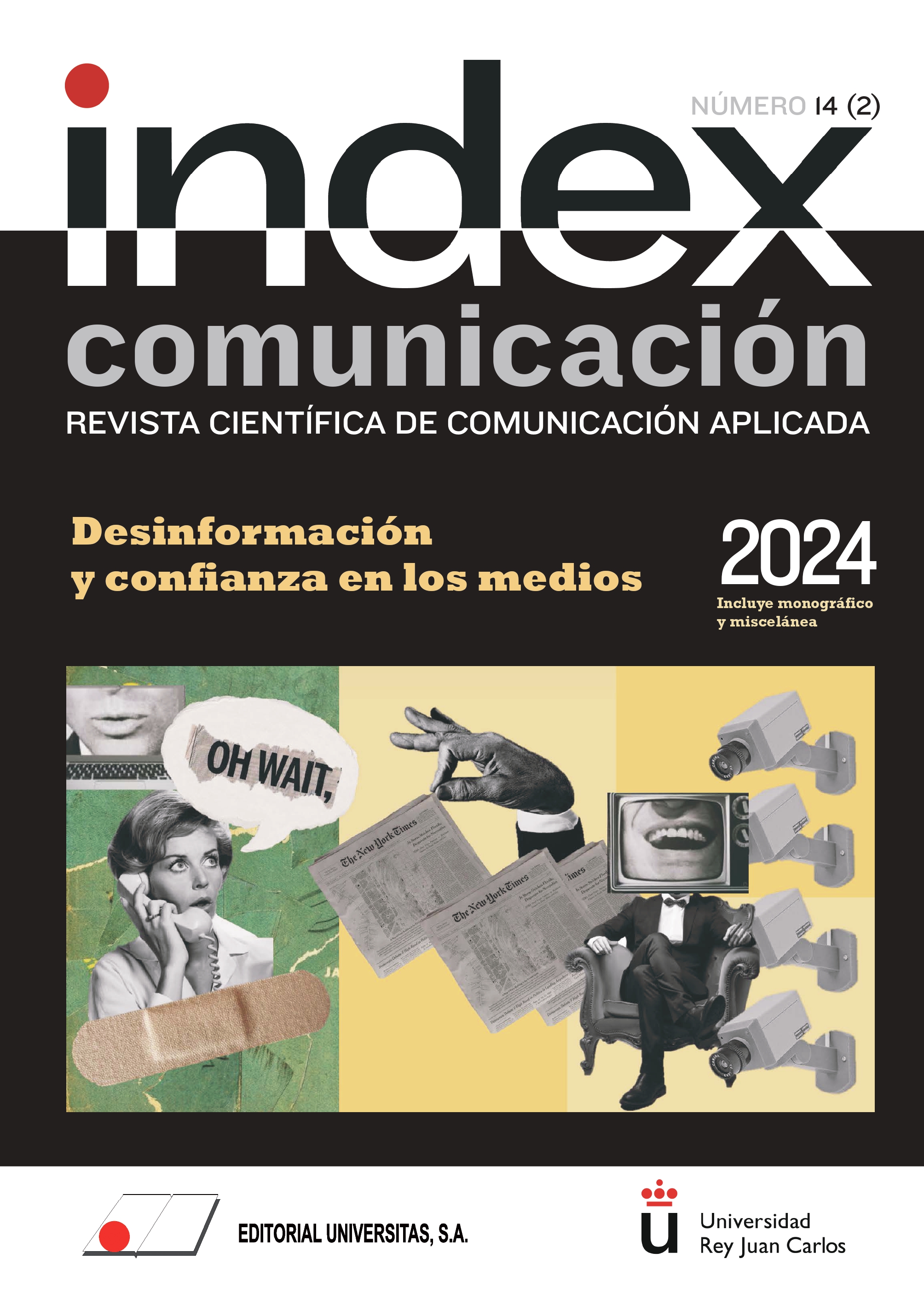
Desinformación y confianza en los medios: propuestas de actuación
DOI:
https://doi.org/10.62008/ixc/14/02YconfiPalabras clave:
desinformación, confianza en los medios, periodismo, solucionesResumen
La desinformación ha influido en la confianza de la ciudadanía en las instituciones democráticas, particularmente en los medios de comunicación. A través de ejemplos de países con diversos niveles de calidad democrática, se muestra cómo la desinformación es utilizada para polarizar y movilizar políticamente. El rol de los medios en este contexto es crucial, ya que la confianza en ellos depende de múltiples factores interrelacionados, como el impacto de la desinformación en el consumo de noticias y la confianza del público, los factores psicológicos y socioculturales que afectan la vulnerabilidad a la desinformación, y los avances tecnológicos, especialmente la inteligencia artificial generativa. A partir de este diagnóstico, se proponen mecanismos de autorregulación y una mayor transparencia como bases para mejorar la confianza. Además, se enfatiza la necesidad de investigación académica sobre el papel de las plataformas digitales y los algoritmos en la propagación de la desinformación y su impacto en la confianza y la calidad democrática.
Métricas
Citas
ARGUEDAS, A. R.; BADRINATHAN, S.; MONT’ALVERNE, C.; TOFF, B.; FLETCHER, R. & NIELSEN, R. K. (2022). Snap judgements: how audiences who lack trust in news navigate information on digital platforms. Reuters Institute for the Study of Journalism. https://tinyurl.com/5fhhdu97
BACHMANN, I. & VALENZUELA, S. (2021). El fenómeno de la desinformación y el desafío de corregirla: Una revisión bibliográfica. https://tinyurl.com/58jkzws9
BENKLER, Y.; TILTON, C.; ETLING, B.; ROBERTS, H.; CLARK, J.; FARIS, R. ... & SCHMITT, C. (2020). Mail-in voter fraud: Anatomy of a disinformation campaign. Berkman Center Research Publication. https://dash.harvard.edu/handle/1/37365484
BOGART, L. (1981). Press and Public: Who Reads What. When, Where, and Why in American Newspapers. Lawrence Erlbaum Associates Inc.
BROMLEY, R. V. & BOWLES, D. (1995). Impact of Internet on use of traditional news media. Newspaper Research Journal, 16(2), 14-27. doi.org/10.1177/073953299501600203
CAGÉ, J. (2016). Saving the media: Capitalism, crowdfunding, and democracy. Harvard University Press.
CHADWICK, A. (2013). The hybrid media system: Politics and power. Oxford University Press.
COLEMAN, S. (2012). Believing the news: From sinking trust to atrophied efficacy. European Journal of Communication, 27(1), 35-45. doi.org/10.1177/0267323112438806
COPPEDGE, M. J.; GERRING, C. H.; KNUTSEN, S. I.; LINDBERG, J.; TEORELL, N.; ALIZADA, D.; ALTMAN et al. (2021). V-Dem Dataset v11.1. Varieties of Democracy Project. doi.org/10.23696/vdemds21
CORRALES, J. (2005). In Search of a Theory of Polarization: Lessons from Venezuela, 1999-2005. European Review of Latin American and Caribbean Studies, 79, 105-118. doi.org/10.18352/erlacs.9666
DELOIRE, C. (2019). La Journalism trust initiative, une initiative d'auto-régulation innovante. Légipresse, 61, 67-70. doi.org/10.3917/legip.hs61.0067
EDELMAN (2024). Edelman Trust Barometer. Innovation in peril. www.edelman.com/trust/2024/trust-barometer
EUROPEAN COMMISSION (2018). Flash Eurobarometer 464. Fake news and disinformation online. https://tinyurl.com/5739j566
EUROPEAN COMMISSION (2023). Flash Eurobarometer FL012EP – Media & News Survey 2023. https://tinyurl.com/5739j566
FAÚNDEZ, C. A. (2024). Libertad de expresión en Chile: notas a propósito de la Comisión contra la Desinformación creada por el gobierno chileno en 2023. Derecom, 36, 87-108. https://tinyurl.com/3fw8d34u
FAWZI, N.; STEINDL, N.; OBERMAIER, M.; PROCHAZKA, F.; ARLT, D.; BLÖBAUM, B.; DOHLE, M.; ENGELKE, K. M.; HANITZSCH, T.; JACKOB, N.; JAKOBS, I.; KLAWIER, T.; POST, S.; REINEMANN, C.; SCHWEIGER, W. & ZIEGELE, M. (2021). Concepts, causes and consequences of trust in news media–a literature review and framework. Annals of the International Communication Association, 45(2), 154-174. doi.org/10.1080/23808985.2021.1960181
FENGLER, S.; EBERWEIN, T.; ALSIUS, S.; BAISNÉE, O.; BICHLER, K.; DOBEK-OSTROWSKA, B.; EVERS, H.; GLOWACKI, M.; GROENHART, H.; HARRO-LOIT, H.; HEIKKILÄ, H.; JEMPSON, M.; KARMASIN, M.; LAUK, E.; LÖNNENDONKER, J.; MAURI, M.; MAZZOLENI, G.; PIES, J.; PORLEZZA, C. … ZAMBRANO, S. V. (2015). How effective is media self-regulation? Results from a comparative survey of European journalists. European Journal of Communication, 30(3), 249-266. doi.org/10.1177/0267323114561009
FINK, K. (2019). The biggest challenge facing journalism: A lack of trust. Journalism, 20(1), 40-43. doi.org/10.1177/1464884918807069
FISHER, C. (2018). What is meant by “trust” in news media? K. OTTO y A. KÖHLER (eds.), Trust in media and journalism: Empirical perspectives on ethics, norms, impacts and populism in Europe (pp. 19-38). Springer.
FLEW, T. (2019). Digital communication, the crisis of trust, and the post-global. Communication Research and Practice, 5(1), 4-22. doi.org/10.1080/22041451.2019.1561394
FUNKE, D. & FLAMINI, D. (2022). A guide to anti-misinformation actions around the world. Poynter. https://tinyurl.com/2p8ftet5
GEARY, D. L. (2005). The decline of media credibility and its impact on public relations. Public Relations Quarterly, 50(3), 8-12.
GENTZKOW, M. & SHAPIRO, J. M. (2006). Media bias and reputation. Journal of Political Economy, 114(2), 280-316. doi.org/10.1086/499414
HAERPFER, C.; INGLEHART, R.; MORENO, A.; WELZEL, C.; KIZILOVA, K.; DIEZ-MEDRANO, J.; LAGOS, M.; NORRIS, P.; PONARIN E. & PURANEN, B. (eds.) (2020). World Values Survey: Round Seven - Country-Pooled Datafile. JD Systems Institute y WVSA Secretariat. doi.org/10.14281/18241.13
IPI (2020). European media freedom suffers under COVID-19 response. International Press Institute. https://tinyurl.com/4jk8hpvs
JACKOB, N. G. E. (2010). No alternatives? The relationship between perceived media dependency, use of alternative information sources, and general trust in mass media. International Journal of Communication, 4, 18. ijoc.org/index.php/ijoc/article/view/615
JACQUETTE, D. (2009). Journalism ethics as truth-telling in the public interest. A. Stuart (ed.), The Routledge Companion to News and Journalism (pp. 213-222). Routledge.
KENNEDY, I.; WACK, M.; BEERS, A.; SCHAFER, J. S.; GARCIA-CAMARGO, I.; SPIRO, E. S. & STARBIRD, K. (2022). Repeat spreaders and election delegitimization: a comprehensive dataset of misinformation tweets from the 2020 US election. Journal of Quantitative Description: Digital Media, 2. doi.org/10.51685/jqd.2022.013
KOVACH, B. & ROSENSTIEL, T. (2021). The elements of journalism, revised and updated 4th edition: What newspeople should know and the public should expect. Crown.
LABARCA, C.; VALENZUELA, S.; BACHMANN, I. & GRASSAU, D. (2022). Medios de comunicación y confianza política en América Latina: Análisis individual y contextual del rol de las noticias en la confianza en el gobierno y el Estado. Revista Internacional de Sociología 80(4), e216. doi.org/10.3989/ris.2022.80.4.M22-01
LATINOBARÓMETRO (2023). Informe Latinobarómetro 2023: La recesión democrática de América Latina.
LATINOBARÓMETRO (2021). Informe Latinobarómetro 2020: Adiós a Macondo.
MAGALLÓN-ROSA, R.; PAISANA, M. et al., (2024). Disinformation consumption patterns in Spain and Portugal. Pamplona: IBERIFIER. doi.org/10.15581/026.007
MAGALLÓN-ROSA, R. & CAMPOS, E. (2021). Redes sociales y polarización. Cuando el algoritmo amplifica las emociones humanas. Dossieres EsF, 42, 27-31. https://tinyurl.com/43mxfkhj
MAISEL, R. (1973). The decline of mass media. Public Opinion Quarterly, 37(2), 159-170.
MAZZOLI, E. (2023). Digital Trust Initiatives: Seeking to Reward Journalistic Ethics Online. Center for International Media Assistance (CIMA). https://tinyurl.com/5m7d56mt
MCCOMBS, M. & VALENZUELA, S. (2020). Setting the agenda: Mass media and public opinion. John Wiley & Sons.
MCMANUS, J. H. (1992). What kind of commodity is news. Communication research, 19(6), 787-805. doi.org/10.1177/009365092019006007
NEWMAN, N.; FLETCHER, R.; KIRSTEN, E.; ROBERTSON, C. T. & NIELSEN, R. K. (2023). Reuters Institute Digital News Report 2023. Reuters Institute for the Study of Journalism. https://tinyurl.com/yc8ex85f
NEWMAN, N.; FLETCHER, R.; ROBERTSON, C. T.; ARGUEDAS, A. R. & NIELSEN, R. K. (2024). Reuters Institute Digital News Report 2024. Reuters Institute for the Study of Journalism. https://tinyurl.com/yvwbnpyx
NIELSEN, R. K. & FLETCHER, R. (2020). Democratic creative destruction? The effect of a changing media landscape on democracy. N. PERSILY & J. A. TUCKER (eds.), Social media and democracy: The state of the field, prospects for reform (pp. 139-162). Cambridge University Press.
O’NEILL, D. & O’CONNOR, C. (2008). The passive journalist: How sources dominate local news. Journalism Practice, 2(3), 487-500. doi.org/10.1080/17512780802281248
PALAU-SAMPIO, D. (2023). Pseudo-media disinformation patterns: Polarised discourse, clickbait and twisted journalistic mimicry. Journalism Practice, 17(10), 2140-2158. doi.org/10.1080/17512786.2022.2126992
PALAU-SAMPIO, D. & CARRATALÁ, A. (2022). Injecting disinformation into public space: pseudo-media and reality-altering narratives. Profesional de la Información, 31(3). doi.org/10.3145/epi.2022.may.12
PANIAGUA ROJANO, F. P.; SEOANE PÉREZ, F. & MAGALLÓN-ROSA, R. (2020). Anatomía del bulo electoral. Revista Cidob d'afers internacionals, 124, 123-146. doi.org/10.24241/rcai.2020.124.1.123
PENNYCOOK, G. & RAND, D. G. (2021). The psychology of fake news. Trends in Cognitive Sciences, 25(5), 388-402. doi.org/10.1016/j.tics.2021.02.007
PHILLIPS, A. (2013). Transparency and the new ethics of journalism. En The future of journalism (pp. 289-298). Routledge.
PRESIDENCIA DEL GOBIERNO (2023). Foro contra las campañas de desinformación en el ámbito de la Seguridad Nacional. Trabajos 2023. Gobierno de España. Ministerio de la Presidencia, Relaciones con las Cortes y Memoria Democrática.
PRIOR, M. (2013). Media and political polarization. Annual Review of Political Science, 16, 101-127. doi.org/10.1146/annurev-polisci-100711-135242
REPORTEROS SIN FRONTERAS (29 enero 2024). La Ley Europea de Libertad de Prensa fomenta el uso de la JTI como referencia para identificar medios de comunicación fiables. https://tinyurl.com/ysyr9ur4
SÁDABA, C. & SALAVERRÍA, R. (2023). Combatir la desinformación con alfabetización mediática: análisis de las tendencias en la Unión Europea. Revista Latina de Comunicación Social, 81, 17-33.
doi.org/10.4185/RLCS-2023-1552
SALAVERRÍA, R. (2019). Digital journalism: 25 years of research. Review article, Profesional de la Información, 28(1), e280101. doi.org/10.3145/epi.2019.ene.01
SALAVERRÍA, R. & CARDOSO, G. (2023). Future of disinformation studies: emerging research fields. Profesional de la Información, 32(5), e320525. doi.org/10.3145/epi.2023.sep.25
SCHRANZ, M.; SCHNEIDER, J. & EISENEGGER, M. (2018). Media trust and media use. K. Otto & A. Köhler (eds.), Trust in media and journalism: Empirical perspectives on ethics, norms, impacts and populism in Europe (pp. 73-91). Springer. doi.org/10.1007/978-3-658-20765-6_5
SKOVSGAARD, M. & ANDERSEN, K. (2020). Conceptualizing news avoidance: Towards a shared understanding of different causes and potential solutions. Journalism Studies, 21(4), 459-476. doi.org/10.1080/1461670X.2019.1686410
STEMPEL III, G. H.; HARGROVE, T. & BERNT, J. P. (2000). Relation of growth of use of the Internet to changes in media use from 1995 to 1999. Journalism & Mass Communication Quarterly, 77(1), 71-79. doi.org/10.1177/107769900007700106
STRÖMBÄCK, J.; TSFATI, Y.; BOOMGAARDEN, H.; DAMSTRA, A.; LINDGREN, E.; VLIEGENTHART, R. & LINDHOLM, T. (2020). News media trust and its impact on media use: toward a framework for future research. Annals of the International Communication Association, 44(2), 139-156. doi.org/10.1080/23808985.2020.1755338
SUÁREZ-VILLEGAS, J. C. (2015). La Comisión de Deontología como referente de la autorregulación del periodismo: apuntes doctrinales sobre el periodismo digital. Communication & Society, 28(3), 135-152. doi.org/10.15581/003.28.35956
SWART, J. & BROERSMA, M. (2022). The trust gap: Young people’s tactics for assessing the reliability of political news. The International Journal of Press/Politics, 27(2), 396-416. doi.org/10.1177/19401612211006696
TOFF, B. & NIELSEN, R. K. (2018). “I just google it”: Folk theories of distributed discovery. Journal of Communication, 68(3), 636-657. doi.org/10.1093/joc/jqy009
TSFATI, Y. & CAPPELLA, J. N. (2003). Do people watch what they do not trust? Exploring the association between news media skepticism and exposure. Communication Research, 30(5), 504-529.
doi.org/10.1177/ 0093650203253371
VACCARI, C. & CHADWICK, A. (2020). Deepfakes and disinformation: Exploring the impact of synthetic political video on deception, uncertainty, and trust in news. Social Media+ Society, 6(1). doi.org/10.1177/2056305120903408
VACCARI, C.; CHADWICK, A. & KAISER, J. (2023). The campaign disinformation divide: believing and sharing news in the 2019 UK General election. Political Communication, 40(1), 4-23. doi.org/10.1080/10584609.2022.2128948
VAN AELST, P.; STRÖMBÄCK, J.; AALBERG, T.; ESSER, F.; DE VREESE, C. et al. (2017). Political communication in a high-choice media environment: a challenge for democracy? Annals of the International Communication Association, 41(1), 3-27. doi.org/10.1080/23808985.2017.1288551
WAHL-JORGENSEN, K. & HANITZSCH, T. (eds.). (2009). The handbook of journalism studies. Routledge.
WAISBORD, S. (2018) Truth is what happens to news. Journalism Studies, 19(13), 1866-1878. doi.org/10.1080/1461670X.2018.1492881
WAGNER, C. & BOCZKOWSKI, P. J. (2019). The reception of fake news: The interpretations and practices that shape the consumption of perceived misinformation. Digital Journalism, 7(7), 870-885. doi.org/10.1080/21670811.2019.1653208
WILLAERT, T.; PEETERS, S.; SEIJBEL, J. & VAN RAEMDONCK, N. (2022). Disinformation networks: A quali-quantitative investigation of antagonistic Dutch-speaking Telegram channels. First Monday, 27(9). doi.org/10.5210/fm.v27i5.12533
WILNER, T.; WALLACE, R.; LACASA-MAS, I. & GOLDSTEIN, E. (2022). The tragedy of errors: Political ideology, perceived journalistic quality, and media trust. Journalism Practice, 16(8), 1673-1694. doi.org/10.1080/17512786.2021.1873167
ZELIZER, B.; BOCZKOWSKI, P. J. & ANDERSON, C. W. (2022). The Journalism Manifesto. Polity Press.
Publicado
Cómo citar
Número
Sección
Licencia
Derechos de autor 2024 Ramón Salaverría, Ingrid Bachmann, Raúl Magallón Rosa (Autor/a)

Esta obra está bajo una licencia internacional Creative Commons Atribución-NoComercial 4.0.
Los autores que publican en esta revista están de acuerdo con los siguientes términos:
Los autores conservan los derechos de autor y garantizan a la revista el derecho de ser la primera publicación del trabajo al igual que licenciado bajo una Licencia Creative Commons Atribución-NoComercial 4.0 Internacional que permite a otros compartir el trabajo con un reconocimiento de la autoría del trabajo y la publicación inicial en esta revista, sin finalidad comercial.
Los autores pueden establecer por separado acuerdos adicionales para la distribución no exclusiva de la versión de la obra publicada en la revista (por ejemplo, situarlo en un repositorio institucional o publicarlo en un libro), con un reconocimiento de su publicación inicial en esta revista.
Se permite y se anima a los autores a difundir sus trabajos electrónicamente (por ejemplo, en repositorios institucionales o en su propio sitio web) antes y durante el proceso de envío, ya que puede dar lugar a intercambios productivos, así como a una citación más temprana y mayor de los trabajos publicados (Véase The Effect of Open Access) (en inglés).