El español como lengua puente de culturas en el eje África, América, Europa
Keywords:
Enseñanza del español, África, estudios literarios, afrodescendientesAbstract
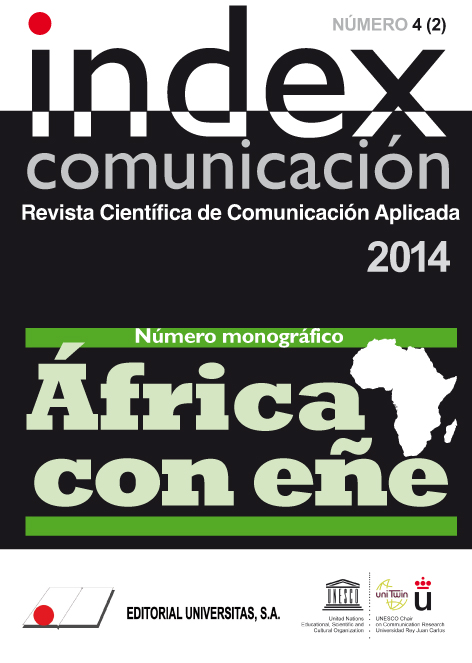
Este número monográfico de la revista index.comunicación es el fruto de la colaboración de la Cátedra Unesco de Investigación en Comunicación y África (http://www.unescoafricom.es/) y la Fundación Mujeres por África (http://www.mujeresporafrica.es/) a partir de la firma de un artículo 83 suscrito en noviembre de 2013.
Dentro de este convenio una de las acciones fue la organización del Congreso “África con eñe” que se celebró el 29 y 30 de abril de 2014 en la Universidad Félix Houphouët-Boigny de Abdijan, Costa de Marfil y cuya información detallada puede verse en http://www.mujeresporafrica.es/hispanistas2014/hola.html y http://www.unescoafricom.es/concluye-el-congreso-internacional-africa-con-n/[1].
[1] Tienen ya una cierta tradición los Congresos Ibero-Africano de Hispanistas, convocados por la Universidad de Navarra y que tuvieron lugar en Dakar, Senegal (2009), en El Cairo, Egipto (2012) y en Fez, Marruecos (2014). La particularidad de estos congresos es que se centran fundamentalmente en la literatura y en especial en la del siglo de oro.
Metrics
References
Mosley, Ch (ed) (2010): Atlas of the world’s Languages in Danger, 3rd edn, París, UNESCO Publishing
Downloads
Published
How to Cite
Issue
Section
License
Authors who submit to this journal agree to the following terms:
Authors retain copyright and ensure the magazine's right to be the first publication of the work as licensed under a Creative Commons Attribution-NoComercial 4.0 International License that allows others to share the work with an acknowledgment of authorship of the work and the initial publication in this magazine, with no commercial purpose.
Authors can establish separate additional agreements for non-exclusive distribution of the version of the work published in the magazine (for example, to an institutional repository or publish it in a book), with an acknowledgment of its initial publication in this journal.
It allows and authors are encouraged to disseminate their work electronically (eg, in institutional repositories or on their own website) prior to and during the submission process, as it can lead to productive exchanges, as well as a citation more early and most of the published work (See The Effect of Open Access).